
Semtech Elevates Data Center Growth and IoT Connectivity via Strategic Integration
Semtech’s Q1 fiscal 2027 results reveal rising integration costs and restructuring as it leverages data center demand and LoRa-based IoT solutions to drive expansion.
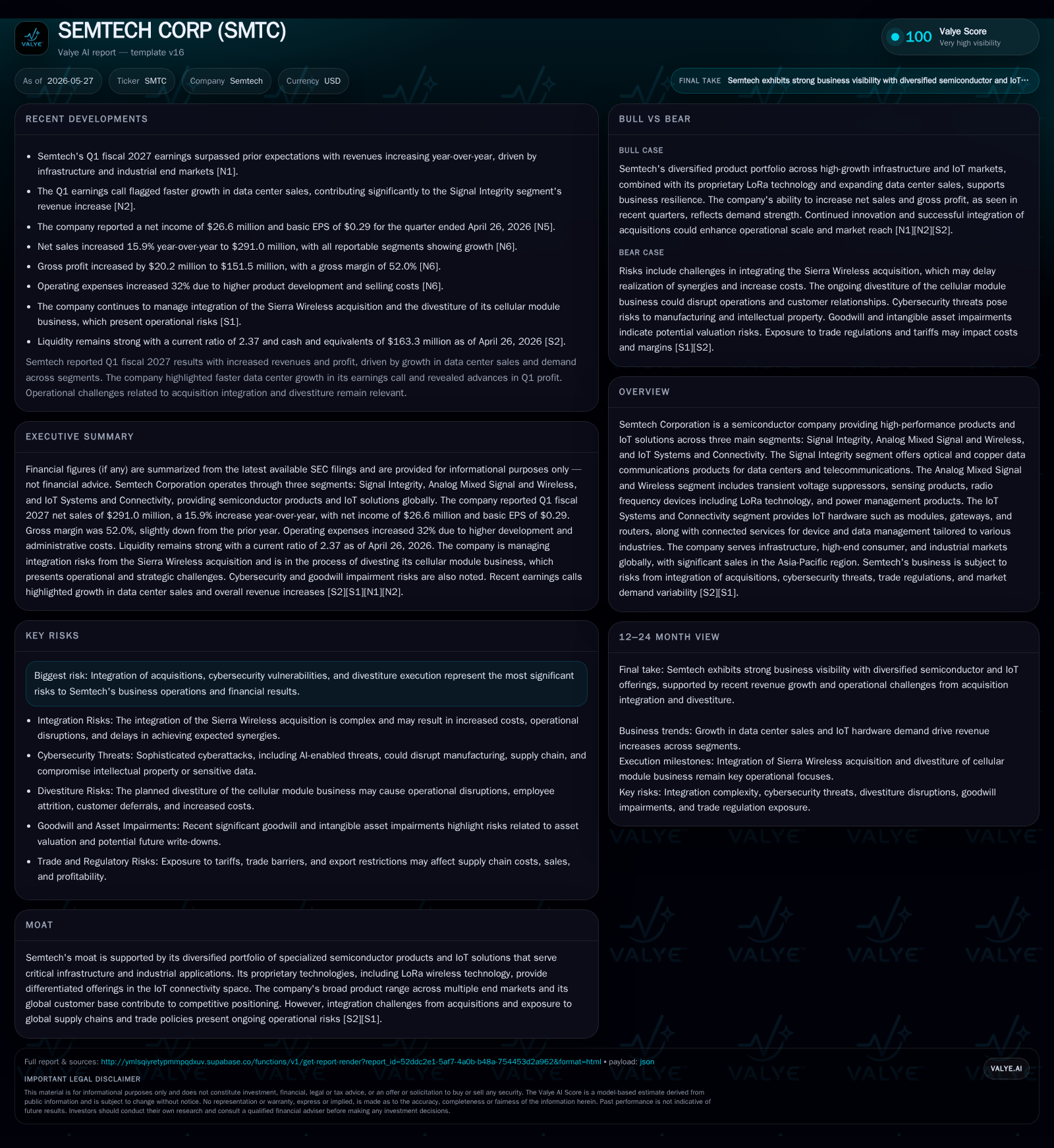
In Q1 fiscal 2027, Semtech faced increased transaction and integration expenses related to the Sierra Wireless acquisition alongside restructuring charges aimed at workforce realignment. Despite these near-term cost pressures, growth was supported by stronger demand in the Signal Integrity segment for data center optical communications and expanding adoption of LoRa technology within its Analog Mixed Signal & Wireless and IoT Systems & Connectivity segments. The company’s diversified semiconductor portfolio enables penetration across infrastructure and industrial end markets globally. Ongoing integration complexities and supply chain risks temper operational leverage. Semtech maintains solid liquidity with approximately $163 million cash against $503 million total debt, supporting its capacity to invest in innovation and scale IoT connectivity strategically [S2][F1].
Latest Quarterly Operating Update: Cost Structure and Integration Impact
Semtech's Q1 fiscal 2027 earnings report highlights elevated operational expenses tied mainly to integrating recent acquisitions—most notably Sierra Wireless—and ongoing workforce realignment [S2]. Transaction and integration expenses increased by $1.7 million compared to the prior year period, partially offset by a $0.9 million decrease in depreciation costs. Restructuring expenses related to cost-saving measures amounted to $1.2 million, reflecting structural workforce reductions. Additionally, intangible amortization from acquired technology assets rose to $0.3 million from $0.1 million year-over-year, reflecting continued investment in proprietary intellectual property within cost of sales
These non-recurring charges indicate that while Semtech is actively pursuing operational unification post-acquisition, synergy realization remains in early stages. This moderates operating leverage despite strengthening revenue drivers.
Business Model Overview: Core Segments and Product Portfolio
Semtech operates through three reportable segments:
Signal Integrity: Provides advanced optical and copper data communication products for data centers, telecom networks, enterprise systems, and video transport applications. Offerings include integrated circuits and photonic components such as gain chips, semiconductor optical amplifiers, and distributed feedback lasers supporting data rates from 100 Mbps to 1.6 Tbps compliant with Ethernet, Fibre Channel, PON, InfiniBand standards [S1]. This segment targets latency-sensitive infrastructure requiring high bandwidth interconnects.
Analog Mixed Signal & Wireless: Offers transient voltage suppressors (TVS) protecting electronics from voltage transients; sensing technologies including proximity and force sensing; specialized RF products featuring industry-leading LoRa wireless technology enabling low-power wide-area IoT connectivity; plus power management ICs such as switching voltage regulators [S1]. These products safeguard sensitive electronics while enabling robust wireless links for machine-to-machine communication.
IoT Systems & Connectivity: Delivers hardware platforms including modules, gateways, routers alongside managed services for device provisioning, connectivity management, data collection, and analytics tailored to industrial verticals [S1]. This segment complements semiconductor offerings by providing turnkey IoT solutions designed for scalable deployment.
Revenue stems primarily from OEM customers embedding Semtech semiconductors into networking equipment or industrial/consumer devices. Pricing dynamics depend on product complexity, proprietary technology differentiation (e.g., LoRa IP), volume scales—particularly in data centers—and contract-based service extensions.
Industry Context: Competitive Dynamics and Technology Differentiation
Within the semiconductor sector focused on data communications and IoT enablement, Semtech occupies a specialized niche combining photonic expertise for high-performance optical modules with unique analog protection devices and a dominant position in the LoRa wireless ecosystem.
The market features competition from larger semiconductor conglomerates offering broad portfolios but often less specialization in ultra-long-range low-power RF or custom photonic ICs critical for hyperscale data centers [S1]. Switching costs are elevated due to embedded design wins in complex hardware systems requiring long validation cycles with OEMs.
However, the company is exposed to global semiconductor supply chain vulnerabilities stemming from geopolitical tensions, manufacturing constraints especially for specialty components, and cybersecurity threats targeting manufacturing processes [S1].
Growth Drivers: Expanding Data Center Demand and LoRa Ecosystem Penetration
Key growth areas include:
Data Center Optical Communications: Accelerating AI workloads and cloud services drive bandwidth needs upward. Semtech captures share via high-speed photonic modules with sales outperforming expectations per recent earnings commentary [N1]
Analog Mixed Signal & Wireless Expansion: Increased shipment of TVS products safeguards complex electronics amid higher frequency operations; concurrently LoRa-enabled device sales grow due to expanding industrial IoT applications requiring cost-effective wide-area coverage at low power consumption [S2][N2]
IoT Hardware Solution Adoption: Modular hardware addressing vertical-specific connectivity needs enhances customer value while unlocking incremental managed service revenues through device management platforms fostering sticky end-user relationships [S1].
Together these trends position Semtech well within structurally growing markets driven by digital transformation imperatives.
Risks and Constraints: Integration Complexity and Supply Chain Vulnerabilities
Despite positive drivers several risks must be monitored:
Integration Challenges: The Sierra Wireless acquisition introduces operational system consolidation complexity, cultural assimilation risks, synergy realization uncertainty, potential talent loss—all contributing to elevated transaction/integration expenses recently reported [S1][S2]. Delays could further pressure margins.
Cybersecurity Threats: Extensive supplier networks including third-party software/hardware providers create exposure to ransomware or nation-state attacks potentially disrupting production or compromising intellectual property [S1]
Macroeconomic Headwinds: Adverse conditions in key regions such as Asia-Pacific could reduce capital expenditures among infrastructure clients impacting order visibility.
Financial Covenants Compliance: While currently compliant with credit facility covenants supported by ample liquidity ([S2]; revolving credit availability ~$452 million), ongoing adherence requires close expense management amid cost fluctuations.
Forward Looking: Key Milestones and Execution Watchpoints
Investor focus should track:
- Progress on Sierra Wireless integration milestones including system harmonization timelines highlighted during earnings calls [N3].
- Operating expense normalization post-restructuring phase enabling improved operating leverage [S2].
- Sales cadence shifts aligned with seasonal data center refresh cycles.
- Rollout of next-generation IoT modules targeting untapped enterprise verticals leveraging LoRa network advantages.
- Management commentary on mitigating supply chain constraints or cybersecurity risks affecting operational continuity [N3].
Financial Profile: Liquidity, Debt Structure, and Expense Trends
As of April 26, 2026, Semtech reported cash balances near $163 million against total debt approximating $503 million resulting in net debt around $340 million—reflecting moderate leverage levels supportive of operational flexibility [F1][S2]. The company's current ratio stood at approximately 2.37 indicating solid short-term liquidity supported by $451.6 million available undrawn revolving credit capacity subject to customary conditions [F1][S2].
Debt includes convertible senior notes due 2027 bearing interest at 1.625% payable semi-annually along with zero-coupon convertible notes maturing in 2030 jointly guaranteed by wholly-owned domestic subsidiaries providing long-term capital stability without onerous interest burdens [S2]
This analysis integrates disclosures from Semtech's Q1 fiscal 2027 Form 10-Q filing dated May 27, 2026 ([S2]), recent event filing ([S3]), annual report ([S1]), supplementary news sources ([N1]-[N3]), and verified financial snapshot data ([F1]). It aims solely to provide an informed evaluation of Semtech's evolving business dynamics without providing investment advice.
Disclaimer: This is research-only, informational analysis and not investment advice. It may include AI-generated interpretation and general industry context. Always verify important details using primary sources.

Comments