
Snowflake's AI Data Cloud Boosts Growth with Consumption Model but Faces Profitability and Competitive Challenges
Snowflake’s latest quarterly update highlights revenue acceleration driven by AI platform adoption amid ongoing operating losses and competitive pressures.
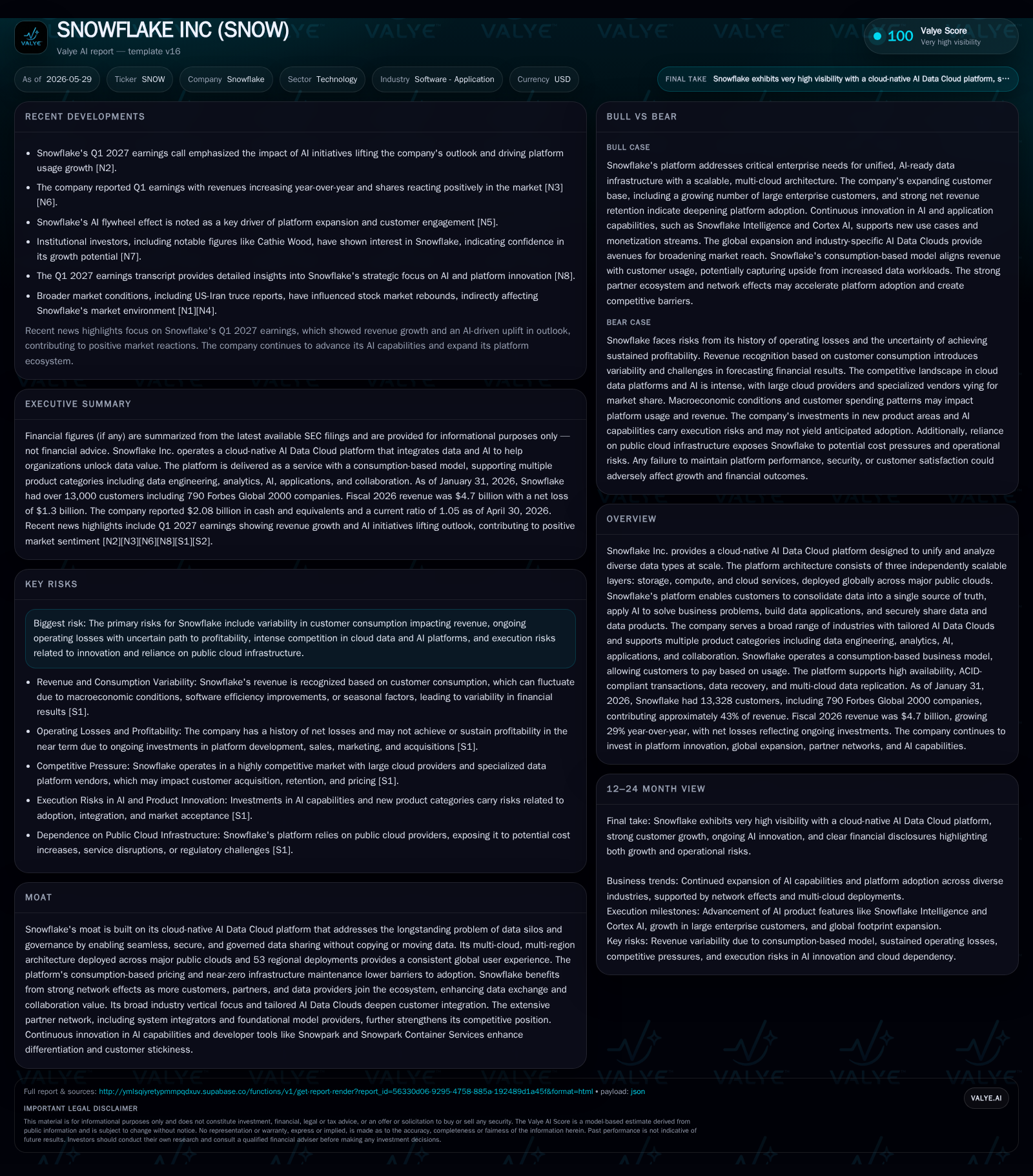
Snowflake Inc. reported strong revenue growth for Q1 FY2027, reaching $1.4 billion, up from $1.0 billion a year earlier, fueled by expanding AI Data Cloud adoption and consumption-based pricing [S2][S3]. The company’s cloud-native platform enables enterprises to unify and analyze diverse data at scale across multiple public clouds with minimal infrastructure management [S1]. Snowflake benefits from network effects in data sharing, a broad industry vertical focus, and a robust partner ecosystem powering growth. However, its path to sustained profitability remains uncertain given current operating losses and variable customer consumption patterns [S2][F1]. Competitive intensity in cloud data platforms and regulatory risks in highly regulated sectors are notable headwinds. Upcoming milestones include customer expansion in regulated industries, innovation in AI capabilities, and execution on multi-cloud scalability.
Recent Operating Update
In its latest quarterly filing (10-Q dated May 29, 2026), Snowflake reported fiscal first quarter 2027 revenue of $1.4 billion, marking a robust year-over-year increase from $1.0 billion in Q1 FY2026 [S2][S3]. This accelerated growth is primarily attributed to strong demand for Snowflake’s AI Data Cloud platform capabilities that unify diverse enterprise data across multi-cloud environments while enabling advanced AI workloads. Despite this momentum, the company continues to face significant operating losses with an operating income deficit exceeding $1.4 billion as of January 31, 2026 [F1], reflecting high investment levels in R&D and sales to capture market share.
Guidance reaffirmed in the recent filings indicates management's confidence in sustained consumption growth driven by expanding customer engagement with AI products embedded deeply within the core Data Cloud platform [S21]. Additionally, leadership transition bringing in Jonathan Beaulier as Chief Revenue Officer is expected to bolster sales effectiveness across industries and geographies during this critical growth phase.
Business Model
Snowflake’s business revolves around its cloud-native AI Data Cloud platform which integrates storage, compute, and cloud services into a logically unified yet independently scalable stack deployed over major public clouds such as AWS, Azure, and Google Cloud [S1][S25]. Customers pay based on actual usage—termed a consumption-based pricing model—which contrasts with traditional subscription models. This means revenue derives from resource consumption metrics like query volume, compute time, storage used, and data transfers.
This approach lowers friction for initial adoption but drives variability in revenues since customers can optimize or reduce consumption based on budget or operational priorities as highlighted in the risk disclosures [S2]. The platform's design enables near-zero infrastructure maintenance for clients by abstracting away hardware management burdens common in legacy or self-managed data warehousing solutions.
Product offerings span key categories:
- Data Engineering: Efficient pipelines ingesting batch/streaming data with SQL/Python interfaces.
- Analytics: Concurrent analytics workloads without resource contention.
- AI: Advanced model training/deployment powered by integrated GPU resources for ML workflows.
- Applications & Collaboration: Native application development frameworks plus managed marketplaces for data products aiding customer monetization strategies [S18][S24][S25].
Industry Structure and Competitive Position
Snowflake competes in the cloud data platform industry dominated by hyperscale cloud providers (AWS Redshift Spectrum, Google BigQuery) alongside other specialized players like Databricks focusing on unified analytics platforms incorporating machine learning. Its moat derives from having built an AI-optimized multi-cloud architecture that facilitates seamless governed data sharing across partner ecosystems without expensive data duplication—a long-standing enterprise problem [Valye excerpt overview; S1].
Its global footprint spans 53 regional deployments providing low latency access for multinational clients while supporting compliance requirements through region-specific controls. The Snowflake Partner Network comprising system integrators (GSIs), SaaS platforms integrations, and foundational model providers buttresses distribution reach and collaborative innovation acceleration crucial for staying ahead against tech giants.
Network effects play a pivotal role: As more customers onboard their datasets into Snowflake’s marketplace and native ecosystems (including AI agents developed via Snowflake Cortex AI), the aggregated value of accessible live datasets increases non-linearly enhancing customer retention via ecosystem lock-in dynamics [S11]
Growth Drivers
Growth is structurally underpinned by several vectors:
- AI Platform Adoption: Snowflake’s pivot towards tightly integrating generative AI capabilities alongside traditional analytics fuels increased usage intensity especially given the rising enterprise appetite for applying large language models on proprietary datasets [N1][N6].
- Industry-Specific Cloud Offerings: Tailored AI Data Clouds for regulated sectors such as finance, healthcare, public sector help unlock new demand pockets where compliance-heavy requirements limit competitors’ agility yet require premium product features [S8][S15].
- Partner Ecosystem Expansion: Increasing alliance depth with GSIs expedites digital transformation programs driving large-scale migrations onto Snowflake’s platform; also partnerships with foundational model providers embed cutting-edge models natively improving value proposition [S11].
- Marketplace Monetization: The Snowflake Marketplace catalyzes novel monetization streams from third-party datasets combined with customer-owned live data allowing creation of proprietary analytic insights or embedded intelligence within applications [S13][N6].
- Multi-cloud & Global Region Scaling: The architecture’s elasticity supports incremental customer additions or expansions without linear increases in costs giving operational leverage potential over time as utilization rises [S25].
Risks & Growth Constraints
Despite promising growth trends several risks constrain near-term performance:
- Revenue Variability: Consumption-based pricing introduces forecasting challenges; macroeconomic uncertainties encourage clients to optimize usage suppressing near-term top-line growth velocity leading to slower revenue ramp forecasts cautioned in recent filings [S2].
- Profitability Path Uncertainty: Operating losses remain significant due to sustained investments into R&D innovation cycles (notably around AI) plus scaled sales & marketing necessary for market penetration; margin expansion timelines remain undefined though visibility is improving per commentary [F1][N14].
- Intense Competition: Hyperscalers continue evolving their native integrated solutions bundled within broader cloud ecosystems potentially eroding differentiation; specialist rivals advancing alternative unified analytics approaches add pressure on displacement cost-benefit analyses by buyers.
- Regulatory Burdens: Engagements with governments and heavily regulated industries impose complex compliance workloads raising cost bases; failures or delays can temper deal velocity or increase churn risk especially under evolving global privacy/data sovereignty laws [S15].
- Legal & IP Challenges: Pending lawsuits around intellectual property claims including class actions over data security incidents create contingent liabilities that may cause distraction or reputational impact if outcomes are adverse beyond expected provisions [S16].
What to Watch Next
Key observable indicators for monitoring execution include:
- Quarterly bookings versus billings trends particularly within regulated verticals reflecting traction beyond core technology-driven growth pockets.
- Adoption metrics around new AI services usage such as Cortex AI query volumes or native app frameworks signaling success of product-led expansions.
- Expansion rates among existing high-profile accounts (e.g., Forbes Global 2000 customers) revealing upsell/cross-sell effectiveness amid competitive bid scenarios.
- Financial guidance updates focusing on incremental margin improvements or adjusted CAPEX profiles indicating scalability path clarity.
- Further partnership announcements with major SaaS platforms or foundational model providers enhancing ecosystem defensibility.
Financial Profile Snapshot
As of April 30, 2026, Snowflake held cash & equivalents totaling approximately $2.08 billion with current assets just covering current liabilities at a ratio of about 1.05x indicating balanced near-term liquidity coverage despite cash burn from operations continuing historically negative operating income near -$1.4 billion as reported at January fiscal year-end [F1][S2]. This financial posture underscores the strategic imperative to convert rapid top-line momentum into sustainable positive cash flow while managing investment cadence prudently.
This analysis synthesizes publicly filed disclosures along with sector-contextual insights without offering investment advice or price targets. It aims to present a grounded perspective on Snowflake’s business dynamics amid its evolving position at the nexus of cloud-native AI-enabled enterprise data management.
Disclaimer: This is research-only, informational analysis and not investment advice. It may include AI-generated interpretation and general industry context. Always verify important details using primary sources.

Comments