
Sensei Biotherapeutics Recasts Oncology Focus with PIKTOR and Strategic Acquisition
Integration of Faeth Therapeutics and advancement of PIKTOR shape Sensei's clinical and strategic trajectory.
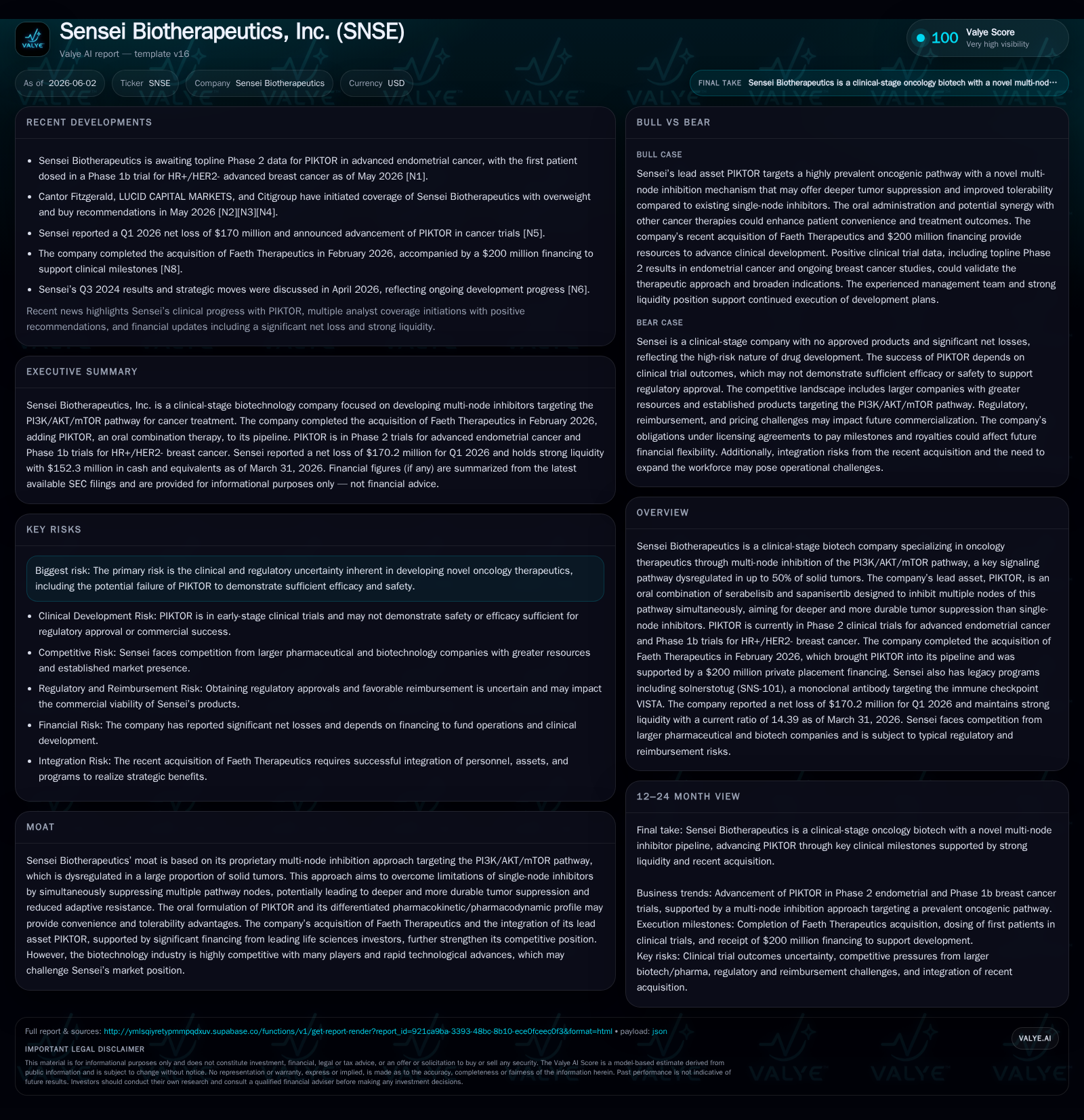
Sensei Biotherapeutics’ latest quarterly filing emphasizes progress post-acquisition of Faeth Therapeutics, incorporating the lead oral multi-node PI3K/AKT/mTOR inhibitor PIKTOR into its pipeline. The company reports a strong cash position following a $200 million private placement supporting ongoing Phase 2 and 1b trials in solid tumors including endometrial and breast cancers. Key near-term catalysts center on clinical data readouts and regulatory readiness as Sensei reconstitutes its board and fine-tunes its executive team. Though promising, risks remain primarily clinical and regulatory given the innovative multi-node inhibitor approach competing in a dynamic oncology biotech landscape.
Latest Quarterly Operating Update: Integration and Pipeline Progress
Sensei Biotherapeutics’ May 15, 2026 Form 10-Q provides a clear snapshot of its operating status following the transformative acquisition of Faeth Therapeutics in February 2026 [S2], [S1]. The deal, supported by a substantial $200 million private placement financing from a syndicate of leading life sciences investors, added PIKTOR—an all-oral dual inhibitor targeting multiple nodes on the PI3K/AKT/mTOR cascade—to Sensei’s clinical-stage pipeline. Financially, the company entered Q1-end with approximately $152 million in cash and equivalents against modest current liabilities around $14 million, yielding a robust current ratio above 14x [F1].
Complementing this liquidity strength is an active reshaping of leadership roles and governance consistent with the company’s refocused oncology direction. Event filings dated May 22 detail expected board reconstitution tied to the June 2026 Annual Meeting including delayed appointment of Dr. Karen Vousden until later this year for personal reasons, appointment of Bob Holmen as chair of the Nominating and Corporate Governance Committee, and a reduction in board size to five directors [S3]. This governance refresh aligns with a strategic reset that includes anticipated CEO transition to Anand Parikh.
Multi-Node Inhibition Approach: Business Model and Therapeutic Differentiation
At the core of Sensei’s business model is PIKTOR—a proprietary combination of serabelisib (PI3K inhibitor) and sapanisertib (mTOR inhibitor)—designed for simultaneous blockade at multiple actionable points within the PI3K/AKT/mTOR signaling pathway frequently dysregulated in roughly half of solid tumors [S1]. This strategic approach aims to overcome limitations observed with single-node inhibitors, notably adaptive resistance mechanisms that diminish durability of response.
The product is in late clinical development with Phase 2 trials targeting advanced endometrial cancer—a tumor type for which treatment options remain limited—and ongoing Phase 1b studies exploring efficacy in hormone receptor-positive/HER2-negative breast cancer [S1]. Oral administration provides convenience benefits over intravenous regimens common among competitors, potentially improving patient adherence and tolerability profiles vital for combination therapies.
Legacy assets remain part of the portfolio, notably solnerstotug (SNS-101), a monoclonal antibody checkpoint inhibitor targeting VISTA undergoing Phase 1/2 evaluation [S22]. However, PIKTOR clearly represents Sensei’s strategic pivot towards metabolic pathway-driven oncology therapeutics following Faeth integration.
Competitive Landscape: PI3K/AKT/mTOR Targeting in Oncology Biotech
The oncology biotech sphere targeting the PI3K/AKT/mTOR axis is marked by established players offering single-node inhibitors alongside emerging novel combinations. Sensei's dual inhibition attempts differentiate it via simultaneous suppression, potentially delivering superior depth and duration of tumor control compared to monotherapies [S1]. This mechanism-focused differentiation has garnered positive market coverage from Cantor Fitzgerald, Citigroup, and Lucid Capital initiating optimistic analyst coverage recently [N2], [N3], [N4].
Nevertheless, such novel combination agents face heightened regulatory scrutiny due to complex pharmacodynamics AND tolerability considerations. Multitargeting can increase adverse events risk if off-pathway toxicities arise. Thus balancing efficacy-safety remains critical. Within indications like advanced endometrial cancer—a less crowded niche than other breast or lung tumor spaces—PIKTOR may gain clinical foothold if data validates benefit-risk favorably.
Key Sector Metrics: Clinical Trial Phases, Manufacturing, Regulatory Readiness
Sensei’s current trial portfolio status reflects typical developmental progression KPIs for clinical-stage biotechs. Enrollment into Phase 2 advanced endometrial cancer studies continues while Phase 1b HR+/HER2- breast cancer evaluations probe dose escalation / tolerability markers [S1]. From a CMC perspective, management believes the existing inventory of serabelisib and sapanisertib suffices for active trials but continues process validation geared towards production batches suitable for pivotal or registrational study use plus potential NDA submissions [S1]. This anticipation of manufacturing scalability underscores operational maturity critical ahead of commercial launch preparations.
Regulatory engagement appears poised to intensify post-Phase 2 readouts given standard oncology approval pathways while tolerability data will play an outsized role due to oral agent safety expectations.
Growth Drivers: Clinical Data Progress, Indication Expansion, Commercial Preparation
Near-term growth catalysts revolve around successful clinical milestone achievements. Market commentary from Nasdaq notes that investors keenly await pivotal Phase 2 data evaluating PIKTOR’s efficacy/safety profile [N1]. Positive results could propel expansion into additional solid tumor indications or combination regimens enhancing therapeutic versatility.
Complementing data development are execution elements like validation of chemistry manufacturing controls enabling scale-up manufacturing activities supportive of broader registrational trials or eventual marketing authorization submissions [S1]. Additionally, integration of former Faeth personnel expands operational bandwidth crucial for evolving trial demands.
Strategically realigned leadership efforts—including planned CEO transition—aim to streamline commercialization pathways preparing for eventual market entry distinct from legacy programs.
Risks and Watchpoints: Trial Outcomes, Regulatory Hurdles, Competitive Encroachment
As typical for early-stage biotech innovators pursuing novel oncology modalities, primary risks cluster around achieving statistically significant efficacy breakthroughs coupled with manageable safety/tolerability signals necessary for regulatory acceptance [S9], [N5]. The multi-modal mechanism heightens complexity both in biological effect interpretation and adverse event profile prediction.
Regulatory uncertainties compound these risks given evolving agency expectations towards combination oral agents targeting metabolic pathways at multiple nodes simultaneously. Competitive risk derives from contemporaneous efforts by established biopharma combatting similar oncogenic signaling axes potentially limiting Sensei’s eventual market share if superior alternatives emerge rapidly [S22].
Financially, reported Q1 net losses illustrate ongoing cash burn reflective of R&D intensiveness common across clinical-stage biotechs but mitigated here by substantial cash reserves post-transaction fueling runway extension through key trial phases [S2], [F1].
Upcoming Catalysts to Monitor: Phase 2 Data Readouts, Board Reconstitution, Financing Activity
Watchpoints include imminent Phase 2 data disclosures potentially between Q2-Q3 2026 aligned with standard oncology trial reporting timelines. These results will strongly influence investor perception regarding clinical validity and pathway forward including potential partner interest or licensing discussions.
Governance changes foreshadowed by proxy filings signal a reconstituted board focused on advancing Sensei’s repositioned oncology strategy including installation of key executives such as Anand Parikh stepping into CEO duties post-June annual meeting event [S3], [S10]. Additionally, progress on conversion effects related to Series B Preferred Stock issuance may affect ownership structure dynamics impacting corporate funding flexibility going forward.
Brief Financial Overview: Capital Raised and Liquidity Position
As of March 31, 2026 quarter-end—covered by the latest SEC quarterly report—the company held approximately $152 million in liquid assets versus current liabilities below $15 million resulting in exceptional short-term liquidity ratios exceeding 14x [F1], [S2].
Operating losses persist consistent with early-stage biotech investing heavily in drug development infrastructure; however this is balanced by well-capitalized position following recent equity raises underpinning ongoing trial investments especially related to PIKTOR advancement post-Faeth acquisition events.
This analysis is based exclusively on publicly filed company documents and verified news sources as referenced. It does not constitute investment advice or research views.
Disclaimer: This is research-only, informational analysis and not investment advice. It may include AI-generated interpretation and general industry context. Always verify important details using primary sources.

Comments