
Spruce Power's Transition From Operating Losses to Positive Operating Income Amid Debt and Liquidity Pressures
Spruce Power Holding Corp operates a diversified portfolio of approximately 84,000 residential solar assets under long-term contracts, generating recurring subscription-based revenues but facing significant refinancing risks and ongoing negative cash flow.
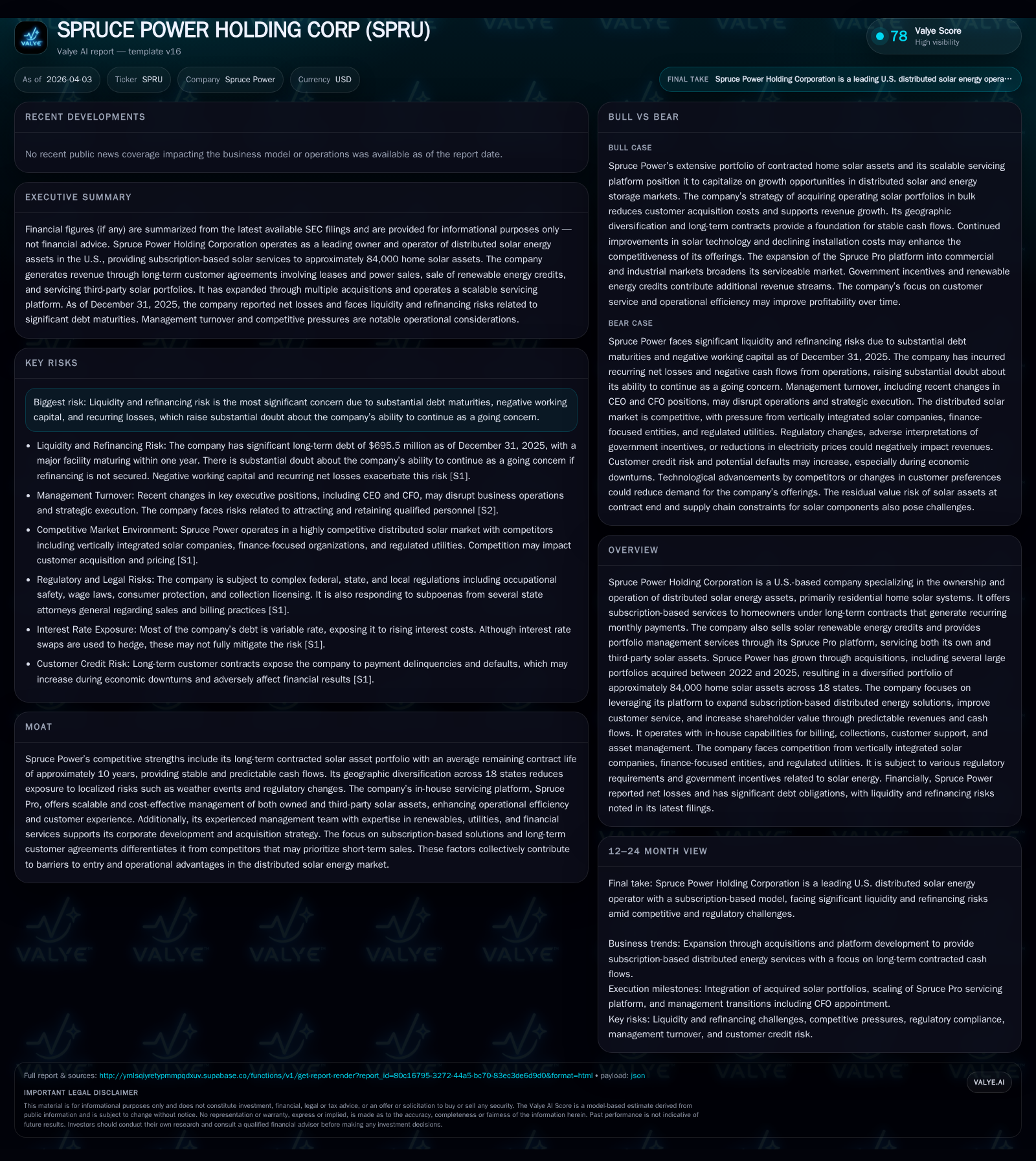
Spruce Power Holding Corporation has rapidly expanded its distributed solar energy asset portfolio through acquisitions since 2022, establishing a geographically diverse base of roughly 84,000 home solar systems. The company achieved positive operating income in 2025 after several years of large operating losses, yet it continues to report net losses and negative operating cash flow amid substantial near-term debt maturities. Its subscription-based business model via the Spruce Pro platform provides predictable revenues, but liquidity constraints and refinancing uncertainties present material challenges. Future growth depends on leveraging scale, managing credit and regulatory risks, and stabilizing financial health.
Company Background and Historical Performance
Spruce Power Holding Corporation (SPRU) is a leading owner and operator of distributed residential solar energy assets across the United States. The company’s core business model centers on subscription-based services delivered through long-term customer agreements generating recurring monthly payments from approximately 84,000 home solar installations spread across eighteen states [S1][S22]. This portfolio was largely built through bulk acquisitions of existing contracted systems following the company's strategic pivot from fleet electrification solutions (formerly XL Fleet) starting in early 2022 [S1][S16].
The company generates revenue primarily from leasing solar equipment or selling electricity under power purchase agreements (PPAs), supplemented by sales of solar renewable energy credits (SRECs) and third-party servicing via its Spruce Pro platform launched in Q1 2024. Spruce Pro supports operational management services including billing, collections, account support, asset operations, and SREC transaction services for over 60,000 third-party systems alongside the owned portfolio [S1][S22].
Financially, Spruce Power’s revenue increased markedly from approximately $15.6 million in FY2021 to $23.2 million in FY2022—an increase of about 48.7%—primarily driven by acquisitions [F1]. The company experienced significant operating losses through FY2024 ($50.4 million loss), reflecting integration costs and scaling expenses [F1]. However, FY2025 saw a turnaround to positive operating income of $17.9 million while net losses persisted at $26 million due to financing costs and other non-operating expenses [F1].
Historical performance (annual)
| FY | Net ($mm) | CFO ($mm) | OpInc ($mm) | Capex ($) | Net YoY |
|---|---|---|---|---|---|
| 2025 | -26 | -4 | 18 | 221000 | +63.1% |
| 2024 | -70 | -42 | -50 | 354000 | -7.1% |
| 2023 | -66 | -34 | -37 | 499000 | +29.9% |
| 2022 | -94 | -60 |
Source: SEC companyfacts cache [F1].
Capital returns and efficiency (annual)
| FY | FCF ($mm) |
|---|---|
| 2025 | -4 |
| 2024 | -42 |
| 2023 | -34 |
| 2022 |
Source: SEC companyfacts cache [F1].
Note: Post-2022 revenue figures are not available; operating income shows improvement despite continued net losses.
Growth Strategy and Outlook
Spruce Power’s growth approach focuses on acquiring existing portfolios of contracted home solar assets rather than organic direct-to-consumer sales, aiming to reduce customer acquisition costs significantly [S7][S21][S26]. Since late 2022, key acquisitions include Legacy Spruce Power’s portfolio (84,000 systems), SEMTH (22,500 contracts), Tredegar (2,400 systems), and NJR (9,800 systems), collectively representing over half a gigawatt in direct current capacity [S21][S22]. These portfolios carry long-term contracts averaging about ten years remaining life, providing stable recurring revenues [S12][S21].
The Spruce Pro platform broadens revenue sources by offering comprehensive servicing solutions beyond residential roofs into commercial and industrial sectors with scalable technology-driven operations that centralize billing, collections, monitoring, financial reporting and customer service functions [S1][S7][S13].
Industry tailwinds include improving solar cell efficiencies and declining installation costs supporting increased adoption across served states; however, regulatory risks remain material with potential changes to net metering policies or subsidy reductions affecting third-party owned system economics [S11][S14][S29]. Investigations by multiple state attorneys general into business practices add compliance uncertainty that could lead to fines or operational restrictions particularly in key jurisdictions such as New Jersey and New York [S25]. Additionally, competition intensifies as vertically integrated utilities pursue rate-basing strategies granting them guaranteed returns unavailable to Spruce Power’s model [S17].
Financial Condition — Liquidity Challenges and Capital Structure
A principal concern is Spruce Power’s leveraged balance sheet combined with constrained liquidity metrics [F1][S8][S18]. As of December 31, 2025, the company held $695.5 million in long-term secured debt with a significant portion maturing within twelve months without committed refinancing arrangements at filing date—resulting in negative working capital of approximately $122.9 million and an auditor’s going concern qualification citing substantial doubt about continuing operations absent successful refinancing or equity raises [S8][S18].
The current ratio stood below 0.5 at fiscal year-end reflecting that current liabilities substantially exceed current assets [F1]. Despite low capital expenditure levels ($221k in FY2025), operating cash flow remained negative at -$3.53 million leading to negative free cash flow near -$3.75 million—a sign of ongoing challenges converting contractual revenues into positive cash generation amidst interest expenses on variable-rate debt [F1].
Interest rate swaps are used to mitigate exposure to rising rates but residual risks remain that could increase financing costs further under sustained higher interest rate environments complicating refinancing efforts given the company’s leveraged position [S10]. Equity dilution risk exists due to outstanding options and restricted stock units authorizing issuance of up to approximately four million shares without shareholder approval under the incentive plan framework; no dividends or share buybacks are planned amid liquidity constraints reflecting prudent capital allocation policy [S5][F1][S15].
Operational Strengths & Customer Focus
Spruce Power benefits from a contract portfolio averaging ten years remaining duration supporting predictable recurring revenues; geographic diversification across eighteen states mitigates localized weather or regulatory risks; proprietary Spruce Pro servicing platform drives operational efficiencies integrating owned and third-party portfolios with enhanced self-service options improving customer retention metrics [S12][S13][S7].
Contrasting competitors focused on short-term sales volumes without long-term contracts, Spruce Power emphasizes subscription-based services with low customer acquisition costs via bulk portfolio acquisitions complemented by online channels upselling additional services to existing customers—positioning it distinctively within an evolving renewable energy landscape demanding reliable distributed generation solutions [S7].
Human capital initiatives include training programs branded as 'Spruce University' aimed at employee development supported by competitive compensation packages aligned with growth objectives; however recent senior leadership turnover including CEO transitions pose retention risks requiring close management focus to maintain strategic continuity [S26][S2].
Regulatory & Legal Risks
Operating within complex regulatory frameworks exposes Spruce Power to evolving consumer protection laws related to sales practices alongside data privacy mandates increasing compliance costs and potential liabilities if breached [S4][S11]. The company faces subpoenas from multiple state attorneys general investigating business conduct that could result in fines or injunctions impacting market participation especially in major states where large portfolios operate [S25]. Intellectual property litigation risk remains limited given the service-oriented model but possible claims around technology use exist though no material impacts have been reported so far [S14]. State-level regulatory changes affecting net metering policies threaten contract economics since utilities seek more restrictive frameworks disadvantaging third-party owned distributed resources economically relative to utility-owned assets receiving regulated returns—a competitive challenge for Spruce Power's business model.
Key Milestones & What To Watch Next
- Progress on refinancing or restructuring near-term SP1 Facility debt maturity critical for avoiding default scenarios.
- Quarterly financial updates showing integration success of acquired portfolios impacting revenue scale.
- Trends in operating cash flow stabilization given persistent negative CFO less capex.
- Outcomes of state attorneys general investigations influencing compliance risk profile.
- Expansion traction of Spruce Pro into commercial/industrial segments broadening revenue base.
- Stability in senior management team especially CFO appointment impacting investor confidence.
- Developments in regulatory environment including net metering policy adjustments affecting long-term contract economics.
Conclusion
Spruce Power Holding Corp exemplifies a growth-focused operator building scale in distributed residential solar through acquisition-led portfolio aggregation paired with technology-enabled servicing platforms delivering subscription-model revenues backed by decade-long contracts. Despite turning profitable on an operating basis by fiscal year 2025 after years of steep losses, the company faces acute liquidity pressures due to heavy near-term debt maturities lacking committed refinancing which creates substantial uncertainty around ongoing viability absent successful recapitalization.
Its competitive moat rests on long-duration contracts geographically diversified enhancing revenue predictability while leveraging centralized servicing capabilities via Spruce Pro supporting owned plus third-party assets demonstrating scalable growth potential targeting broader market segments.
However significant risks persist including refinancing strain compounded by negative working capital positions alongside continued net losses translating into negative free cash flow; heightened regulatory scrutiny introducing uncertain market dynamics especially around third-party ownership incentives common within U.S distributed energy markets; plus ongoing legal investigations posing compliance exposures requiring vigilant oversight.
Investors should monitor debt refinancing progress closely alongside operational cash flow trends while assessing evolving regulatory landscapes impacting contract economics for third-party residential distributed solar portfolios as well as management stability essential for executing accretive M&A preserving portfolio quality within an evolving sector context.
This analysis relies exclusively on disclosed historical filings from SEC reports as referenced without providing investment advice or recommendations.
Disclaimer: This is research-only, informational analysis and not investment advice. It may include AI-generated interpretation and general industry context. Always verify important details using primary sources.

Comments