
Capital Strategy and Deal-Making Potential Shape SPACSphere Acquisition Corp.’s Path
SPACSphere advances from capital raising to active deal phase with Mobilewalla merger registration, leveraging management expertise amid typical SPAC risks.
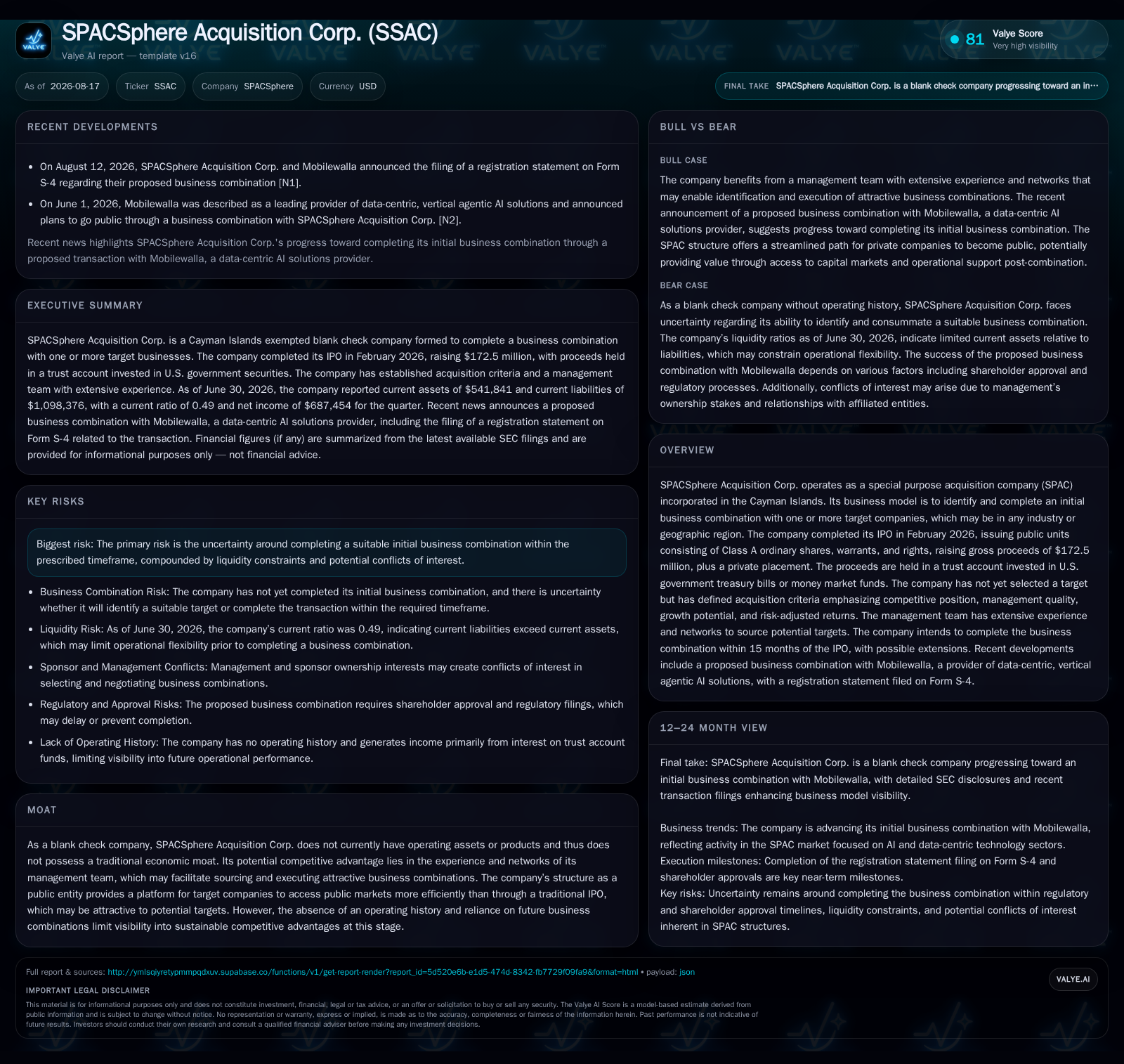
SPACSphere Acquisition Corp. recently filed a Form S-4 registration statement signaling a key step toward consummating its initial business combination with Mobilewalla, advancing from a capital-raising entity to an operational acquisition vehicle. With $172.5 million raised in its IPO and private placement securely held in a trust account invested in U.S. Treasury bills and money market funds, the company benefits from a strong liquidity base while operating under the usual SPAC time constraints. Its experienced management team’s network is a crucial asset for sourcing quality targets, positioning SPACSphere competitively within the broader SPAC ecosystem despite inherent risks such as shareholder redemptions and deal execution timing. Monitoring upcoming proxy votes and redemption rates will be critical to assessing SPACSphere’s ability to successfully complete the de-SPAC transaction.
From Capital Raise to Execution: Recent Filing Signals Commitment to Mobilewalla Deal
SPACSphere Acquisition Corp., launched as a Cayman Islands blank check company, took a decisive step forward on August 12, 2026, by filing a Form S-4 registration statement with the SEC relating to its previously announced business combination with Mobilewalla [S3][N1]. This registration move transitions SPACSphere from a pure capital-raising shell into an active participant in executing its de-SPAC transaction—typically the most critical inflection point for any special purpose acquisition company.
The timing of this filing is significant given standard SPAC timelines that generally allow 18 to 24 months to complete an initial business combination before forced liquidation or return of capital. Having consummated its IPO earlier this year in February 2026 and now actively registering merger documents roughly six months later fits well within sector norms for efficient deal cadence [S1][S3]. This milestone also resets certain performance expectations for market participants evaluating redemption risk and post-merger outlook.
Understanding SPACSphere’s Acquisition Vehicle Model: Capital and Deal-Making Mechanics
SPACSphere raised approximately $172.5 million gross proceeds through its February 2026 initial public offering coupled with an additional private placement that generated about $2.8 million from sponsor and institutional investors [S1][S10]. The IPO structure consisted of units made up of one Class A ordinary share, half a redeemable warrant (exercisable at $11.50/share), and rights convertible into fractional shares upon business combination completion [S1].
Following closing, these gross proceeds were deposited into a dedicated trust account managed by Odyssey Transfer and Trust Company, which invests exclusively in U.S. government Treasury bills maturing within 185 days or money market funds restricted under Rule 2a-7 of the Investment Company Act [S10]. This setup is standard among SPACs to protect public investor capital until deployment into an acquisition.
Fund deployment flexibility is enhanced by the company’s stated intent to pay consideration using cash from this trust account or combine cash with newly issued shares or debt instruments as necessary [S1]. However, relying primarily on the trust account earnings preserves investor protections while giving management optionality in deal structuring.
SPACSphere incurs general administrative costs ahead of business combination completion but maintains focus on limiting expenses to preserve runway within mandated deadlines [S2]. Without target revenues until after closing, all operating losses stem currently from administrative functions.
Industry Dynamics: How SPACSphere Fits Within the Broader SPAC Ecosystem
Within the wider SPAC landscape, SPACSphere operates alongside prominent vehicles such as Pershing Square Tontine Holdings (PSTH) and Churchill Capital Corp series that have cemented reputations through large-scale deals or rapid de-SPAC execution. While lacking PSTH’s scale or notoriety yet, SPACSphere leverages similar mechanics: raise capital via IPO from broad public investors utilizing units comprised of shares plus warrants with redemption rights.
In comparison to traditional IPO pathways available for private companies accessing public markets, SPACs offer faster route-to-market with less upfront regulatory disclosures but create exposure to shareholder redemption risk that can erode deal funding unexpectedly. Target companies often view merging via SPAC favorably when seeking speed or certainty versus prolonged IPO processes.
PIPE financing involvement post-announcement is another key competitive factor shaping final deal funding quality and valuation dynamics; although no PIPE arrangements are documented yet for this transaction [S3], this remains an important subsequent element common across peer deals.
Deal Drivers: Management Expertise and Target Criteria Underpin Growth Expectations
Central to SPACSphere’s value proposition is its management team's depth of experience as operators, investors, and advisors across early stage through scaled businesses [S1][S12]. Their networks enable access to proprietary acquisition targets while rigorous due diligence processes spanning financial scrutiny, legal review, operational assessments, facility inspections, and stakeholder interviews enhance transaction quality control.
Acquisition criteria emphasize defensible competitive positioning — including technology leadership, brand equity or scale advantages — combined with strong incumbent management teams capable of driving growth post-merger [S5][S12]. The strategy prioritizes scalable platforms positioned at inflection points where operational improvements or expansion can accelerate value creation.
This alignment aims not only at deal sourcing efficacy but also on ensuring delivered risk-adjusted returns attractive enough to satisfy public shareholders who often gauge SPAC transactions based on post-merger performance prospects.
Risks at the Cusp of Deal Completion: Redemption, Timing, Liquidity, Dilution
Though advancing steadily towards its first business combination execution phase, SPACSphere confronts sector-wide risk factors that merit close scrutiny. Shareholder redemption rights pose dilutionary challenges; high redemption levels reduce available cash for the merger consideration potentially forcing alternative capital raises or modifying transaction terms unfavorably [S1][F1]
Time pressure intensifies as mandated deadlines approach given the company’s limited operating runway before needing either extension approval or liquidation—a common constraining factor in mid-stage deals leading to negotiation urgency or target selection compromises.
Dilution may arise not only from conversion of redeemable warrants but also through issuance of additional shares or subordinated debt financing instruments that can alter shareholder voting power or economic interests adversely [S1]
Further compounding liquidity risks is a current ratio below 1 (approximately 0.49), based on June 30, 2026 balance sheet data suggesting limited liquid assets relative to short-term obligations outside the trust account likely earmarked strictly for acquisition use rather than ongoing operations [F1]. While typical for pre-combination shells relying heavily on escrowed IPO proceeds rather than substantive operating cash inflows, it raises monitoring importance until deal closure.
Forward View: What Investors Should Monitor Next in Execution and Market Response
Upcoming milestones critical for evaluating transaction viability include shareholder proxy solicitation progress post-registration statement distribution and attendant tender offer documentation accompanying definitive merger terms disclosure [S3][N1]. The magnitude of public unit redemptions following these filings will signal investor sentiment regarding deal attractiveness.
Subsequent monitoring of warrant exercise rates provides insights into underlying investor conviction levels regarding post-merger equity appreciation potential. With no operational revenues pre-combination but substantial latent risk exposure tied to timing constraints and valuation uncertainties around Mobilewalla’s business fundamentals—which remain confidential pending disclosure—the execution complexity remains material.
The capacity for structured PIPE financing participation if cash shortfalls become apparent will further affect funding certainty metrics typical within this sector dimension.
Financial Profile Discussion: Trust Account Status and Cash Position to Support Transaction
As of June 30, 2026—a recent reporting period—SPACSphere holds current assets totaling approximately $541,841 against current liabilities averaging $1,098,376 yielding a current ratio around 0.49 indicative of tight near-term liquidity conditions outside trust funds [F1]. These liabilities largely reflect deferred fees payable and accrued expenses associated with maintaining public reporting status absent operational cash flow generation prior to business combination realization.
Operating income data remains negative reflecting ongoing general administrative expenses incurred ahead of transaction closure expected until equity event realization post-acquisition completes.[F1] This pattern aligns with typical SPAC economics prior to merger consummation when no operating company revenues exist yet overhead costs persist.
Overall financial positioning portrays typical blank check vehicle status poised for transition pending near-term de-SPAC execution backed by committed IPO capital reserves in low-risk securities—yet contingent on successful investor vote outcomes coupled with minimized redemption levels enabling full transaction funding without additional dilutive financings.[S2][F1]
This analysis reflects current publicly filed disclosures by SPACSphere Acquisition Corp. Given inherent uncertainties prior to formal de-SPAC closure—including absence of operating revenues until post-merger—the profile continues being dominated by execution risks balanced against sizable capital resources raised through recent offerings supporting strategic optionality today.
Disclaimer: This is research-only, informational analysis and not investment advice. It may include AI-generated interpretation and general industry context. Always verify important details using primary sources.

Comments