
Stewart Information Services Strengthens Commercial Title Revenue and Strategic Investments in 2025
Strong domestic commercial growth and expanded credit services underpin Stewart's revenue and cash flow gains despite real estate market risks.
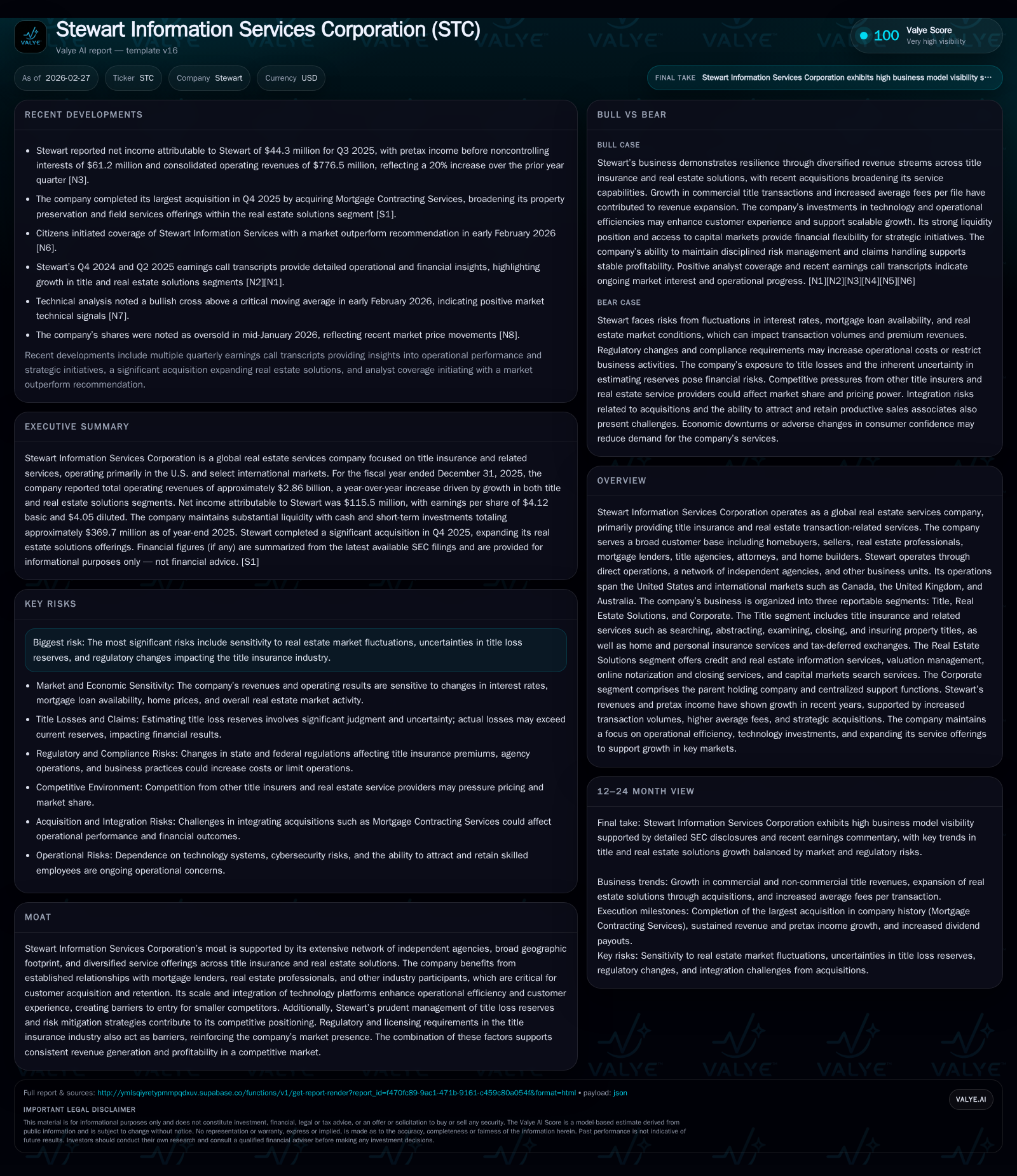
Stewart Information Services Corp advanced to $2.92 billion in revenue for 2025, a 17% increase fueled predominantly by higher domestic commercial title insurance premiums and international expansion. Net income surged 58% to $115.5 million, supported by higher operational efficiency and lower title claims payments. The company increased capital spending to enhance technology platforms and completed strategic acquisitions to broaden real estate solutions offerings. Dividend payouts rose alongside steady share repurchases, while liquidity remained robust with renewed credit facilities and reduced leverage despite macroeconomic uncertainties impacting the real estate market.
Historical Performance Overview
Stewart Information Services Corporation (STC) has posted meaningful growth over the past three years following a dip during 2022's challenging real estate environment. Total annual revenues increased to approximately $2.92 billion in calendar year 2025, marking a 17.3% improvement versus $2.49 billion in 2024 [F1]. This rebound is largely attributed to heightened activity in the domestic commercial title insurance segment alongside an expansion in international markets such as Canada, the UK, and Australia.
Net income similarly improved substantially from $73.3 million in 2024 to $115.5 million in 2025—a year-over-year increase of nearly 58%. This jump reflects not only improved top-line momentum but also more favorable operating leverage through cost controls and fewer title claim payouts [F1][S1][S4]. Operating cash flow doubled since 2023, hitting about $205.7 million last year while capital expenditures accelerated sharply to support modernization initiatives [F1][S6].
Historical performance (annual)
| FY | Rev ($bn) | Net ($mm) | CFO ($mm) | Capex ($mm) | Rev YoY | Net YoY |
|---|---|---|---|---|---|---|
| 2025 | 2.9 | 116 | 206 | 73 | +17.3% | +57.6% |
| 2024 | 2.5 | 73 | 136 | 40 | +10.3% | +140.8% |
| 2023 | 2.3 | 30 | 83 | 38 | -26.5% | -81.2% |
| 2022 | 3.1 | 162 | 192 | 48 |
Source: SEC companyfacts cache [F1].
Capital returns and efficiency (annual)
| FY | Div ($mm) | Buybacks ($mm) | FCF ($mm) |
|---|---|---|---|
| 2025 | 58 | 4 | 132 |
| 2024 | 54 | 4 | 95 |
| 2023 | 51 | 2 | 45 |
| 2022 | 45 | 3 | 144 |
Source: SEC companyfacts cache [F1].
Table notes: Revenue, net income, operating cash flow (CFO), capital expenditures (Capex), dividends paid, buybacks; YoY percentage change from prior year per [F1].
Drivers Behind Past Growth
The company's business model centers around title insurance and related services—searching, abstracting, examining titles—as well as real estate solutions including credit information and online closing tools [S1][S15]. Key determinants of operational performance have included mortgage interest rates, home price fluctuations, new mortgage loan originations, purchase vs refinance ratios, housing inventory levels, and seasonality effects.
In recent years, Stewart has benefited most from rising commercial real estate transaction sizes and volumes (notably data center, energy sector properties), which carry significantly higher premiums compared to residential transactions [S23]. Domestic commercial revenues increased by an impressive +35% in FY25 alone with average fees per file up nearly +40%, illustrating strong pricing power amidst growing transaction complexity.
International operations contributed meaningfully with +13% growth in non-commercial revenue segments driven chiefly by Canadian and U.K markets expanding their residential activities [S15][S23].
The Real Estate Solutions segment—focused on credit services and valuation management—also saw substantial expansion (+29% revenue growth Q4 alone), reflecting Stewart’s deliberate strategic shift into adjacent service lines that tap broader real estate lifecycle customer demands [S23].
Technologically enabled efficiencies including back-office automation and consolidation of processing systems have improved margins while enabling scalability beyond labor-intensive workflows common across the title industry [S17]. Strategic acquisitions totaling around $370 million during FY25 strengthened this multi-prong approach by integrating complementary businesses into Stewart’s platform [S6][S7].
Outlook on Growth Prospects
Looking ahead, Stewart holds several levers that could sustain or accelerate growth:
- Commercial Transaction Expansion: Continued strong demand for large-scale commercial deals (especially in technology infrastructure like data centers) could further boost premium yields per transaction.
- International Market Penetration: Expanding presence beyond core U.S markets into high-growth regions offers diversified revenue streams complementing domestic cyclicality.
- Technology Platform Investment: Ongoing capital expenditure targeting automation aims to reduce unit costs of title production amid competitive pressures.
- Real Estate Solutions Growth: Amplified focus on ancillary offerings such as credit reports and online closing services could add recurring revenue beyond transactional insurance premiums.
- Strategic Acquisitions: Further M&A can accelerate entry into niche markets or geographies while enhancing integrated tech capabilities.
However, this outlook faces tangible constraints:
- Real Estate Market Sensitivity: Fluctuations in housing prices, mortgage loan availability or economic downturns can directly depress transaction volumes affecting title premiums.
- Regulatory Risk: Changes to state-level insurance regulations or licensing requirements may alter pricing structures or operational compliance costs.
- Title Loss Reserves Uncertainty: Unexpected increases in title claim severity could pressure underwriting profitability despite reserve prudence.
Hence, monitoring these market indicators alongside Stewart’s evolving portfolio will be essential for future performance assessment [S1][S15][S25].
Forecasts and Milestones to Watch
While explicit quantitative guidance is not publicly provided for upcoming periods within available filings or transcripts , key milestones include:
- Continued integration results from recent acquisitions such as MCS completed during FY25 will materially impact top-line synergy realization.
- Technology deployment timelines aimed at reducing manual processing steps across direct title operations could be pivotal for margin expansion.
- Adoption rates of Real Estate Solutions products among existing mortgage lender clients offer signals for scaling that segment’s contribution.
- Debt servicing trends following drawdown on revolving lines ($200 million borrowed late FY25) plus senior note obligations bear watching relative to cash flow generation .
- Monitoring external macro factors such as interest rate movements influencing refinance vs purchase mix remain crucial given their immediate effect on business volume.
Absent direct guidance statements, these operational markers serve as barometers for Stewart’s execution effectiveness within its strategic framework [S18][S23].
Returns and Capital Allocation Strategy
Stewart Information Services demonstrates disciplined capital allocation balancing investments in growth with shareholder returns:
- The firm’s return on equity approximates a moderate ~7%, calculated from reported net income against shareholders’ equity of roughly $1.64 billion as of end-FY25 [F1], reflective of capital-intensive nature of insurance underwriting with cyclical exposures.
- Operating cash flows increased robustly +52% year-over-year reaching over $205 million last year while free cash flow after capex hovered around $132 million—demonstrating strong internal financing capacity amid rising investment spending [F1][S17][S19].
- Quarterly dividends rose steadily with total payout climbing from $53.9 million in FY24 to a tally of approximately $58.5 million in FY25 based on a dividend increase from $1.95/share to roughly $2.05/share during that period [F1][S16][S19].
- Share repurchases were minimal (~$3.9 million), primarily executed for employee restricted stock tax withholding rather than opportunistic buybacks—a conservative stance preserving flexibility.[F1]
- Debt profile includes fixed-rate senior notes totaling about $446 million due November 2031 bearing a low coupon near ~3.6%, accompanied by an expanded unsecured revolving credit facility raised from $200 million to $300 million maturing October 2030 that enhances liquidity buffer amid interest rate volatility concerns .
The overall capital structure is prudent with debt-to-equity roughly at ~39%, demonstrating moderate leverage consistent with credit rating agency BBB assessments while ensuring sufficient headroom for strategic investments or unforeseen contingencies .
Industry Positioning and Moat Elements
Stewart's moat rests on a combination of its expansive national footprint complemented by international presence through wholly-owned subsidiaries supported by approximately 550 combined leased/owned facilities [S25]. Its diversified client base crossing lenders, real estate professionals, homebuilders as well as independent agencies creates multilayered retention mechanisms critical within the fragmented title insurance sector plagued often by local competition.
Furthermore, regulatory licensing barriers pose meaningful challenges for smaller entrants seeking scale beyond isolated regional play given the specialized knowledge requirement for underwriting accuracy and compliance rigor enforced under state laws [S15][N6].[Valye analysis: Integration of proprietary technology platforms optimizing back-office workflows offers an additional competitive wedge enabling faster turnaround and enhanced customer experience than peers reliant on paper-based legacy processes.]
Effective risk mitigation via stringent reserve management policies balances exposure related to claims frequency/severity mitigating adverse loss developments typical in cyclical downturns [S10][N3].[Valye analysis: The company's legal reserves approximate substantial portions buffered against policy latencies reflecting conservative actuarial assumptions essential within title insurance underwriting.]
Key Risks Highlighted by Management
Management explicitly cites several risks fundamental to Stewart’s business model sustainability:
- Sensitivity to housing market cycles impacts volume-driven revenues especially when elevated mortgage rates dampen refinancings or purchases causing variability across reporting periods.[S1]
- Exposure to uncertainties in estimating adequate title loss reserves poses potential earnings volatility should claim incidence exceed actuarial provisions.[S10]
- Regulatory reforms including premium rate restrictions or new state-level compliance mandates potentially compress margins or elevate administrative overhead.[S15]
- Macroeconomic shocks inducing slower transaction velocity directly undermine steady premium inflows essential for operational funding.
Robust governance coupled with ongoing monitoring appears aimed at mitigating these risks but stability remains fundamentally tied to external real estate dynamics out of Stewart's direct control.
Conclusion Summary
Stewart Information Services Corp demonstrated resilient financial performance through fiscal year ending December 31, 2025 highlighted by double-digit revenue growth led notably by domestic commercial transactions alongside diversified international contributions. Higher net income driven by operational efficiencies combined with strategic investments position the company well within its industry niche.
Elevated capital spending reflects commitment toward technology-enabled scalability while acquisitions reinforce breadth across varied real estate solutions enhancing long-term prospects beyond pure title insurance products. Liquidity strength paired with prudent leverage management underscores financial flexibility vital amid ongoing real estate sector uncertainties driven by interest rate fluctuations and regulatory factors. Careful attention should remain on evolving market cycles affecting transaction volume patterns together with cost discipline execution especially as competitive pressures intensify within core U.S markets. Stewart’s sustained dividend increases signal confidence though share repurchase restraint indicates measured capital deployment philosophy balancing stakeholder returns with reinvestment needs going forward. This nuanced equilibrium between aggressive growth aspirations tempered by risk-aware capital stewardship delineates Stewart’s pathway moving into coming years given complex industry backdrop.
This analysis is based exclusively on publicly available financial data from SEC filings ([F1],[S#]) and recent transcripts ([N#]), intended solely for informational purposes without investment advice.
Disclaimer: This is research-only, informational analysis and not investment advice. It may include AI-generated interpretation and general industry context. Always verify important details using primary sources.

Comments