
StepStone Group Expands Capital Deployment and Enhances Data Platforms to Drive Customized Private Markets Solutions
StepStone’s latest quarterly update highlights significant capital deployment alongside continued investment in proprietary data analytics to support growth across global private markets.
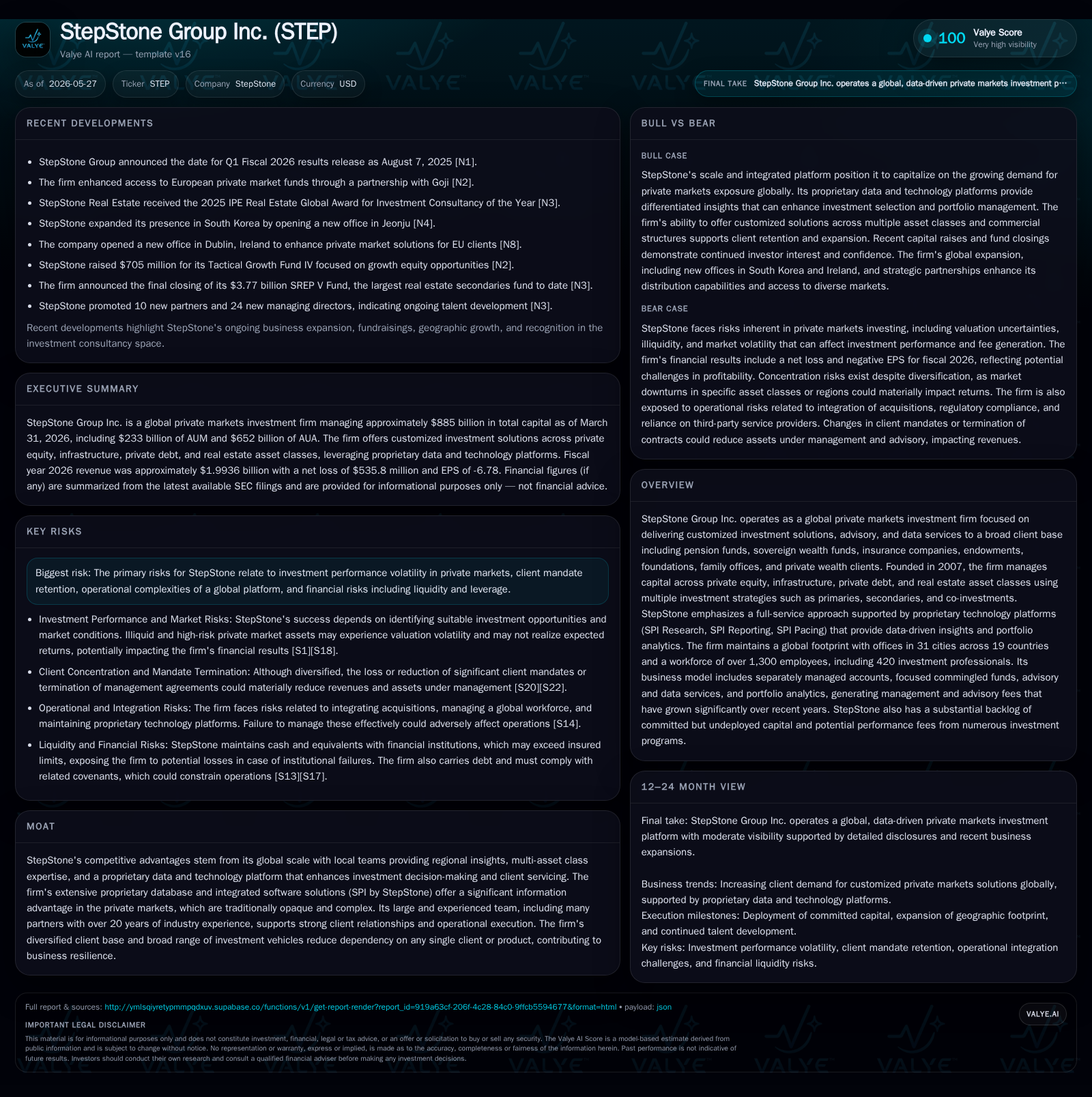
In its Q3 2026 filing, StepStone Group reported active deployment of $40.1 billion in committed but uninvested capital, reinforcing ongoing revenue visibility from management fees. The firm’s integrated multi-asset class platform and globally distributed local teams continue to differentiate its offering in the complex private markets landscape. Proprietary technology tools, including SPI Research and SPI Reporting, serve as strategic advantages by enhancing investment decision-making and client servicing. While client demand for private markets remains structurally robust, StepStone faces regulatory complexity, operational scale challenges, and market-dependent risks inherent in private asset investing.
Recent Operating Update
StepStone Group's Q3 fiscal 2026 10-Q filing dated February 5, 2026 provides the latest operating snapshot that anchors this analysis [S17]. Importantly, the company reported $40.1 billion of already raised committed capital yet to be deployed. This backlog acts as near-term invested capital pipeline likely to contribute recurring management fees once activated
Complementing this capital deployment momentum is ongoing client mandate expansion primarily from existing institutional relationships worldwide. StepStone emphasizes its global-and-local model with offices in 31 cities spanning five continents that enable tailored solutions responsive to regional market dynamics while leveraging global scale advantages [S17][S6].
The May 20, 2026 Form 8-K highlights release of full fiscal year results alongside commentary underscoring continued growth measures including organic client expansion and technology platform monetization initiatives [S3]
Business Model
StepStone operates as an integrated private markets investment firm providing customized portfolio construction, advisory services, and proprietary data/analytics tools. Their revenues derive mainly from management fees on assets under management (AUM), performance-related incentives including carried interest allocations on flagship funds initiated predominantly pre-2020 vintages with considerable accrued backlog ($2.037 billion) [S17], monitoring/reporting fees primarily tied to advisory accounts (AUA), and licensing of data analytics platforms.
Clients span large institutional investors such as pension funds, sovereign wealth funds, insurance companies, endowments/foundations, family offices as well as private wealth clients via a dedicated StepStone Private Wealth (SPW) business targeting broader private markets access to individuals [S1][S11]. Asset class breadth includes primaries (fund commitments), secondaries (existing fund stake acquisitions), co-investments alongside partners directly into companies or projects.
Revenue volumes are driven by fee-paying capital commitments deployed or advised; pricing is generally tiered based on asset class strategies with performance fees linked closely to private market fund returns—a volatile but potentially sticky revenue source reflecting StepStone's alignment with investor outcomes [S4][S27][S28]. Margins benefit substantially from leveraging proprietary SPI platforms which also strengthen client retention via embedded portfolio analytics functions enhancing switching costs
Industry Structure & Competitive Position
The global private markets advisory and fund management sector is marked by increasing sophistication amid opacity challenges inherent in illiquid alternative investments. StepStone's multi-jurisdictional presence coupled with its extensive network differentiates it versus stand-alone specialists or boutique advisory firms that may lack scale or global reach.
Key competitors include leading global alternatives firms with similarly broad platforms such as Blackstone Advisory Partners, Pantheon Ventures (a Carlyle company), Coller Capital in secondaries-focused niches, alongside regional boutiques focused on specific geographies or asset classes.
StepStone's distinct moat lies in its proprietary data ecosystems—SPI Research database covering ~19,000 managers and >293K underlying investments offers unmatched market intelligence supporting sourcing diligence [S13][S27]. Its technological edge extends through SPI Reporting for portfolio monitoring which consolidates daily cash flows and granular underlying asset-level detail facilitating deep client transparency rarely matched at this scale [S28].
Competitively important too is StepStone’s wide-ranging co-investment program which leverages frequent interactions (~5,700 annual fund manager meetings) enabling preferential access to larger deal sizes including non-traditional transactions beyond classic co-invest scope such as add-on acquisitions exceeding standard concentration limits [S25]. This fosters privileged deal flow reinforcing its differentiation.
Growth Drivers
Capital Deployment: The substantial pool of committed but undeployed capital ($40.1 billion) serves as an immediate growth base translating into incremental management fees upon investment over coming periods [S17]
Existing Client Expansion: Deep engagement enables cross-asset allocation growth from existing institutional clients responding to expanding appetite for diversified private exposure amid persistently low yield environments in public markets [S17].
Private Wealth Platform: SPW targets underserved segments by offering registered funds and co-investment vehicles meeting stricter liquidity/transparency needs for individual investors broadening addressable market [S1][S11]
Product & Geographic Diversification: Multi-asset expertise across private equity/infrastructure/private debt/real estate combined with localized teams offers tailored solutions fitting diverse mandates globally—a key driver for winning mandates amid heterogeneous investor preferences across regions including Asia-Pacific, Europe and the Americas [S6][S17]
Technology & Data Monetization: The proprietary SPI toolkit—Research for manager intelligence; Reporting for post-investment monitoring; Pacing for liquidity forecasting; Benchmarking for market transparency—creates operating leverage by reducing manual data processing costs internally while enabling fee-based standalone licenses and strategic partnerships with data vendors enhancing incremental revenue streams beyond pure asset management fees [S4][S13]
Strategic Acquisitions: The company maintains disciplined acquisition strategy aimed at complementary bolt-ons to augment product offerings or geographic footprint enhancing competitive positioning without distracting from organic growth focus [S4][S16].
Risks / Watchpoints / Growth Constraints
Investment Performance Volatility: As a significant portion of revenue is derived from performance fees tied to carried interest allocations in private funds launched pre-2020 vintage years (~59% of accrued carried interest), poor investment returns can materially reduce earnings visibility impacting fundraising success for future funds [S1]
Regulatory Complexity & Compliance Costs: Operating across multiple jurisdictions subjects StepStone to evolving requirements including Investment Company Act rules related to registered fund offerings aimed at retail/private wealth clients; EU directives like AIFMD II/MiFID II increasing operational burdens; heightened SEC focus on valuation practices amid opaque assets; emerging AI governance mandates—all adding regulatory risk and compliance cost layers which could hamper speed-to-market or product innovation [S14]
Operational Scalability Challenges: Managing operational complexity across more than thirty offices globally demands continuous investment in infrastructure including technology systems integration (e.g., SPI platforms), talent recruitment/retention amidst competition for specialized resources (investment professionals plus engineers), exposing the company to fixed cost risks if revenue growth slows unexpectedly [S4][S8]
Liquidity Constraints & Leverage Levels: The company’s total debt stood around $275 million offset partially by cash deposits resulting in an approximate net debt position of $131 million indicating moderate leverage relative to asset base supportive of ongoing platform expansion and acquisitions [F1]
Client Concentration & Mandate Retention Risks: While diversified across multiple institutional investors globally reduces concentration risk structurally; reliance on large sovereign wealth funds or pension plans increases sensitivity to potential allocation shifts by a few large clients driven by changing internal policies or external political pressures [S1]
What to Watch Next
- Capital Deployment Pace: Tracking absorption rate of undeployed $40+ billion capital into active investments will be critical to assess near-term management fee growth trajectory. Milestones tied to new vintage fund launches or co-investment deals also offer insights into dealflow quality.
- Client Mandate Expansion Trends: Renewal rates coupled with mandate upsizing among core institutional clients provide early signals about ongoing demand strength amid macroeconomic headwinds.
- Regulatory Developments Affecting Product Offerings: Implementation progress on EU AIFMD II regulations along with SEC regulatory guidance especially focused on retail/private wealth product compliance require monitoring given expanding step into these segments.
- Technology Platform Adoption & Monetization: Uptake rates for standalone SPI software licenses or new data partnerships announce scaling success beyond direct asset management services.
- Operating Margin Trajectory: Balancing fixed cost investments against expanding revenues will indicate sustainability of profitability improvements amid scaling efforts.
- Acquisition Activity: Any new bolt-on deals signaling targeted capability enhancements or entry into adjacencies may alter growth vectors.
- Financial Position Dynamics: Changes in debt levels or liquidity ratios post Q3 filings will inform assessment of financial flexibility amid strategic initiatives.
Financial Profile Briefly Noted
As per the Q3 period ended March 31st 2026 filing supplemented by companyfacts snapshot metrics: Revenue totaled approximately $1.99 billion while net income was a loss near $536 million reflecting factors such as increased operating investments or impairments not detailed here but consistent with scale-up phases typical at integrated alternatives firms [F1]. Total debt stood around $275 million offset partially by cash deposits resulting in an approximate net debt position of $131 million indicating moderate leverage relative to asset base supportive of ongoing platform expansion and acquisitions
Disclaimer
This analysis is intended solely for informational purposes reflecting facts derived from reported SEC filings without offering investment advice or research views. Readers should perform independent due diligence before making any decisions involving StepStone Group Inc.
Disclaimer: This is research-only, informational analysis and not investment advice. It may include AI-generated interpretation and general industry context. Always verify important details using primary sources.

Comments