
Stratus Properties Inc. Rebounds with Strong Profitability Amid Regional Regulatory Shifts
The company recovered from multi-year losses in 2025 despite revenue contraction and faces ongoing regulatory and liquidity challenges in the Texas residential market.
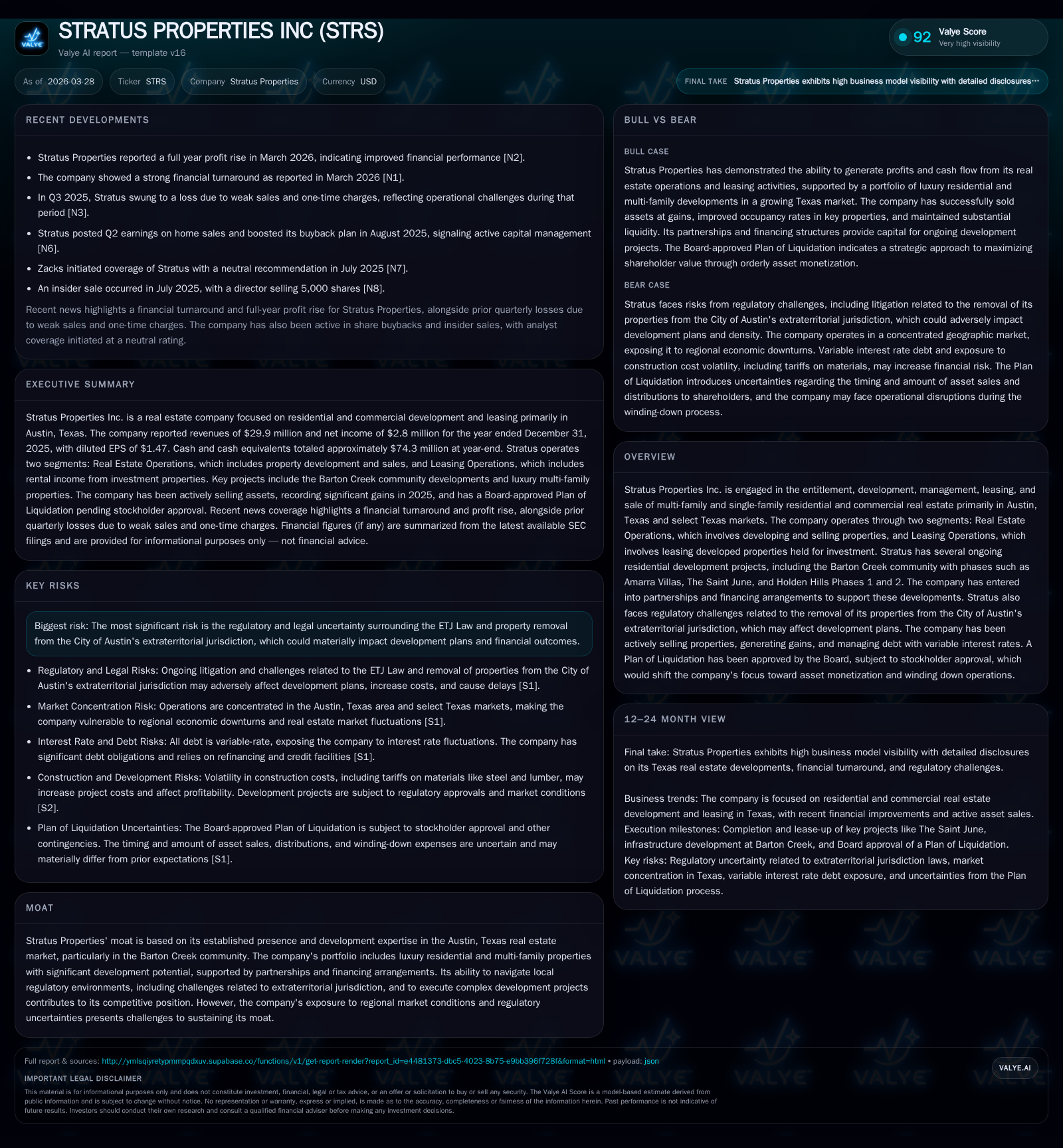
Stratus Properties Inc. reversed a pattern of sizable operating losses with a $10.8 million operating income and $2.8 million net income in FY2025, driven largely by project completions and sales in the Austin area. While revenue declined sharply by 44.8% year-over-year due to fewer property sales, the company improved profitability margins amid its continuing development pipeline focused on communities such as Barton Creek’s Holden Hills phases. Stratus maintains a significant cash reserve and has actively managed debt, including revolving credit facility amendments and project-level loans tied to infrastructure commitments. Yet, regulatory uncertainty from changes to Austin’s extraterritorial jurisdiction law and heavy negative operating cash flows highlight key risks ahead as it balances development execution with capital discipline.
Financial Recovery from Operating Losses to Profitability
Stratus Properties Inc.'s financial trajectory shifted decisively in fiscal year 2025 after consecutive years of operating deficits. The company reported an operating income of $10.79 million compared to an operating loss of $2.16 million in FY2024—a turnaround exceeding 600% year-over-year improvement [F1]. Net income similarly rebounded to a positive $2.80 million, reversing the prior year's net loss of roughly $1.91 million [F1].
However, this profitability gain came during a nearly halving top-line revenue figure, which dropped from $54.18 million in FY2024 down to $29.91 million in FY2025, representing a decline of approximately 44.8% [F1]. This reflects the lumpy nature typical for real estate developers where revenue recognition depends on project completion or asset sales rather than recurring operations.
Despite improved earnings metrics, the company's operating cash flow remained deeply negative, deteriorating further from -$5.84 million in FY2024 to -$29.90 million in FY2025 [F1]. This widening negative cash flow aligns with intensified capital expenditures inherent in multi-phase residential developments still under construction or lease-up.
Historical performance (annual)
| FY | Rev ($mm) | Net ($mm) | CFO ($mm) | OpInc ($mm) | Rev YoY | Net YoY |
|---|---|---|---|---|---|---|
| 2025 | 30 | 3 | -30 | 11 | -44.8% | +247.0% |
| 2024 | 54 | -2 | -6 | -2 | +213.7% | +88.4% |
| 2023 | 17 | -16 | -51 | -17 | -53.9% | -118.4% |
| 2022 | 37 | 90 | -55 | -8 |
Source: SEC companyfacts cache [F1].
Capital returns and efficiency (annual)
| FY | Div ($mm) | Buybacks ($mm) | ROE% |
|---|---|---|---|
| 2025 | 0 | 3 | 1.4 |
| 2024 | 0 | 2 | -1.0 |
| 2023 | 1 | 2 | -8.6 |
| 2022 | 39 | 8 | 43.3 |
Source: SEC companyfacts cache [F1].
Source: Company filings; all figures are for fiscal years ended December 31 [F1]
Drivers Behind Revenue Swings and Development Activity
Stratus Properties’ revenue profile is closely tied to milestone-driven recognition linked to entitlement approvals, construction completions, sales closings, and leasing operations across multiple residential communities concentrated around Austin, Texas.
Recent financials indicate that revenue contractions coincided with shifts in project phases: completions at Barton Creek's Amarra Villas concluded earlier leading into later stages such as The Saint June's stabilization mid-2025 [S1]. These transitions introduce timing volatility through fluctuating absorption rates—reflecting leasing velocity or home sales—which directly impact revenue recognition.
In addition to lump-sum revenues from asset sales at closing, stabilized leasing operations generate ongoing rental income streams once properties reach operational phase; however, these are currently overshadowed by faster-moving development revenues during active buildout stages [S1].
Joint venture partnerships support funding for complex developments; for example, contributions exceeding $47 million from noncontrolling interests facilitated progress on Holden Hills Phase 2 infrastructure commitments while co-investors participate proportionally in servicing debt obligations linked to projects such as The Saint George Apartments undergoing lease-up [S8].
Strategic Positioning and Project Pipeline
Stratus Properties benefits from entrenched developer presence within the growing Austin real estate market—particularly within luxury multi-family residential segments focused on Barton Creek community developments including Amarra Villas alongside progressive phases like The Saint June and Holden Hills that provide scale expansion opportunities amid regional housing supply-demand imbalances [S1][N2].
The company’s expertise includes navigating entitlement processes through multifaceted administrative frameworks coupled with infrastructure buildouts encompassing roads and utilities installations—targeting premium market niches commanding above-average per-unit pricing relative to commoditized housing stock [N2].
However, geographic concentration heightens exposure risks should macroeconomic conditions soften or municipal regulatory regimes become less favorable.
Pipeline assets include key projects like Holden Hills Phases 1 & 2 undergoing final construction stages requiring sustained capital deployment alongside planned initiatives pending resolution of local government jurisdictional matters vital for permitting approvals [N2].
Regulatory Environment: Extraterritorial Jurisdiction Impacts
A significant external challenge involves recent changes to the City of Austin’s extraterritorial jurisdiction (ETJ) areas where several development parcels—including portions encompassing Barton Creek properties—have been removed from city control under Texas state law revisions [S19].
This affects municipal oversight on land use regulations including zoning authority, permitting procedures, utility connections mandates, and infrastructure obligations impacting development timelines and cost projections.
The legal ambiguity surrounding ETJ status has prompted disputes potentially delaying progress or necessitating revised construction approaches subject to alternate permitting bodies outside prior city frameworks [S19]. Such uncertainties could reduce project returns if timelines extend or costs inflate beyond underwriting assumptions.
No material contingent liabilities have been reported related to these regulatory challenges as yet [S19], but they represent material risk factors for future planning.
Capital Structure Optimization and Debt Management
Stratus actively manages its capital structure using variable-rate SOFR-based borrowings via construction loans secured on specific projects plus corporate revolving credit facilities providing liquidity flexibility during cyclical fluctuations [S4][S6][S8].
Total principal debt outstanding declined from approximately $163.7 million at end-FY2024 to $143.8 million by FY2025 reflecting amortizations plus selective repayments through asset sale proceeds including disposal of Kingwood Place retail asset early-2026 thereby easing leverage pressure [F1][S4][S14].
The Fifth Third Bank revolving credit facility underwent amendments extending maturity from March 2027 up to March 2028 plus incremental borrowing base increases following updated appraisals boosting availability from roughly $17 million net of letters of credit up towards near $24+ million by Q1-2026 [S4][S5][S13][S21]. Letters of credit totaling approximately $10 million secure road/utility infrastructure performance obligations linked primarily to Holden Hills Phases and Lakeway projects per lender conditions restricting distributions until completion benchmarks are met ensuring creditor protections [S13].
Project-level loans balance principal amounts tailored per construction schedules such as The Annie B land loan extended through March 2024 (with modifications noted) requiring monthly interest payments while preserving financial headroom under covenants targeting net asset values near $125 million threshold plus sub-50% aggregate debt-to-gross asset value ratios confirming prudent leverage governance despite sector cyclicality [S6][S15][S17].
Share Repurchase Program and Dividend Policy Evolution
Capital returns policy evolved over recent years balancing cash conservation against shareholder value enhancement mechanisms constrained by lending covenants requiring bank consent for repurchases/dividends above nominal thresholds [S7][S10][F1].
Since November 2023 board authorization allowing up to $5 million stock repurchase limit then raised substantially in June 2025 to a ceiling of $25 million (with Fifth Third Bank’s approval), Stratus purchased approximately $3.15 million worth of common shares during FY2025 alone at average prices near low-$20s per share demonstrating measured opportunistic buyback activity serving dual objectives: offsetting dilution from employee equity programs while signaling confidence without compromising liquidity reserves critical for ongoing developments [F1][S7].
Dividend outflows were minimal—paid dividends dropped consistently near quarter-million dollars reflecting cautious approach given negative operating cash flow trends though accrued dividend liabilities on RSUs remain immaterial [F1].
Forward-Looking Considerations and Milestones
Looking ahead, Stratus’ momentum rests heavily upon successfully extending construction loan maturities—especially regarding Holden Hills Phase 1 where short-term extension granted through June ‘26 is subject to longer-term refinancing negotiations—and advancing discrete development milestones translating into stabilized leasing occupancy enabling positive free cash flow generation projections eventually becoming distributable surplus for stakeholders [N2][S3].
Resolving ETJ-related litigation outcomes remains critical given potential impacts on entitlements or added compliance costs possibly curbing scheduled build-outs or forcing redesigns incompatible with current underwriting models.
Capital availability will continue gating new project starts since substantial operating loans were extended across partnerships like The Annie B ($8+ million aggregate outstanding) evidencing ongoing funding demands burdening parent-level resource allocation strategies influencing risk appetite absent secured financing commitments upfront.[S26]
Absorption rates within new multi-family luxury segments post-deliveries will dictate leasing velocity underpinning rent roll stability crucial for loan covenant compliance plus overall profitability carrying implications across cyclical downturn vulnerability.
Summary: Balancing Turnaround Against Market Constraints
Stratus Properties emerged from years shadowed by deep losses into tangible profitability improvements illustrating operational execution capabilities within its high-barrier Austin luxury residential niche enhanced through successful phased completions albeit amid meaningful headwinds including sharply contracted revenues reflecting lumpy development cycle effects alongside persistent substantial negative operating cash flows underscoring capital intensity inherent in its business model.
Its moat emphasizes localized market expertise augmented by strong partnerships facilitating asset monetizations though geographic concentration exposes it acutely to regional economic shifts plus escalating political/regulatory uncertainties notably extraterritorial jurisdiction redefinitions generating potential delays or cost increments adverse to project economics consequently driving implicit regulatory risk premiums embedded within valuations currently.
Prudent capital structure maneuvers demonstrated via reduced gross debt exposure combined with flexible SOFR-indexed facility terms sustain financial stability presaging capacity for enhanced shareholder returns through scaled share buybacks while mindful not to exhaust liquidity buffers necessary for committed infrastructure investments critical for unlocking embedded future value.
Stakeholders should monitor forthcoming ETJ dispute resolutions alongside evolution toward sustained positive operating cash flows—the latter being essential benchmark validating long-term viability beyond accounting profit appearances—to fully appraise Stratus’ turnaround durability balanced against structural market constraints characterizing investor risk-return calculus within specialized Texas real estate product segment.
This analysis was prepared based solely on publicly available information including SEC filings ([S#]), company facts data ([F1]) and news sources ([N#]), without offering investment advice or recommendations regarding any securities mentioned herein.
Disclaimer: This is research-only, informational analysis and not investment advice. It may include AI-generated interpretation and general industry context. Always verify important details using primary sources.

Comments