
Latham Group 2025 Performance Sharpens Industry Leadership and Margin Expansion
The company’s strategic push towards fiberglass pools, backed by dealer longevity and operational efficiency, drove a notable financial turnaround in 2025.
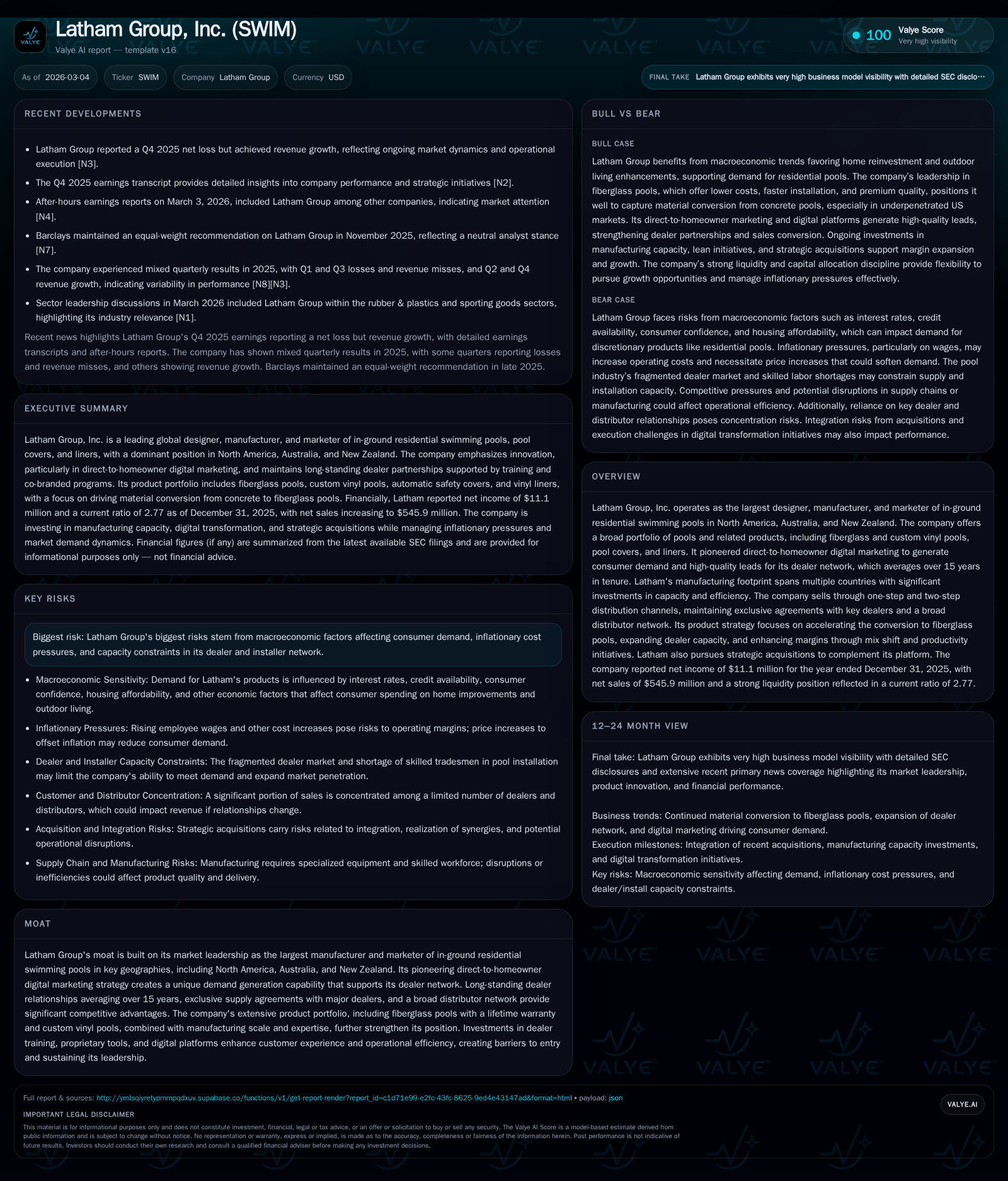
Latham Group transitioned from a net loss in 2024 to profitability in 2025, underpinned by increased fiberglass pool penetration and integrated acquisitions boosting sales. Operating income rose sharply by over 67% year-over-year, while Adjusted EBITDA margins improved to 18.3%. The company plans to leverage direct-to-homeowner digital marketing and dealer capacity expansions to sustain growth despite a largely flat market environment. Capital discipline is evident in improved cash flows and deleveraging efforts with no outstanding revolver borrowings at year-end.
From Losses to Profits: Latham’s Recent Historic Performance and Growth Drivers
Latham Group completed a significant financial turnaround in fiscal year 2025 after grappling with losses the year before. Revenue for the year grew by a solid 7.4% year-over-year to $545.9 million, up roughly $37.4 million from $508.5 million in FY2024 [F1][S1]. This top-line growth emanated primarily from volume gains which accounted for approximately $32.8 million of the increase, supported by price adjustments including tariffs contributing around $4.6 million [S18]. Among product categories, pool covers led the charge with nearly $29.4 million in additional sales; liners and pools contributed $5.2 million and $2.7 million increases respectively.
On the profit front, operating income soared by 67%, reaching approximately $30.6 million compared to $18.3 million in the prior year [F1]. Net income swung from a loss of $17.9 million in FY2024 to a positive result of $11.1 million in FY2025, producing a modest net margin of roughly 2% [F1][S20]. Adjusted EBITDA advanced by nearly $20 million, rising to about $99.8 million—a margin expansion from 15.8% up to an impressive 18.3%—reflecting successful operational execution including lean manufacturing and value engineering initiatives plus the accretive impact of recent acquisitions such as Coverstar Central [S1][S13][N2].
This rebound was underpinned by robust demand for fiberglass pools, which continue eroding legacy concrete pool market share due to their faster installation times (days versus months for concrete), durability backed by lifetime warranties, and lower lifecycle costs [S12][S15]. The company’s proprietary direct-to-homeowner digital lead generation strategy remains central to expanding consumer awareness and driving purchase-ready traffic to its long-tenured dealer network averaging over 15 years [S1].
Latham Group Historical Financial Summary
Historical performance (annual)
| FY | Net ($mm) | CFO ($mm) | OpInc ($mm) | Capex ($mm) | Net YoY |
|---|---|---|---|---|---|
| 2025 | 11 | 63 | 31 | 25 | +162.3% |
| 2024 | -18 | 61 | 18 | 20 | -647.9% |
| 2023 | -2 | 116 | 16 | 33 | +58.1% |
| 2022 | -6 | 32 | 30 | 40 |
Source: SEC companyfacts cache [F1].
Capital returns and efficiency (annual)
| FY | Buybacks ($mm) | FCF ($mm) | ROE% |
|---|---|---|---|
| 2025 | 38 | 2.7 | |
| 2024 | 0 | 41 | -4.6 |
| 2023 | 281 | 83 | -0.6 |
| 2022 | 281 | -7 | -1.5 |
Source: SEC companyfacts cache [F1].
All values sourced from [F1]; YoY % change calculated where applicable.
The Fiberglass Conversion Catalyst: Future Market Dynamics and Strategy Execution
Fiberglass pools hold a clear advantage in key markets due to superior homeowner benefits including rapid installation (2–3 days vs several months for concrete), reduced maintenance burden thanks to non-porous surfaces resisting algae buildup, and lifetime structural warranties that enhance consumer confidence [S12][S15]. Despite this, fiberglass remains underpenetrated especially relative to markets such as Canada, Australia, New Zealand and Western Europe where it commands greater share [S14]. Latham is capitalizing on this gap through intensified marketing outreach.
The company’s hallmark innovation — its direct-to-homeowner digital marketing platform — stands out in an industry traditionally focused on business-to-business interactions between manufacturers and dealers [S1][N1]. By targeting consumers directly via digital channels like social media and search advertising, Latham creates purchase-ready leads fed into its elite dealer base with exclusive supply agreements covering over 375 large dealers (“Latham Grand”) across North America [S15][S23]. This ecosystem both pulls demand via consumer interest and pushes product availability through robust distribution networks exceeding 475 distributor locations.
Looking ahead into calendar year 2026, management anticipates continuing outperformance despite an expected flat U.S residential inground pool market overall [N1]. Increased focus will target high-growth Sand State markets (notably Florida, Texas, Arizona) bolstered by expanded homebuilder and contractor engagement—a strategic go-to-market adjustment aimed at opening underpenetrated consumer clusters [N1][S7]. Expanded marketing investment is planned along with operational actions such as dealer capacity enhancements and product innovation emphasizing autocovers complementary to fiberglass pool growth [N1][S1].
Financial Outlook and Operational Milestones to Track
While explicit forward guidance remains limited beyond early commentary by management [N1], several parameters form critical markers for monitoring Latham’s trajectory:
- Fiberglass sales growth rate: Sustained acceleration versus broader market will validate conversion strategy success.
- Dealer network capacity & tenure: Expansion or strain within dealer/install partner capabilities could materially affect order fulfillment cycles.
- Margin improvement initiatives: Ongoing value engineering efforts aiming at gross margin uplift through lean manufacturing processes will be key measure points.
- Marketing spend efficiency: Direct-to-homeowner lead quality metrics will offer insight on return over incremental brand-building expenditures.
- Geographic expansion results: Gains in Sand States penetration will be especially telling given historical underrepresentation.
Investors should watch how these operational metrics align with annual financial outcomes reported starting Q2/26 earnings onward as combined indicators of sustainable growth amid cost management against inflationary pressures [N1][S25].
Capital Allocation Focus: Cash Flow Strength, Leverage Reduction, and Return on Equity
Latham exhibited disciplined capital management aligned squarely with its growth-through-profitability strategy during FY2025:
- The company generated operating cash flow of approximately $63.4 million against capital expenditures of about $25.4 million—a capex increase of ~26% reflecting investments in product innovation and upgrading manufacturing systems [F1][S22]. This produced free cash flow near $38 million (operating cash flow minus capex).
- Net debt stood at approximately $280 million on its Term Loan facility after no principal prepayments made during FY25 following an aggressive paydown of more than $18 million plus amortization payments in FY24 [S8][S19]. Revolving Credit Facility borrowings were zero at year-end with full unused availability of about $75 million providing liquidity optionality [S5][S8].
- No share repurchases occurred since end-2023 after cumulative repurchases approximating $280 million earlier demonstrating prudence amid recovery focus instead prioritizing deleveraging and organic growth funding [F1].
- Equity base expanded moderately supporting an approximate trailing twelve-month ROE of around 2.7%, consistent with rebuilding profit levels post-loss years but leaving room for improvement as operational leverage intensifies with scale enhancement [F1].
Overall, the company appears well-positioned financially with manageable leverage metrics aligned to covenant requirements coupled with sufficient liquidity buffers—a foundation for sustained innovation funding while maintaining financial flexibility [S6][S19].
Dealer Network as Strategic Moat: Long Tenure and Lead Generation Expertise
Latham’s moat is strongly reinforced through exclusive relationships established under its “Latham Grand” program encompassing more than 375 major dealers across North America governed by exclusivity supply arrangements incentivized through co-branded marketing campaigns, advanced training programs focused on fiberglass pool installation excellence, priority access to leads generated via Latham’s innovative consumer marketing efforts as well as early product previews [S15][S23].
These dealers average over fifteen years’ tenure offering robust continuity that reduces channel churn risk common in highly fragmented building industries prone to subcontractor volatility [S1]. Concurrently, the firm maintains extensive distributor footprints exceeding over four hundred branch locations sustaining broad coverage allowing multi-tiered business-to-business supply chains leveraging one-step dealer direct sales complemented by two-step distributor stockpile models thus balancing market reach against inventory dispersion risks efficiently.
The digital lead-generation transformation pioneered early on enhances demand visibility directly tied to measurable regional dealer capacities while enabling dynamic targeting based on dealer installation bandwidth and regional market saturation—an industry-unique pull mechanism uncommon among competitors relying principally on traditional trade show or print-based marketing channels [S15][N1].
Product Portfolio Evolution: Margin Management through Mix Shift and Efficiency
Latham offers what it terms the industry’s broadest portfolio encompassing main product categories comprised of fiberglass pools manufactured using an advanced seven-layer composite process backed by finite element modeling ensuring durability; custom vinyl pools characterized by non-corrosive frames topped with vinyl liners; automatic safety pool covers (acquired via Coverstar Central vertical integration); seasonal mesh or solid winter covers; plus related products such as liners servicing both Latham-manufactured pools as well as third-party installs [S13][N2].
Margin expansion owes much to deliberate shift toward higher-margin fiberglass pools alongside increased autocover penetration which carry stronger pricing power relative to commoditized vinyl liners or competitive concrete products outside their control set [S13][S16]. Lean manufacturing initiatives drive reduced unit costs through value engineering reforms applied not only in raw material utilization but also overhead management across multiple production sites spanning North America down under operations improving fixed cost absorption without sacrificing quality benchmarks given warranties extend over pool lifetimes enhancing perceived value premium justification for price increases.
Macroeconomic Risks Impacting Demand and Supply Chain Constraints
Disclosures highlight risks primarily stemming from:
- Inflation-driven raw material cost volatility notably PVC plastics, fiberglass resin prices impacting gross margins;
- Interest rate environments depressing discretionary spending influencing timing or cancellation of backyard renovation projects including new pool installations;
- Continued challenges around housing affordability restraining new home construction activity indirectly limiting ancillary swimming pool demand;
- Capacity bottlenecks tied specifically to skilled labor availability across dealers/installers imposing lead time elongation potentially suppressing volume conversion rates;
- Weather seasonality remains a variable external factor affecting short-term quarterly performance though mitigated somewhat through diversified geographic footprint spanning U.S., Canada, Australia & New Zealand territories reducing single-region weather impact concentration risk;
- Competitive landscape evolving away from traditional concrete toward fiberglass although competition remains intense needing continuous innovation investment to defend leadership positioning.
These headwinds necessitate careful financial stewardship balanced against aggressiveness required for brand building investment; ongoing strategic initiatives appear crafted precisely toward these factors mitigating some concerns ahead.[S25][N2]
Disclaimer: This report is intended solely for informational purposes reflecting data extracted from company filings and credible news sources as cited; it does not constitute investment advice or recommendations.
Disclaimer: This is research-only, informational analysis and not investment advice. It may include AI-generated interpretation and general industry context. Always verify important details using primary sources.

Comments