
Tian'an Technology Group’s Strategic Shift to Graphene Health Faces Revenue Decline and Liquidity Pressure
The company’s pivot from power control solutions to graphene-based health products has driven sharp revenue contraction and operating losses in 2025.
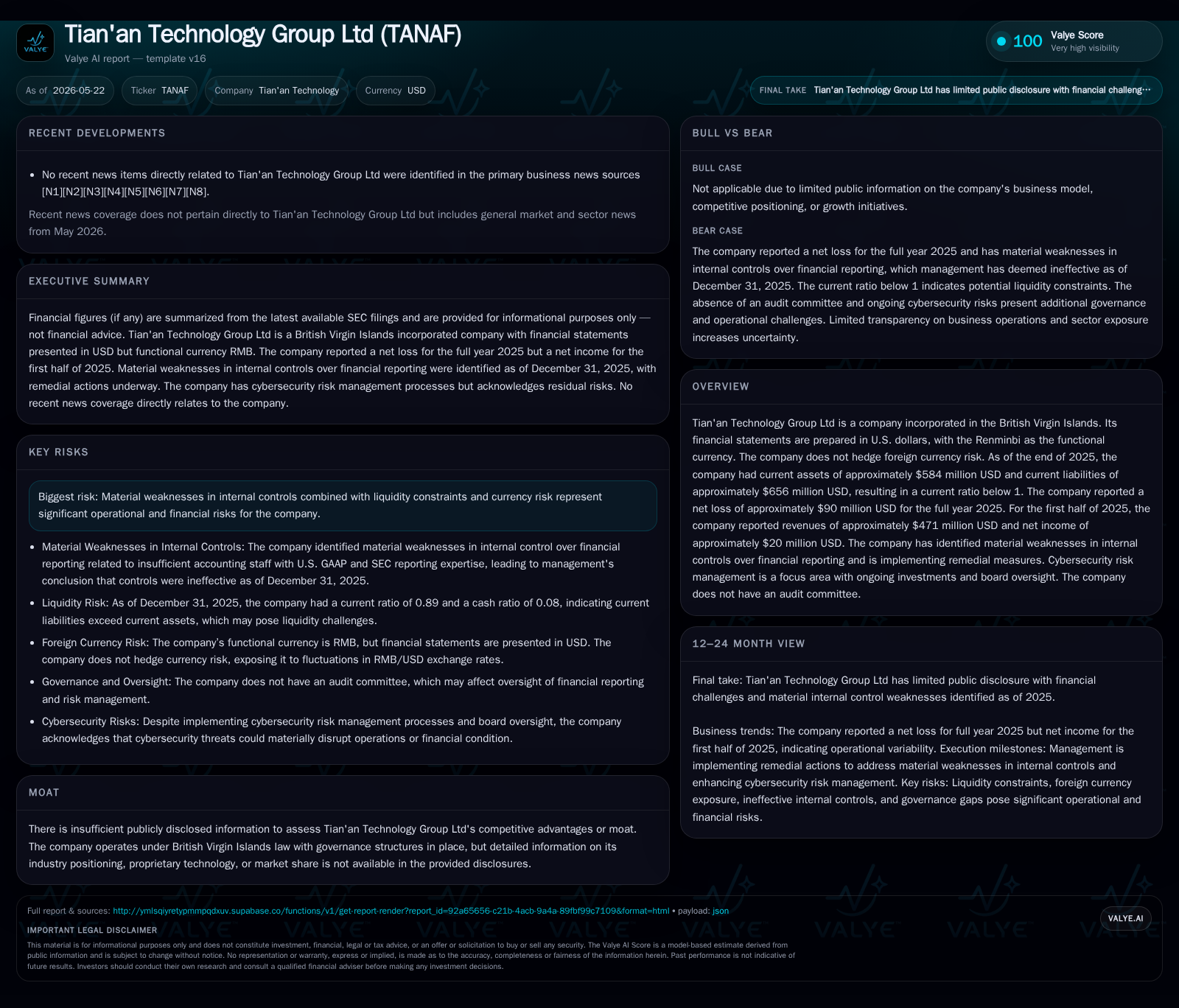
Tian'an Technology Group Ltd transitioned its core business toward graphene production and health therapy integration starting in 2022, leveraging far-infrared properties of graphene. Despite innovative product positioning, the company encountered intensified competition, sharp declines in related-party transactions, and weakened third-party demand leading to a 58.8% drop in revenue in 2025. Operating losses widened amid only modest reductions in operating expenses. Liquidity constraints persist with a current ratio below 1 and net negative working capital, although operating cash flow turned positive for the first time in recent years. The company faces risks from internal control weaknesses, currency exposure, and funding uncertainty as it pursues restructuring initiatives.
Recent Operating Update
Tian'an Technology Group Ltd's latest publicly disclosed interim report dated August 27, 2025 ([S2]) details its operational transition. The entity no longer directly operates but functions through wholly owned PRC subsidiaries Shanghai Qige Power Technology Co., Ltd. and Henan Qige Power Artificial Intelligence Technology Co., Ltd. Initially centered on technology-driven sales of power control and service systems solutions via Shanghai Qige, the company pivoted in Q3 2022 toward graphene production with a particular emphasis on health therapy leveraging graphene’s far-infrared heat properties. This strategic shift integrates scientific advances into product offerings aimed at healthcare markets.
The annual filing dated May 22, 2026 ([S1]) confirms that this reorientation continues with an expansion into healthcare services through the establishment of Henan Qige subsidiary in late 2024. Plans include developing an online medicine distribution platform, suggesting a move toward digital health services complementing physical product lines. Tian'an HK also began limited sales activities in 2025 but remains primarily a holding entity.
Business Model
The company's revenue generation depends on selling graphene-enhanced health therapy products utilizing far-infrared heat technology—an innovative aspect intended to differentiate their offering within growing health-tech niches. Previously focused on power control systems sales through Shanghai Qige, the business now relies on its two operating subsidiaries within China for manufacturing and sales activities.
Revenue recognition conforms strictly to ASC Topic 606 standards, recording revenue upon transfer of control net of taxes ([S2]). The shrinking contribution from related parties—from over half a million dollars in 2024 down to about $10K in 2025—indicates a structural shift away from internal group transactions toward external customers, though overall third-party demand has also weakened ([S1]).
Pricing dynamics suggest diminished pricing power as intensified competition forces Tian'an to lower prices on higher-margin products to sustain volumes ([S1]). Selling and marketing expenses decreased significantly (about -31.8%) due to cutbacks in promotional activity reflecting conservative cost management amid revenue decline ([S1]). General administrative expenses also saw moderate trimming through tighter discretionary spend controls.
Operationally, customer acquisition hinges on expanding beyond initial Eastern China marketing efforts toward a nationwide footprint via an emerging marketing network ([S11]). Yet competitive differentiation beyond far-infrared graphene technology remains obscure owing to limited public disclosures regarding proprietary advantages or patents.
Industry Structure and Competitive Position
However, intensified competition has materially compressed gross margins as Tian'an reduced prices for their premium margin products ([S1]). The shift away from lucrative related-party sales underlines a more open market approach but also exposes reliance on volatile external demand conditions.
Growth Drivers
Growth drivers appear rooted in:
- Commercialization of novel graphene far-infrared heating therapies tapping into rising interest in non-pharmaceutical wellness technologies.
- Expansion into AI-driven healthcare services via new subsidiary ventures aiming at online medicine distribution platforms.
- Geographic scaling beyond Eastern China supported by reputation for product quality and after-sales service ([S11]).
Nonetheless, given the deterioration of revenues and margins during fiscal year 2025 accompanied by a steep drop-off in related-party business, these drivers remain nascent rather than reflected in financial outcomes yet.
Risks and Watchpoints
Material risks documented include:
- Liquidity constraints: Current ratio below one (0.89) and negative working capital (~$72K) limit operational flexibility ([F1], [S4]).
- Internal controls: Material weaknesses reported over financial reporting systems necessitate concerted remediation efforts ([S1], [S20]).
- Foreign currency exposure: Functional currency RMB versus reporting currency USD introduces translation volatility without hedging protections ([S16]).
- Market competition: Aggressive price competition threatens gross margin sustainability amid commoditizing product offerings.
- Dependence on related party funding: Historically reliant on founder CEO Heng Fei Yang’s financial support; future capital raising may dilute equity or add debt burdens ([S4]).
- Regulatory environment: Operating primarily through Chinese subsidiaries exposes Tian'an to geopolitical and regulatory uncertainties such as fund transfer restrictions and taxation policy shifts ([S19], [S16]).
Monitoring these areas will be critical for assessment of ongoing viability and operational stability.
What To Watch Next
Key developments to watch include:
- Progress and market reception of Henan Qige's AI-based healthcare service initiatives including launch metrics for the online medicine distribution platform.
- Execution details of restructuring plans aiming to extend cash runway including potential strategic collaborations or divestitures outlined by management ([S4]).
- Improvements or disclosures regarding remediation status of internal control deficiencies impacting investor confidence.
- Quarterly financial updates revealing any inflections in revenue trajectory or improvements in gross margins amid evolving competitive dynamics.
- Capital structure events such as new equity or debt issuance which could materially alter liquidity profiles or shareholder dilution.
These milestones will provide insight into the company's ability to stabilize operations and capitalize on its technological repositioning.
Financial Profile Summary
Historical performance (annual)
Capital returns and efficiency (annual)
In fiscal year ended December 31, 2025, Tian'an reported revenues of approximately $735K representing a sharp decline of nearly 59% compared to $1.78 million for 2024. This drop largely stemmed from lower related-party transactions which plunged from $587K to just over $10K alongside softening third-party demand affected by increasing competition ([S1], [F1]). Cost of revenues decreased proportionally but gross profit still fell nearly 70% to $254K reflecting both volume effect and price reductions.
Operating expenses were reduced by only about 10.6% totaling $342K driven mainly by cuts in selling/marketing activities (-31.8%) and smaller decreases (-5.5%) in general administrative costs such as legal, audit fees associated with public company compliance ([S1]). Consequently, operating income swung from positive $456K profit in 2024 to an $88K loss in 2025 while net income followed a similar pattern (-$90K loss).
Positively, cash flow from operations rebounded strongly from a negative $513K outflow recorded previously to a positive inflow of $126K aided by working capital improvements such as declines in accounts receivable and advances payable ([F1], [S8],[S23]). This progress improves short-term liquidity outlook despite continued net working capital deficit (current assets $584K vs liabilities $656K) translating into a current ratio under unity (0.89) at year-end ([F1]). Total debt stood near $44K while cash balances were just under $50K providing modest liquidity buffer but underscoring funding fragility absent external capital injections ([F1],[S19]).
Overall ROE is significantly negative given reported losses against negative shareholders' equity position (~-$72K) indicating challenging financial health during this transition phase.[F1]
This analysis is based entirely on publicly available SEC filings dated up through May 22, 2026 (20-F) complemented by the latest interim disclosures (6-K) as well as companyfacts data sets. It aims solely to describe Tian’an Technology Group Ltd’s reported operating results, industry positioning, growth outlooks, risks, and financial status without providing investment advice or forecasting future performance.
Disclaimer: This is research-only, informational analysis and not investment advice. It may include AI-generated interpretation and general industry context. Always verify important details using primary sources.

Comments