
Tailwind 2.0 Acquisition Corp. Advances SPAC Search in Emerging Electron Economy Sector
The SPAC maintains a robust trust account and leverages sector expertise to target transformative energy and compute infrastructure businesses.
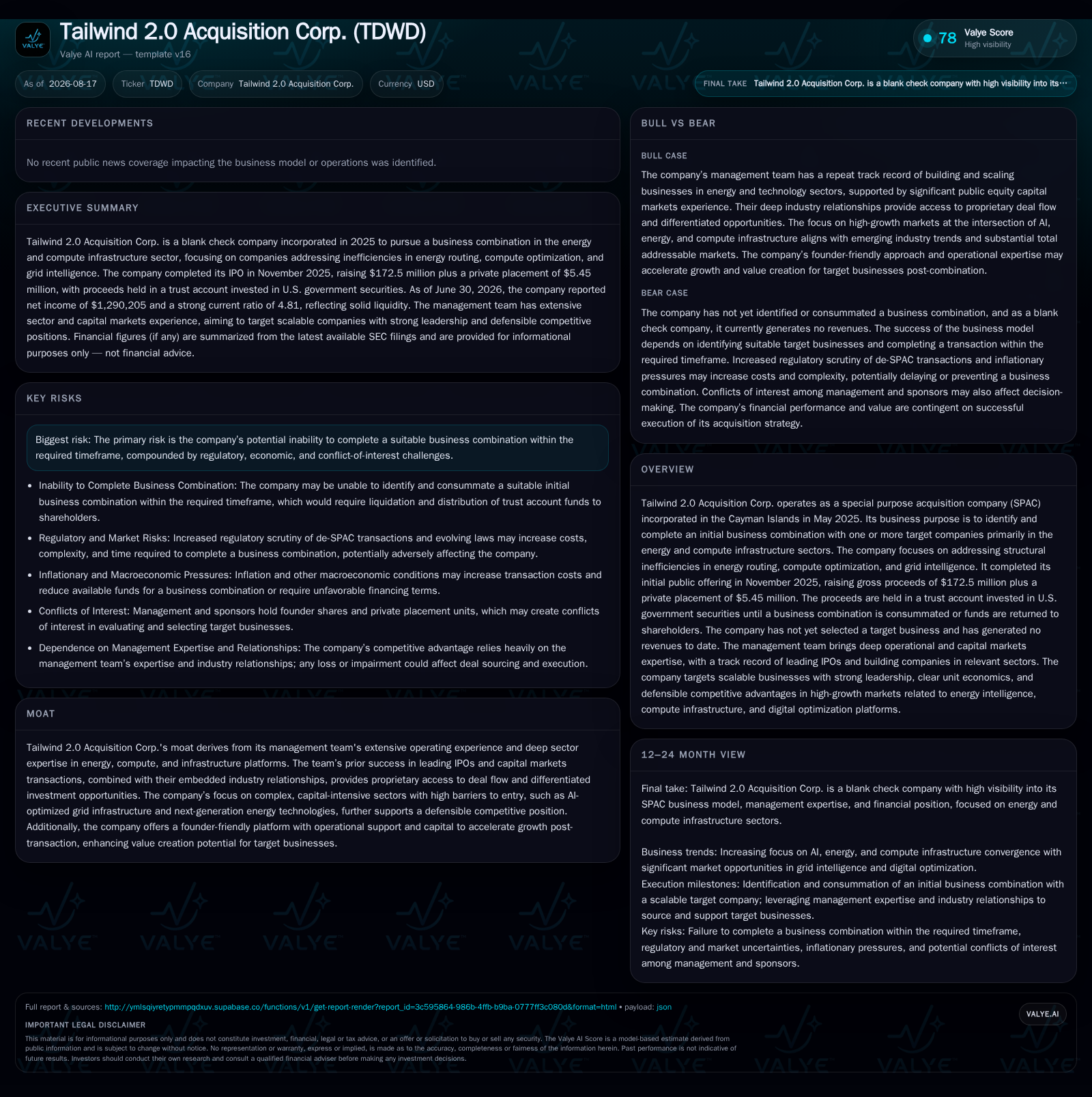
Tailwind 2.0 Acquisition Corp., a Cayman Islands-based SPAC formed in May 2025, completed its IPO in November 2025 raising approximately $172.5 million, with additional private placement proceeds held primarily in a trust account invested in U.S. government securities. Focused on merging with companies shaping the 'Electron Economy'—characterized by AI-driven grid optimization and compute infrastructure—the SPAC has yet to finalize a business combination but relies on a management team with deep sector expertise to source and evaluate prospective targets. Key risks remain, including the challenge of completing a transaction within the mandated timeframe under evolving regulatory scrutiny, alongside typical SPAC redemption and cost pressures.
Recent Operating Update
The absence of operating revenues is standard for SPACs at this stage; the company realizes modest non-operating income from interest earned on these trust assets [S1]. Any expenses incurred related to administrative, legal, financial reporting, or due diligence activities are funded outside of the trust account to avoid jeopardizing shareholder capital earmarked for transaction financing
Business Model
As a Special Purpose Acquisition Company (SPAC), Tailwind 2.0 Acquisition Corp. operates exclusively as a capital-raising vehicle formed for the purpose of merging with or acquiring one or more target companies within prescribed sectors—specifically those enabling intelligence layers over energy and compute infrastructure such as grid modernization, energy routing optimization, and AI-enhanced compute platforms [S1], [S15]. Its monetization mechanics revolve around an initial public offering (IPO) that raised net proceeds placed into a segregated trust account invested conservatively to maintain capital integrity while seeking acquisition targets.
Investor returns materialize through the successful identification and consummation of a "business combination," where the private target becomes publicly traded through merger or share exchange mechanisms known as de-SPAC transactions. Post-transaction value creation is intended to be driven by management's operational expertise combined with capital infusion leveraged through flexible consideration methods including cash, equity issuances, or debt instruments tailored according to target company needs [S9], [S15].
This model depends heavily on the management team's ability to source unique targets leveraging industry relationships across venture capital networks and strategic partnerships long established within technology-driven energy infrastructure markets featuring elevated barriers to entry and regulatory complexity. The company's upstream position in capital markets allows it to act chiefly as financier and strategic advisor without engaging directly in commercial operations prior to deal completion.
Industry Structure and Competitive Position
SPACs like Tailwind occupy an intermediary role facilitating private-to-public transitions outside traditional IPO routes, which remain alternatives albeit less sector-tailored. Within its focus on energy and compute infrastructure sectors—particularly under themes of electrification and digital transformation powered by AI—the company competes for deals with other SPACs emphasizing technology sectors, private equity investors targeting high-growth infrastructure companies, and traditional investment banks underwriting conventional IPOs.
The key competitive differentiator cited is management’s sector specialization encompassing deep knowledge of grid architecture and compute system optimization combined with technical insight necessary for navigating complex regulatory landscapes. This expertise potentially lowers due diligence risk premia and accelerates integration value post-combination relative to generalist SPAC sponsors who may lack domain-specific experience [S15].
Peer benchmarking would include technology-focused SPAC vehicles that have pursued transactions in AI infrastructure or clean energy technology segments; however, Tailwind's explicit targeting of structural inefficiencies in electron routing and grid intelligence situates it within an increasingly relevant niche aligned with shifting policy support such as bipartisan infrastructure funding accelerations [S10]. Such positioning suggests potential access to proprietary deal flow but also exposes Tailwind to execution risks common in novel market segments characterized by nascent technologies and capital intensity.
Growth Drivers
Tailwind’s growth prospects hinge on several structural macro trends: accelerating electrification worldwide increases demand for resilient grid modernization solutions; commitments from enterprises toward decarbonization create urgency for scalable intelligent energy systems; bipartisan federal infrastructure initiatives provide capital injections driving innovation adoption timelines compressing; advancements in artificial intelligence enable increasingly efficient compute resource optimization tightly coupled with energy consumption reductions—all core elements within Tailwind’s stated investment mandate [S10].
Additionally, regulatory clarity improving compliance frameworks around SPAC transactions supports better execution timing compared with prior years' high regulatory uncertainty burdens faced across the space [S2]. Management’s capacity to source founder-friendly deals focusing on companies solving urgent market problems substantiates incremental growth potential by targeting businesses exhibiting validated product-market fit poised for scalable expansion once public market access is achieved via de-SPAC transactions [S15].
Increased regulatory scrutiny over SPACs globally elevates compliance costs while potentially delaying negotiations or closing timelines via heightened disclosure demands thereby straining execution feasibility especially amid macroeconomic volatility characterized by inflationary pressure pushing transaction fees higher [S2], [S25]. The concentration of assets exclusively in U.S. Treasury securities exposes the interest income buffer to prevailing low or fluctuating rates reducing excess returns available for operating costs coverage ahead of closing deals.
Redemption risk whereby public shareholders choose to redeem shares at merger votes reduces available deal financing capacity forcing reliance on alternative sources such as additional financing or sponsor participation which may impose dilution or unfavorable terms affecting residual shareholder economics post-merger [S27]. Conflicts of interest between sponsors holding founder shares with no redemption rights versus public shareholders can complicate vote outcomes albeit mitigated by regulator-mandated disclosures.
Finally, as a blank check company lacking operational history or revenues pre-merger, Tailwind is dependent entirely on management’s sourcing acumen combined with favorable conditions in targeted sectors—a confluence delicate enough that failure along any vector can impair execution viability.
What To Watch Next
Key upcoming milestones include indicators surrounding identification of viable targets consistent with Tailwind’s Electron Economy strategy—updates typically emerge through SEC filings upon signing definitive agreements specifying mergers or business combinations underway.
Shareholder communications referencing terms of proposed deals will reveal valuation approaches employed alongside anticipated capital structure adjustments indicating post-transaction strategic directions including founder-friendly value creation measures claimed by management.
Monitoring SPAC-specific metrics such as redemption election trends during proxy solicitations informs consensus sentiment regarding deal attractiveness while operating expense trends reveal need for potential working capital loans or sponsor intervention prior completion.
Regulatory developments impacting de-SPAC procedural requirements also warrant attention given their capacity to compress feasible timelines or escalate compliance expenditures influencing financial modeling adjustments.
For now, liquidity remains robust supported by approximately $173 million held securely within trust accounts invested chiefly in short-maturity government securities paying modest interest affected by rate cycles; no significant outstanding debt beyond nominal repayable intercompany loans has been reported recently reinforcing capacity for continued search activities ahead of impending deadlines [F1], [S2], [S4].
Financial Profile Discussion
As per the latest quarter ended June 30, 2026, Tailwind reported current assets totaling approximately $921,038 excluding trust account balances dedicated solely for transaction purposes; current liabilities stood at roughly $191,337 resulting in a strong current ratio near 4.81 indicating sound short-term liquidity outside the restricted trust fund corpus which itself represents over $173 million intended exclusively for merger financing absent redemptions or deferred underwriting deductions [F1]. Total reported debt was approximately $147,055 largely associated with temporary related party promissory notes, reflecting minimal leverage concerns pre-combination [F1], [S4].
Operating expenses remain consistent with expected levels for a non-operating shell company focused on deal sourcing activities covering legal fees, administrative costs, proxy statement preparation expenses offset partially by interest income generated from conservative Treasury investments held within the trust account yielding modest non-operating earnings crucially allowing continuation without external fundraising presently needed [F1], [S1].
Underwriting fees paid at IPO totaled roughly $10.86 million composed mainly of upfront cash fees plus deferred components which reduce net available proceeds but are customary nondilutive acquisition-related costs essential for capital raising success securing approximately $172.5 million gross proceeds at launch providing ample financial firepower absent significant shareholder redemptions during eventual transactions [S1], [S9].
In summary, Tailwind currently sustains ample financial stability typical of well-capitalized SPACs positioning it well structurally towards executing its stated business combination strategy within statutory constraints contingent upon successfully identifying complementary technology-enabled infrastructure businesses aligned strategically with emerging electron economy dynamics.
Tailwind 2.0 Acquisition Corp exemplifies an archetype SPAC leveraging niche sector expertise focused on transformative AI-driven energy and computing infrastructure opportunities where market tailwinds meet specialized operational insight providing differentiated competitive positioning among blank check companies despite intrinsic timeline risks integral to the model's economics. Ongoing monitoring should prioritize deal progress markers alongside evolving regulatory context shaping de-SPAC landscape fundamentals essential for assessing ultimate value realization potential post-business combination.
Disclaimer: This is research-only, informational analysis and not investment advice. It may include AI-generated interpretation and general industry context. Always verify important details using primary sources.

Comments