
TEGNA’s Local Broadcast Leadership Faces Growth Limits and Merger Risks
TEGNA leverages a broad local media footprint but contends with revenue declines and uncertainties tied to its pending Nexstar merger.
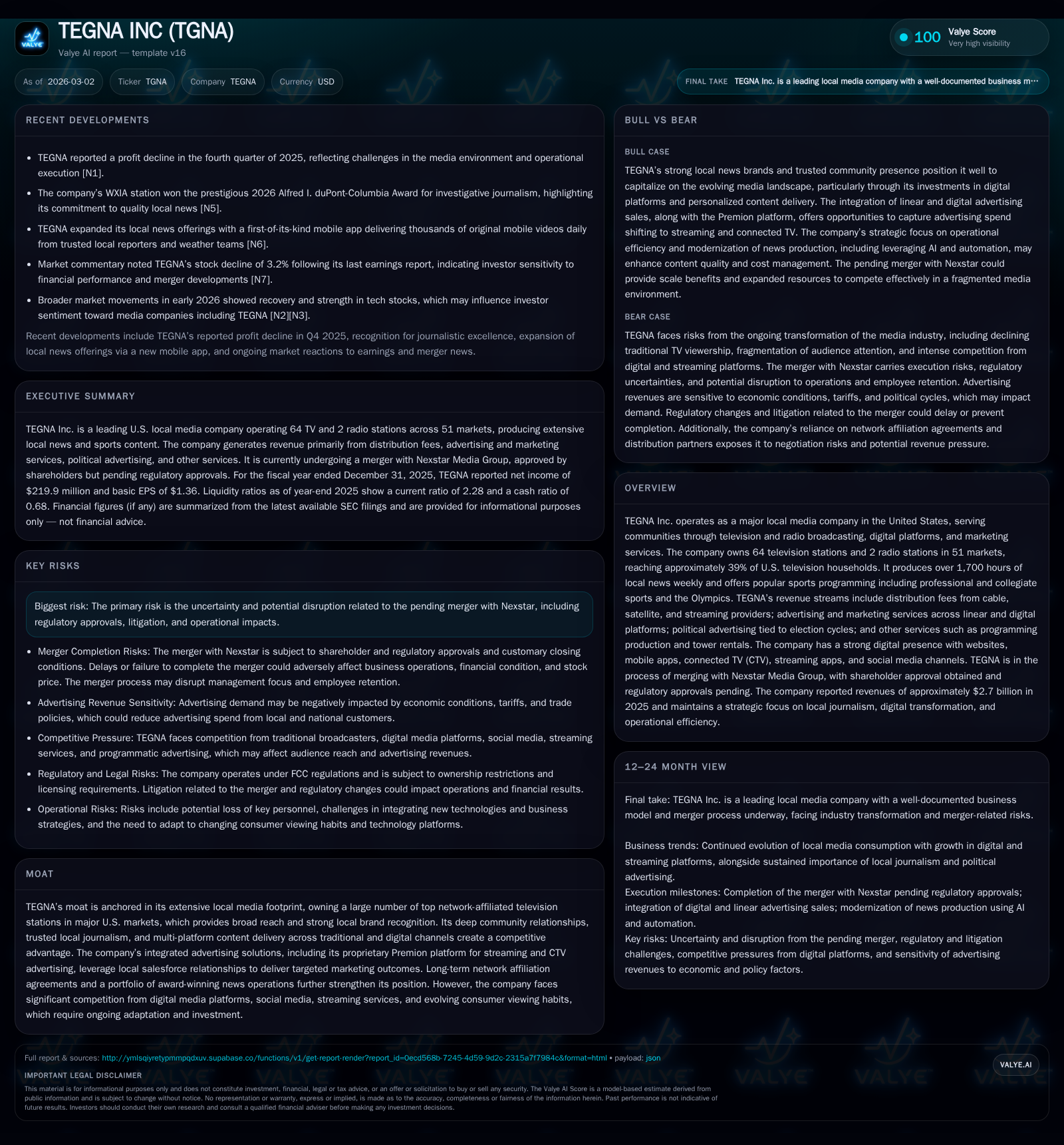
TEGNA Inc., a leading U.S. local media company with 64 TV stations and digital platforms, reported a sharp drop in revenue and profitability in 2025 driven by secular industry challenges and competitive pressures. Its extensive local news production and the Premion platform provide differentiation, but ongoing fragmentation of audiences and advertising dollars across digital channels constrains growth. The firm’s future hinges on completing a merger with Nexstar Media Group, which remains subject to regulatory approvals and litigation risks. Capital return has been consistent but scaled back, reflecting cautious management amid industry headwinds and deal-related uncertainty.
Company Overview and Market Position
TEGNA Inc. stands as one of the largest independent operators of local television stations in the United States. With ownership of 64 TV stations plus two radio outlets spanning 51 markets, it commands reach over approximately 39% of U.S. television households — an impressive scale established through decades of cultivating trusted local brands.[S1][S5] The company distinguishes itself through its robust commitment to local journalism: producing over 1,700 hours per week of news content, covering professional sports including the Olympics and collegiate events via long-term network affiliations with 'Big Four' networks NBC, CBS, ABC, and FOX.[S12]
Beyond broadcast television, TEGNA has sought to expand its digital footprint with websites, mobile apps, connected TV (CTV) streaming applications, FAST channels, and a proprietary streaming advertising platform called Premion launched in late 2016 targeting CTV ad placements across all linear TV markets nationally.[S12] This multi-platform presence aims to meet evolving consumer content consumption habits while providing advertisers with integrated solutions.
Historical Financial Performance
The financial trajectory over recent years captures a pronounced downward trend reflecting structural industry shifts away from linear broadcast towards fragmented digital consumption patterns alongside intensified competitive pressures.
Historical performance (annual)
| FY | Net ($mm) | CFO ($mm) | OpInc ($mm) | Capex ($mm) | Net YoY |
|---|---|---|---|---|---|
| 2025 | 220 | 326 | 443 | 43 | -63.3% |
| 2024 | 600 | 685 | 785 | 52 | +25.8% |
| 2023 | 477 | 587 | 734 | 55 | -24.4% |
| 2022 | 630 | 812 | 991 | 51 |
Source: SEC companyfacts cache [F1].
Capital returns and efficiency (annual)
| FY | Div ($mm) | Buybacks ($mm) | FCF ($mm) |
|---|---|---|---|
| 2025 | 80 | 0 | 283 |
| 2024 | 81 | 275 | 633 |
| 2023 | 84 | 653 | 533 |
| 2022 | 85 | 761 |
Source: SEC companyfacts cache [F1].
¹ Revenue figure only available for this year; other metrics not disclosed. ² Fiscal years for which complete financials are documented.
Revenues show a stark contraction when comparing the available data from FY2017 to FY2025 despite the same recorded top-line figure for these two years likely reflecting changes in operational scope or reporting basis.[F1] Notably operating income decreased by more than 40% between FY2024 (roughly $785 million) and FY2025 ($443 million), while net income plummeted over 60%. These declines signify substantial margin compression linked to disrupted advertising demand, increased programming costs/ecosystem complexity and efficiency challenges.[F1]
Operating cash flows similarly dropped by over half from their peak levels in earlier years but remained positive at ~$326 million in FY2025 after moderate capex reductions suggest capital discipline amidst cost pressures.[F1]
Business Model and Revenue Streams
TEGNA's revenues primarily derive from four key sources: distribution fees from multichannel video programming distributors (MVPDs), advertising & marketing services (AMS) revenues covering traditional spot ads plus digital offerings including Premion CTV ads, political advertising particularly during even-year elections where significant campaign spend boosts revenues temporarily, and other ancillary services such as programming production and tower rentals.[S6][S15]
Distribution revenue stems from retransmission agreements providing TEGNA's content carriage on cable/satellite/streaming packages with fees linked to subscriber counts.[S6] Despite the stable core revenue stream that this model can provide compared to solely ad-dependent businesses, TEGNA acknowledges ongoing regulatory uncertainty around retransmission consent rules that could impact this foundation.[S25]
Advertising sales benefit from TEGNA’s strong community ties enabling it to sell localized marketing solutions across TV and digital platforms blending data-driven targeted campaigns through Premion alongside traditional commercial spots.[S5][S12] This integrated approach aims to defend against budget shifts favoring national or pure-play digital competitors.
Political ad revenue represents a significant though cyclical component anchored by extensive reach into key races across presidential down to state/local election contests every two years.[S15] While reliable when active during cycles like in recent even-numbered years (e.g., election-driven double-digit millions), it inherently fluctuates.
Competitive Dynamics
The media landscape presents acute challenges as TEGNA confronts audience fragmentation from burgeoning alternative platforms including social media giants (Facebook/X/Instagram/TikTok), streaming services (YouTube/Netflix/Hulu), search engines (Google/Bing), programmatic ad platforms aggregating inventory across digital channels, FAST distributors competing for attention through free ad-supported content,[S8] and direct network-owned streaming properties limiting affiliates’ negotiating leverage.[S25]
In particular, linear TV viewership erosion among younger demographics threatens core local station ratings. Advertisers increasingly allocate budgets towards platforms offering greater targeting accuracy or engagement metrics while distributor consolidation further complicates retransmission negotiations threatening revenue stability.[S8]
TEGNA maintains competitive advantages via its trusted local journalism brands consistently recognized by prestigious journalism awards—awarding credibility vital for retaining audiences who view local news as more objective amid widespread distrust of mainstream media.[N6][S17] Moreover, its proprietary Premion technology offers an early-mover benefit tapping into local CTV ad demand unserved by most competitors. However, regulatory constraints limit direct carriage negotiations for network-affiliated stations with virtual MVPDs leaving some price-setting power out of TEGNA’s hands.[S25]
Strategic Outlook & Future Growth Prospects
Management has articulated a multi-faceted transformation strategy focused on:
- Deepening commitment to sustainable local journalism supported by community engagement on platforms best suited for user preferences.
- Talent development fostering a culture of high accountability poised to drive operational excellence.
- Maximizing value derived from existing linear TV operations while adapting business models recognizing evolving consumer behaviors.
- Reimagining news production through AI-assisted automation combined with centralized resource sharing to expand coverage efficiently.
- Integrating sales capabilities across linear/digital streams providing holistic advertiser solutions bolstered by data analytics.
- Delivering personalized viewer experiences shifting towards one-to-one audience engagement leveraging user interaction data.
- Eliminating wasteful spend ensuring investments yield measurable audience growth or margin improvements.[S4][S17]
While these initiatives signal proactive adjustment aligning with industry trends like AI deployment in newsrooms or seamless omni-channel ad sales integration, actual growth may be capped by continued stark competition from well-funded tech platforms siphoning attention/spend away from traditional broadcasters. Political ad strength will remain volatile depending heavily on election cycle timing as well.
Merger Considerations
A material near-term catalyst lies in TEGNA’s pending merger agreement executed August 18th, 2025 with Nexstar Media Group slated to make TEGNA a wholly owned Nexstar subsidiary following regulatory review processes involving the FCC and DOJ antitrust divisions.[S1][S2][S16]
Multiple closing conditions introduce significant timing uncertainty including approval by shareholders and absence of legal injunctions. Shareholder litigation challenging proxy disclosures adds further risk potentially delaying or obstructing deal closure.[S24][S26][N2]
Failure to consummate the merger could adversely impact market confidence causing negative equity re-pricing along with opportunity cost constraints imposed by deal-related covenants limiting alternative strategic initiatives or financing avenues. Management acknowledges these risks candidly highlighting impacts on ongoing operations if prolonged protracted negotiations arise or deal fallout occurs.[S16][S26]
Capital Allocation & Returns Profile
TEGNA maintains steady dividends paid around $80 million annually despite reduced earnings levels consistent with preserving shareholder distributions amid uncertain cash flow trends.[F1]
Share repurchase activity halted completely during FY2025 reflecting prudence given merger uncertainties versus prior years’ opportunistic buybacks totaling hundreds of millions raised during better earnings periods.[F1]
Reported return on equity stands at roughly 7%, illustrating subdued profitability relative to invested capital after recent earnings erosion but still generating positive returns above cost thresholds common in broadcast sectors struggling under secular shifts.[F1]
Free cash flow approximated $283 million in FY2025 after deducting lower capital expenditures confirming availability of discretionary resources albeit compressed markedly versus prior performance highs.[F1]
Risks Summary
Principal risks center on:
- The unresolved completion timeline for the Nexstar merger encompassing regulatory hurdles (FCC licensing rules), DOJ antitrust clearance intricacies plus ongoing shareholder litigation potentially delaying closing or raising transaction costs significantly.[S9][S16][S24]
- Structural decline in linear broadcast audiences exacerbated by accelerating competition from multi-screen digital providers shifting consumer habits away impacting advertising spend allocation unfavorably toward digitally native competitors.[S8][N2]
- Potential regulatory changes affecting retransmission fee rights or broadcast licensing framework adding unpredictability to revenue streams crucial for funding operations.[S25]
- Cost pressures from labor relations including exposure to union strikes impacting programming supply chains or costs amid collective bargaining renewals requiring careful navigation.[S20]
- Risks related to adoption and ethical use of generative AI technologies under evaluation internally presenting reputational/legal concerns that could affect brand trust if mismanaged.[S19]
- Macroeconomic factors influencing advertiser budgets such as tariffs or geopolitical tensions potentially reducing regional/national advertising spend adversely impacting revenues especially AMS segments reliant on small/mid-size businesses affected by trade policies.[S23]
- Extreme weather events disrupting broadcast infrastructure operations ranging from transmission towers to data centers emphasizing vulnerability within physical assets critical for uninterrupted service delivery.[S13]
Conclusion & Watch Points
TEGNA preserves entrenched leadership within highly localized media markets through credible journalism output combined with multi-platform distribution capabilities extending well beyond traditional broadcast signals into fast growing streaming formats. However, substantial financial strain evidenced by sharply reduced revenues/profits reflects formidable headwinds faced transitioning legacy broadcasting models amid heightened marketplace fragmentation.
More immediate prospects are intertwined tightly with successful closure of the Nexstar merger expected potentially by H2/2026 but vulnerable to delays stemming from litigations/regulatory reviews raising notable execution risk exposures.
Key developments warranting monitoring include:
- Merger progress updates regarding regulatory approvals or emerging litigation outcomes impacting timing/finality.
- Advertising revenue trends post-election cycles assessing recovery/stability given macroeconomic climate uncertainties.
- Digital subscriber/viewership growth metrics particularly Premion expansion success countering linear declines.
- Updates on AI integration into news operations reflecting adaptation pace vs technology risks.
- Capital allocation shifts post-merger completion revealing strategic priorities under new ownership structure.
Overall TEGNA exemplifies a traditional broadcaster aggressively adapting for relevance but navigating complex tradeoffs between sustaining legacy assets while investing strategically in nascent digital opportunities under overarching transaction uncertainties that will shape its medium-term trajectory.
This analysis is provided exclusively for informational purposes without any express or implied investment recommendation.
Disclaimer: This is research-only, informational analysis and not investment advice. It may include AI-generated interpretation and general industry context. Always verify important details using primary sources.

Comments