
How Target’s Fulfillment and Media Services Drive Competitive Strength
Target's latest quarter highlights the continued integration of its store network as fulfillment hubs and growth in advertising revenue, reinforcing its competitive moat in discount retail.
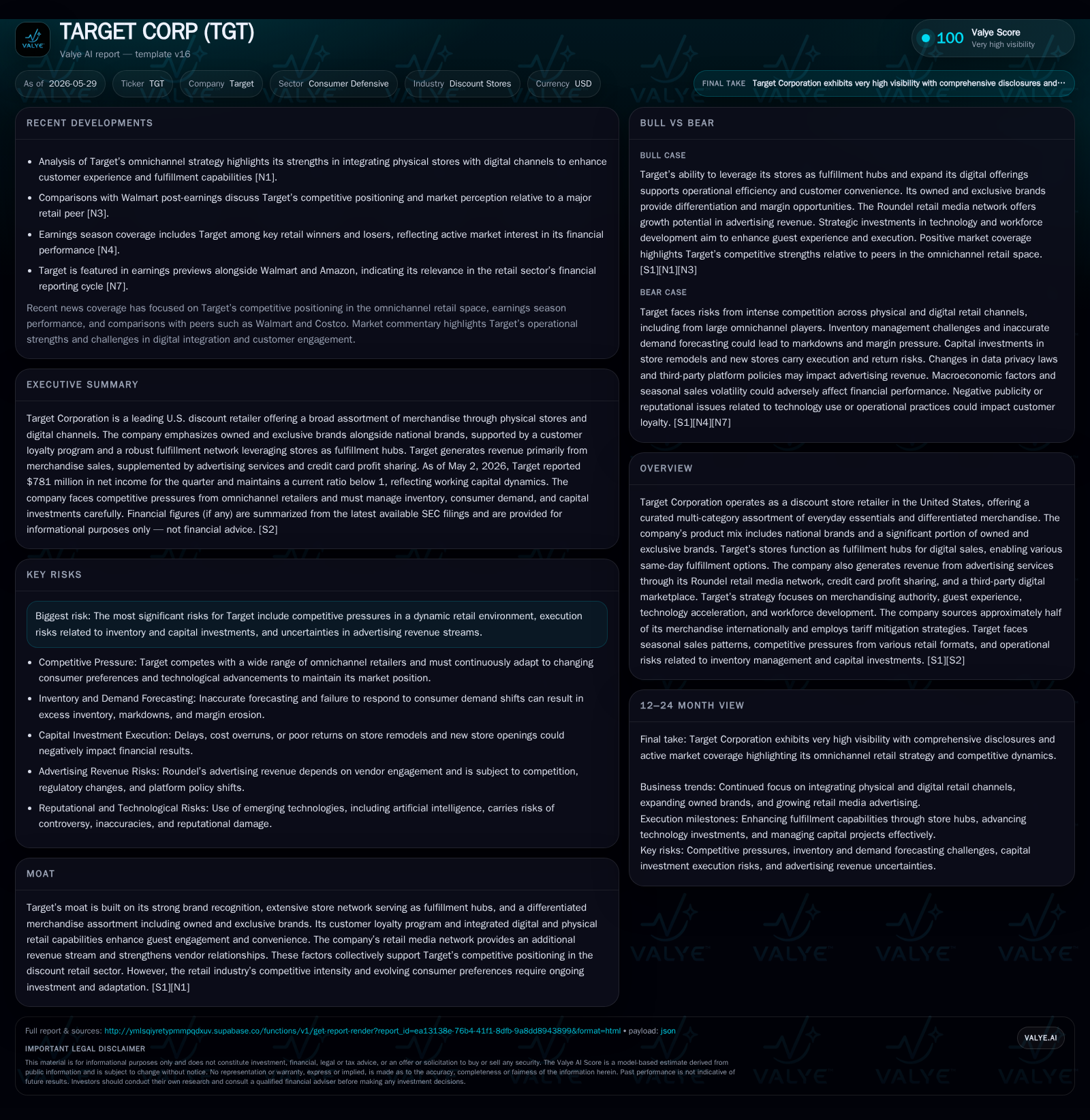
Target Corporation’s Q1 2026 results reaffirm the resilience of its omnichannel strategy, leveraging stores as digital fulfillment centers and expanding its retail media business through Roundel. The company blends national brands with exclusive products to deepen customer loyalty and margin leverage. Competitive pressures in discount retail persist, but Target’s focused investment in technology-enabled fulfillment and advertising partnerships underpin structural growth opportunities.
Q1 2026 Operating Update: Key Developments and Performance Snapshot
Target's May 2026 quarterly filing consolidates the narrative of its omnichannel strength. The company reports sustained momentum in integrating physical stores as fulfillment hubs supporting over 97% of merchandise sales fulfillment [S2]. This approach enables multiple same-day delivery options that cater to evolving consumer preferences for speed and convenience. Although rising supply chain costs pose headwinds, Target is mitigating these through operational efficiencies and tariff management [S3]. Meanwhile, the Roundel retail media network continues to experience expansion with advertising services growing revenue streams tied to vendor ecosystem engagement [S2][S3]. These elements materially reinforce Target’s competitive position as it navigates an increasingly digital-first shopping environment.
Target’s Business Model: Multi-Category Merchandising and Revenue Streams
Competitive Positioning: Differentiated Brands and Omnichannel Fulfillment
Target’s moat stems from three pillars: brand equity fostered by proprietary labels, an expansive yet strategically leveraged store footprint functioning as omnichannel fulfillment centers, and an integrated guest experience linking physical and digital touchpoints [S1][N9]. Unlike pure discounters or warehouse clubs like Walmart or Costco that compete on scale alone, Target leverages design-driven exclusives to provide style differentiation at value prices. Its stores enable rapid same-day order fulfillment including in-store pickup and drive-up options—capabilities that require sophisticated inventory visibility systems but afford better pricing power despite discount segment pricing pressure [N2][N9]. Customer loyalty is deepened via the Target Circle program delivering personalized offers across channels. The Roundel media platform strengthens vendor ties by monetizing shelf space digitally while leveraging data-driven marketing.
Industry Structure: Retail Environment, Competitors, and Emerging Trends
Within the U.S. discount retail sector, competition is intense from legacy rivals Walmart (broadest assortment/scale) and Costco (high-value membership model), alongside e-commerce platforms exerting disproportionate influence on shopper behavior [N3]. Increasing adoption of digital shopping combined with demand for flexible fulfillment models shifts industry economics toward margin compression capitalized by technologically adept players. Supply chains remain complex with international sourcing exposure calling for agile tariff management given ongoing geopolitical trade uncertainties [S1]. Seasonal sales cycles concentrate earnings in Q4 holiday periods but back-to-school seasons also drive spikes. The shift toward experiential shopping pushes retailers like Target to invest both physically (store remodels) and digitally (apps/persona-based offerings) [S1][S26].
Growth Drivers: Digital Expansion, Retail Media Network, and Sourcing Strategies
Target’s scalable growth vectors include expanding marketplace assortments under Target Plus that bring third-party sellers onto its digital platform with lower capital outlay relative to owned inventory [S1]. Roundel acts as a significant ancillary driver by increasing advertising revenue tied to a diverse vendor base actively engaged on the platform; advertiser retention hinges on sustained consumer traffic on Target digital properties [S1][N7]. Continued penetration of same-day delivery options enabled by the store network reduces fulfillment costs while enhancing overall basket sizes through convenience. Strategic sourcing flexibility mitigates inflationary/ trade tariff pressures by diversifying supply origins and negotiating vendor terms aggressively [S25][N7]. Technology investments accelerating personalized marketing capabilities also foster higher conversion rates.
Risks and Constraints: Competitive Pressures and Execution Challenges
The evolving discount retail landscape imposes notable risks. Intense price competition limits pricing power given widespread consumer access to price comparison tools—this constrains margin improvement despite a differentiated offer [S1][S13]. Operational complexity rises as fulfilling multiple delivery models strains inventory accuracy and increases supply chain costs; missteps here can inflate markdowns or cannibalize profitable sales channels. Capital investments required for store remodels, logistics automation, and tech platforms carry execution risk amid uncertain returns if consumer adoption falters or competitors match innovations quickly [S1][S2]. Roundel's advertising revenues face market volatility risks amplified by regulatory changes affecting data privacy or advertiser budgets shifting unpredictably [S1][S28]. Social controversies around product assortment or corporate initiatives also expose reputational risk potentially impacting guest loyalty [S13].
What Investors Should Watch Next: Guidance, Milestones, and Market Signals
Upcoming Q2 results will be critical to evaluate how recent fulfillment innovations translate into cost efficiencies or sales lift amid continued macroeconomic pressures [S2][S3]. Monitoring the trajectory of Roundel’s ad revenue growth against increased competition will signal digital platform engagement strength. Peer moves—especially Walmart’s omnichannel push—and shifts in promotional cadence may reveal comparative momentum or vulnerability [N6][N9]. Execution progress on store remodels alongside expansion of paid loyalty tiers within Target Circle could serve as leading indicators of deeper guest engagement. Any updates on tariff impacts or sourcing adjustments would further contextualize margin outlooks.
Financial Profile: Balance Sheet Strength and Recent Earnings Insights
Target’s balance sheet as of early May 2026 shows total debt near $14.3 billion against cash levels modestly above $2.6 billion ([F1]), yielding a current ratio below parity at approximately 0.93—indicating tight short-term liquidity positioning but manageable leverage given scale ([F1]). Operating income recorded was $5.12 billion with net income around $3.71 billion for fiscal year ending January 2026 ([F1]). While profitability remains robust due to effective mix management favoring higher-margin exclusives alongside operational efficiencies, cash flow generation will require continued focus given elevated capital spend commitments on technology infrastructure plus remodeling initiatives reported in prior filings [S1][S2]. Debt maturity profile appears adequately staggered with no immediate refinancing pressures disclosed.
This analysis synthesizes publicly available information without research view or investment advice. Readers should consider official filings directly for detailed metrics or consult professional advisors for financial decisions.
Disclaimer: This is research-only, informational analysis and not investment advice. It may include AI-generated interpretation and general industry context. Always verify important details using primary sources.

Comments