
Instil Bio’s Strategic Refocus Highlights Asset Impairments and Pipeline Challenges
Instil Bio’s latest quarterly filing reveals significant asset impairments tied to its Tarzana facility and the strategic discontinuation of its lead bispecific antibody program.
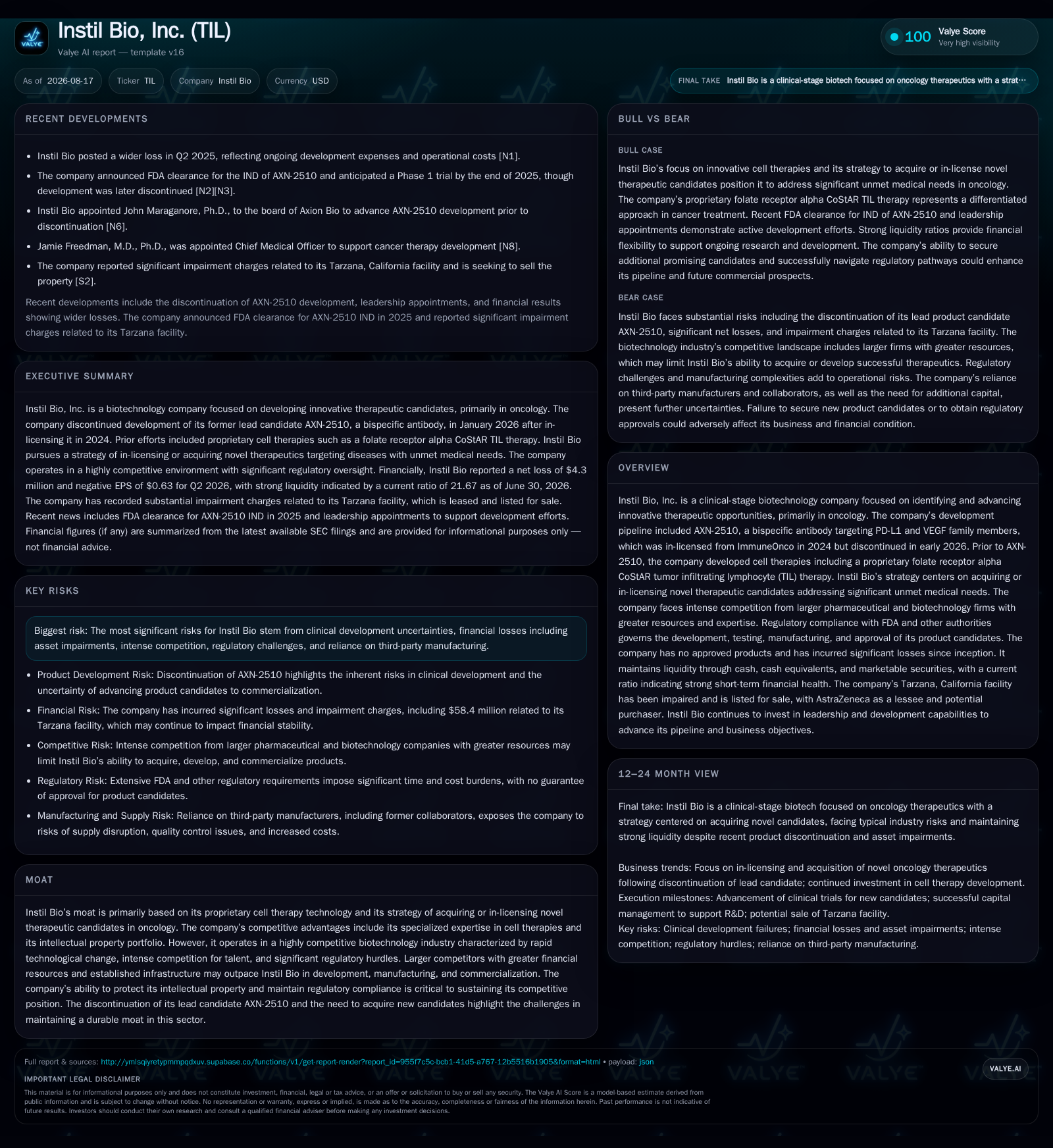
In its Q2 2026 update, Instil Bio disclosed ongoing financial strain from substantial impairment charges related to its Tarzana manufacturing facility, totaling $58.4 million to date, with further losses possible. The company also formally discontinued AXN-2510, its former lead bispecific antibody candidate, signaling a strategic pivot back toward cell therapy platforms centered on its proprietary folate receptor alpha CoStAR tumor infiltrating lymphocyte (TIL) technology. Operating within a highly competitive biotechnology environment, Instil Bio is seeking to in-license or acquire novel oncology assets while managing the risks posed by regulatory hurdles, reliance on third-party manufacturing, and intense peer competition.
Recent Operating Update and Strategic Shift
Instil Bio's most recent quarterly report for Q2 ended June 30, 2026 underscores a challenging near-term operating environment marked by significant asset impairments [S2]. The company recorded cumulative impairment charges totaling $58.4 million related to its Tarzana, California manufacturing facility as of the quarter’s end, including fresh impairments recognized in Q2 itself. This recurring loss signals persistent operational difficulties tied to the Tarzana site that may continue unless the facility is sold or repurposed successfully. However, management cautioned that proceeds from any future sale could fall short of secured debt linked to the asset, potentially triggering further financial setbacks
Alongside these capital-related challenges, Instil Bio formally discontinued AXN-2510—the lead bispecific antibody candidate licensed from ImmuneOnco in August 2024—which targeted programmed death-ligand 1 (PD-L1) and vascular endothelial growth factor (VEGF) pathways implicated in solid tumors [S1]. This program termination was announced in January 2026 alongside termination of the underlying license agreement. The abandonment of AXN-2510 represents a material retreat from a once-promising multi-target immuno-oncology asset and refocuses the company squarely on its proprietary cell therapy platforms typified by folate receptor alpha CoStAR tumor infiltrating lymphocyte (TIL) treatments
Business Model: Clinical-Stage Therapeutics with a Licensing-Focused Strategy
Instil Bio operates as a clinical-stage biotechnology developer concentrating primarily on oncology therapeutics derived from advanced biological technologies such as cell therapies and bispecific antibodies. Its revenue model is currently premised largely on early-stage licensing agreements, milestone payments associated with product development progress or collaborations, and ultimately royalties or sales revenue pending successful regulatory approval and commercialization.
The company’s internal proprietary platform centers on engineered tumor infiltrating lymphocytes (TILs) enhanced through co-stimulatory antigen receptors targeting folate receptor alpha—a strategy designed to potentiate anti-tumor immune responses in cancers that express this antigen. Historically active development efforts have focused on this pipeline as well as external acquisitions or in-licensing deals such as with ImmuneOnco’s AXN-2510.
This approach necessitates sustained investment in research and development (R&D), clinical trials progression through sequential phases (Phase 1 to Phase 3), regulatory submissions particularly US FDA filings, and expanding intellectual property portfolios securing exclusivity around core technologies. Concurrently, monetization remains distant given no marketed products yet exist; thus financial returns heavily depend on executing partnerships or successful clinical outcomes [S1].
Industry Structure and Competitive Positioning
Within the broader biotechnology oncology space—characterized by rapid technological evolution and intense capital requirements—Instil Bio occupies a challenging niche as a smaller clinical-stage firm reliant upon nimbleness in innovation but constrained by limited scale relative to competitors. Larger pharmaceutical companies along with established specialty biotech players possess deeper R&D budgets, extensive commercial infrastructure, sophisticated licensing networks, and integrated manufacturing capabilities that may speed product development cycles and market access.
Notably, peer companies such as Adaptimmune Therapeutics plc and Iovance Biotherapeutics share comparable focuses on TIL-based therapies but generally operate with larger pipelines or more progressed clinical-stage assets underpinned by broader capital backing. Similarly, biotechs like Amgen or Regeneron specializing in bispecific antibodies maintain substantial resources for simultaneous multi-candidate development programs.
Instil Bio’s reliance on third-party manufacturers—exemplified by the operational difficulties at Tarzana—is another competitive limitation when peers increasingly insource complex cell therapy production or develop robust contract manufacturing organization (CMO) partnerships [S1][S2]. Maintaining a strong intellectual property position around proprietary CoStAR TIL constructs also remains essential amid vigorous patenting activities industry-wide
Growth Drivers: Pipeline Advancement and Licensing Opportunities
Future growth for Instil Bio hinges upon successfully advancing its internal cell therapy candidates beyond early clinical phases into pivotal studies validating efficacy and safety profiles that satisfy regulatory bodies. Timely enrollment rates in clinical trials directly affect regulatory submission timelines—governmental approvals which would enable commercialization represent key inflection points for revenue generation.
Simultaneously pursuing strategic licensing or acquisition opportunities remains central to augmenting pipeline breadth. Targeted therapies addressing cancers with unmet medical needs align well with investor interest and market demand for innovative cancer immunotherapies.
Technological advances augmenting therapeutic potency or manufacturing efficiency could also enhance competitive differentiation if realized effectively. Partnerships extending capabilities across discovery platforms or trial networks would aid execution scalability [S1]
Risks and Operational Constraints
The predominant risks confronting Instil Bio relate to uncertain clinical trial outcomes that may delay or derail product approvals; these are compounded by rigorous FDA regulatory requirements demanding voluminous safety data collection over lengthy periods.
Financial stability is tested by the heavy cash burn typical of biotech firms yet exacerbated here due to recurring impairment losses sustained on real estate assets—a non-core expense reflecting inability to optimize fixed infrastructure utilization efficiently.
Manufacturing challenges pose additional impediments where quality control issues or production bottlenecks could postpone patient dosing schedules critical for trial data integrity.
Moreover, intense competition from better-funded peers jeopardizes both access to coveted acquisition targets/license deals and market share upon eventual product launches if rivals deliver superior efficacy or pricing terms sooner.
Intellectual property disputes could also undermine exclusivity protecting patented therapies thereby reducing valuation potential unless adequately defended.
Finally, evolving regulatory landscapes regarding data privacy protection—as reflected in comprehensive cybersecurity oversight responsibilities highlighted within governance disclosures—introduce operational overheads that must be handled prudently to avoid compliance sanctions disrupting business continuity [S1][S2].
What to Watch Next: Milestones Signaling Strategic Trajectory
Key upcoming indicators for monitoring Instil Bio’s execution progress include:
- Advancement status of current TIL therapy candidates measured by phase transition achievement within clinical trials.
- New licensing agreements executed adding promising oncology assets compatible with company focus areas.
- Resolution or divestment outcomes pertaining to Tarzana facility impairments impacting balance sheet liabilities.
- Regulatory submission filings that validate readiness for FDA review reflecting developmental maturity.
- Cash burn performance relative to liquidity reserves establishing runway for sustained operations amid ongoing R&D investments.
- Any partnerships enhancing manufacturing scale either internally or via CMOs influencing production reliability.
Tracking these milestones will provide clarity on whether Instil Bio can overcome recent setbacks and reposition itself competitively within the rapidly evolving oncology biotech industry landscape.
Financial Profile Discussion
As of June 30, 2026, Instil Bio maintained cash and cash equivalents totaling approximately $5.54 million against current liabilities near $3.31 million yielding an exceptionally strong current ratio of about 21.67—suggestive of robust short-term liquidity despite ongoing operational losses [F1]. This liquidity cushion is critical given continued negative operating income pressures common among clinical-stage biotech players without commercial products; end-of-year 2025 figures showed an operating loss around $78.6 million alongside net losses exceeding $71 million [F1].
However, persistent impairment charges linked specifically to the Tarzana plant introduce material non-cash expenses diminishing reported earnings markedly while hinting at deeper structural challenges requiring resolution either through asset sale or write-down completion [S2]
Given the absence of product revenues currently disclosed along with these structural costs borne alongside R&D expenditures funding pipeline progression efforts, it is clear cash flow management remains delicate though manageable based on available balance sheet resources at mid-year [F1][S2]. The company does not report significant debt burdens presently but continued funding needs imply dependence on equity raises or partnership milestone payments ahead.
This analysis is based exclusively on publicly filed SEC documents dated through August 13, 2026 ([S1], [S2], [S3]) supplemented by factual balance sheet data ([F1]). It does not constitute investment advice nor includes speculative forecasts.
Disclaimer: This is research-only, informational analysis and not investment advice. It may include AI-generated interpretation and general industry context. Always verify important details using primary sources.

Comments