
Tiptree Inc. Refocuses Amid Fortegra and Reliance Divestitures, Resetting Capital Allocation Strategy
The company advances divestment of key insurance subsidiaries while reinforcing its patient capital investment approach in credit and specialty financial sectors.
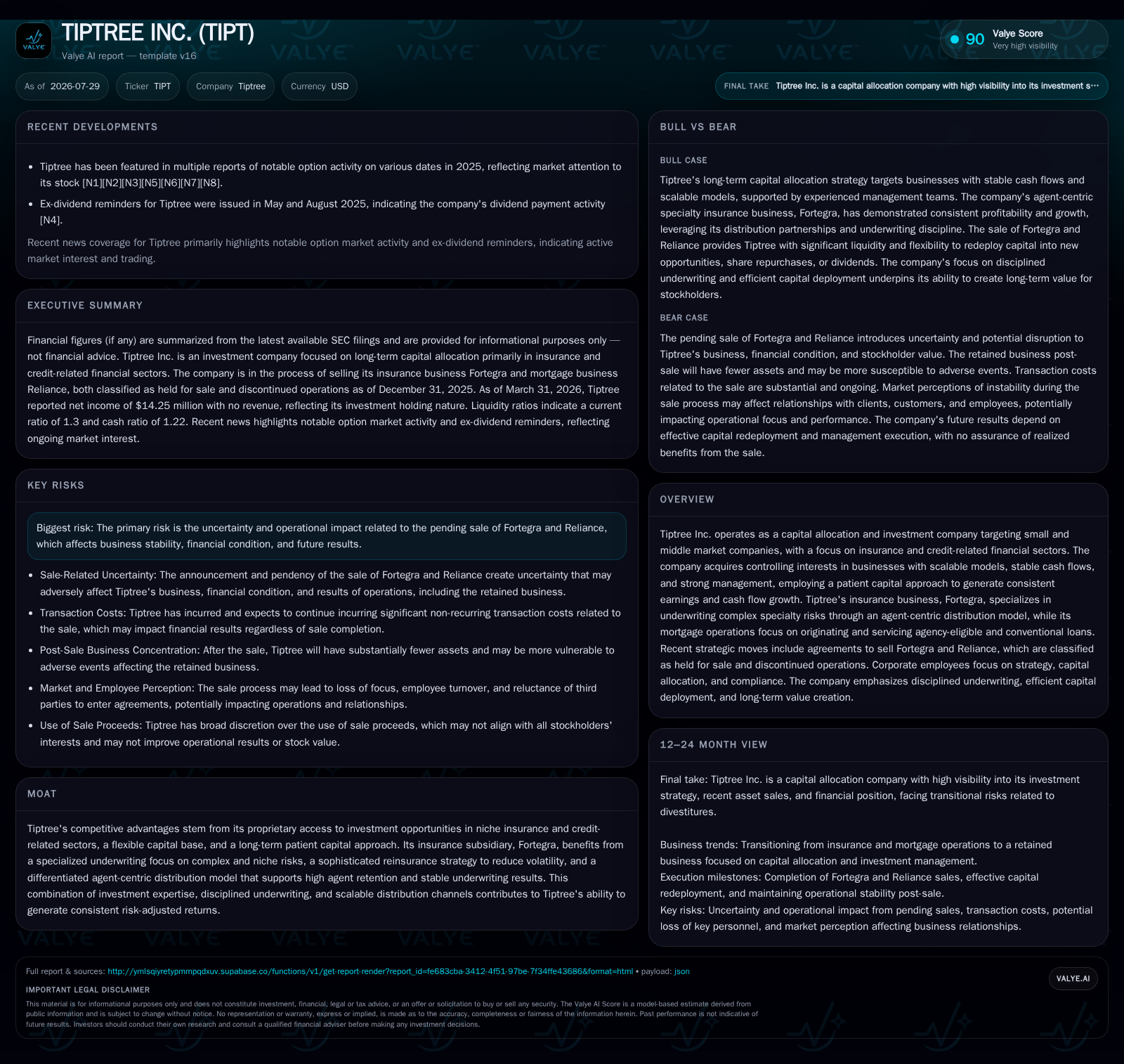
Tiptree Inc.’s latest quarter highlights a strategic pivot through agreements to sell its Fortegra insurance business and Reliance mortgage operations, now classified as discontinued operations. This reshapes Tiptree’s asset base toward its retained businesses focused on specialty credit sectors under a long-term, patient capital philosophy. The divestitures bring transaction-related risks and operational uncertainty but could also streamline capital allocation and sharpen operational focus. Going forward, underwriting discipline, capital deployment, and managing post-sale operational scale will be critical markers of execution.
Recent Operating Update: Strategic Dispositions Signal Portfolio Reset
Tiptree Inc.’s 2026 second-quarter 10-Q filing dated July 29, 2026, confirms that its two largest operating subsidiaries, Fortegra Insurance Group and Reliance Mortgage Services, are classified as held for sale and reported as discontinued operations [S2]. This marks a significant portfolio transformation, shifting Tiptree from a diversified holding company with substantial insurance underwriting and mortgage servicing platforms to a more focused entity concentrating on retained specialty credit businesses. Concurrently, Tiptree entered into a Stock Purchase Agreement to acquire Universal Shield Insurance Group, signaling ongoing capital redeployment within niche insurance sectors [S3].
This strategic pivot has immediate operational and financial implications. The divestitures reduce Tiptree’s asset base and workforce dramatically—from approximately 1,486 employees, mostly within discontinued operations, down to roughly 14 corporate staff focused on strategy, capital allocation, and compliance functions [S1]. The company faces material transaction-related risks, including significant costs associated with the sale process and potential leakage of sale proceeds, which could diminish net cash inflows [S1]. These factors introduce execution risk and operational uncertainty during the transition period.
Business Model: Patient Capital in Specialty Insurance and Credit Sectors
Tiptree operates as an investment holding company specializing in allocating patient capital to small- and middle-market companies primarily in specialty insurance and credit-related financial services [S1]. Its subsidiaries generate revenue through underwriting complex specialty insurance policies, mortgage loan origination fees, servicing income on agency-eligible loans, and investment income from its capital base.
Fortegra Insurance Group is a specialty insurer underwriting non-standard risks via an agent-centric distribution model designed to sustain high policy retention rates through tailored product offerings [S1]. The underwriting discipline at Fortegra emphasizes precise pricing, rigorous claims management, and robust reinsurance programs to mitigate loss volatility and catastrophe exposure—key drivers of underwriting profitability and combined ratio management in specialty insurance [S1]. These underwriting practices aim to maintain loss and expense ratios within targeted ranges, supporting stable underwriting income over market cycles.
Reliance Mortgage Services focuses on originating and servicing conventional mortgage loans eligible for agency securitization, generating revenue from origination fees tied to loan volume and servicing fees correlated with portfolio size [S1]. The mortgage servicing business benefits from scale economies and portfolio diversification, which help manage credit risk and operating leverage.
Tiptree’s capital allocation philosophy centers on patient capital deployment, targeting businesses with stable cash flows and scalable models that can grow earnings across economic cycles. The company balances current earnings generation with long-term capital appreciation by collaborating closely with management teams to unlock value, rather than pursuing short-term accounting gains [S1]. This approach aligns Tiptree with peers such as Markel Corporation and Alleghany Corporation, which emphasize underwriting discipline and long-term value creation.
Industry Context and Competitive Positioning
Within the specialty insurance sector, Fortegra operates in the excess & surplus (E&S) lines market, which typically experiences cyclical hardening phases that enhance pricing power and underwriting margins. Agent-centric distribution is a competitive advantage, fostering strong broker and agent relationships that support policy retention—a critical KPI influencing underwriting profitability and reserve adequacy.
Effective reinsurance arrangements are vital for managing reserve development risk and limiting exposure to catastrophic losses, thereby stabilizing the combined ratio and underwriting results. Expense ratio control through operational efficiency further differentiates specialty insurers competing in this niche.
In mortgage servicing, Reliance’s focus on agency-eligible conventional loans positions it to benefit from government-backed securitization programs, which reduce credit risk and support stable servicing fee income. Scale in loan origination and servicing portfolio size drives operating leverage and enhances profitability.
Tiptree’s competitive moat arises from its proprietary sourcing of investment opportunities in specialty insurance and credit sectors, combined with a capital allocation framework that supports long-term investment horizons and active portfolio management. While larger public peers like Arch Capital Group and Radian Group emphasize scale and product breadth, Tiptree prioritizes control stakes and strategic oversight to maintain underwriting discipline and operational focus [S1]. The current divestitures temporarily reduce operating scale but may enable sharper concentration on core competencies and capital efficiency.
Growth Drivers: Market Tailwinds Support Niches
Several sector-specific dynamics underpin growth opportunities for Tiptree’s retained businesses:
- Specialty insurance markets periodically harden due to increased loss activity or capacity constraints, enabling carriers like Fortegra to raise premiums without significant volume loss, thereby improving underwriting margins.
- The increasing complexity of insured risks favors insurers with specialized underwriting expertise and agent-centric distribution capable of delivering bespoke coverage solutions.
- Mortgage origination volumes benefit from refinancing cycles and favorable housing market fundamentals, supporting growth in servicing portfolios and fee income.
- Advances in underwriting analytics and technology facilitate improved risk selection and pricing accuracy, helping to maintain loss ratios below market averages.
- Strategic acquisitions, such as the Universal Shield Insurance Group deal, demonstrate Tiptree’s commitment to optimizing its portfolio toward high-return specialty niches [S3]
While market cycles introduce volatility, particularly in mortgage refinancing activity and insurance claims experience (including catastrophe losses), Tiptree’s focus on underwriting discipline and patient capital deployment aims to capture sustainable medium-term growth rather than episodic gains.
Risks and Watchpoints: Execution Complexity and Transactional Uncertainty
The primary risk centers on the completion and execution of the Fortegra and Reliance sale transactions. Transaction costs are expected to be substantial, and any leakage—unauthorized cash outflows prior to closing—could materially reduce net proceeds available for redeployment [S1]. Failure or delays in closing would extend operational uncertainty, potentially affecting employee retention, distributor relationships, and regulatory capital adequacy.
Operationally, the divestitures will reduce Tiptree’s scale dramatically, increasing fixed costs as a percentage of revenues at the corporate level and potentially impacting governance and compliance efficiency. The company’s reliance on third-party distribution channels exposes it to channel risk, particularly if intermediary relationships shift post-sale.
Investment portfolio volatility driven by interest rate fluctuations and equity market movements remains a persistent risk, influencing float yield and net investment income—key contributors to overall profitability in insurance holding companies.
Regulatory constraints related to Tiptree’s Investment Company Act exemption impose limits on business activities and asset acquisitions, which must be carefully managed during the transition to maintain compliance and operational flexibility [S1].
What To Watch Next
Key near-term milestones include the timing and successful closing of the Fortegra and Reliance sales. Monitoring net proceeds after transaction expenses and leakage will clarify liquidity replenishment and capital availability for reinvestment or shareholder returns.
Subsequent quarterly filings will provide insight into the operating performance of the retained businesses, free from discontinued operations’ effects, enabling clearer assessment of underwriting profitability, combined ratio trends, and investment income.
The integration progress of the Universal Shield acquisition will be a critical indicator of management’s ability to execute selective capital redeployment within core sectors [S3]. Additionally, commentary on corporate expense rationalization will reveal how Tiptree manages scale normalization post-divestiture.
External factors such as changes in loss frequency and severity affecting combined ratios, mortgage market activity influencing loan origination volumes, and reinsurance cost dynamics will serve as important barometers for sustaining competitive advantage.
Financial Profile Discussion
Following the divestitures, Tiptree’s total assets and liabilities are expected to decline, potentially reducing leverage and improving capital efficiency. Monitoring returns on equity and underwriting income in the post-sale period will be critical to assessing the company’s financial health and capital allocation effectiveness.
Note: This analysis is based solely on publicly available SEC filings dated through July 29, 2026. It does not constitute investment advice or research views. Readers are encouraged to consider multiple information sources when evaluating Tiptree Inc.'s prospects.
Disclaimer: This is research-only, informational analysis and not investment advice. It may include AI-generated interpretation and general industry context. Always verify important details using primary sources.

Comments