
T-Mobile US: Sustaining Growth Through 'Un-carrier' Innovation and Network Excellence in a Crowded Telecom Landscape
T-Mobile's blend of customer-focused disruption and multi-layered 5G network leadership underpins its competitive position amid intensifying industry pressures.
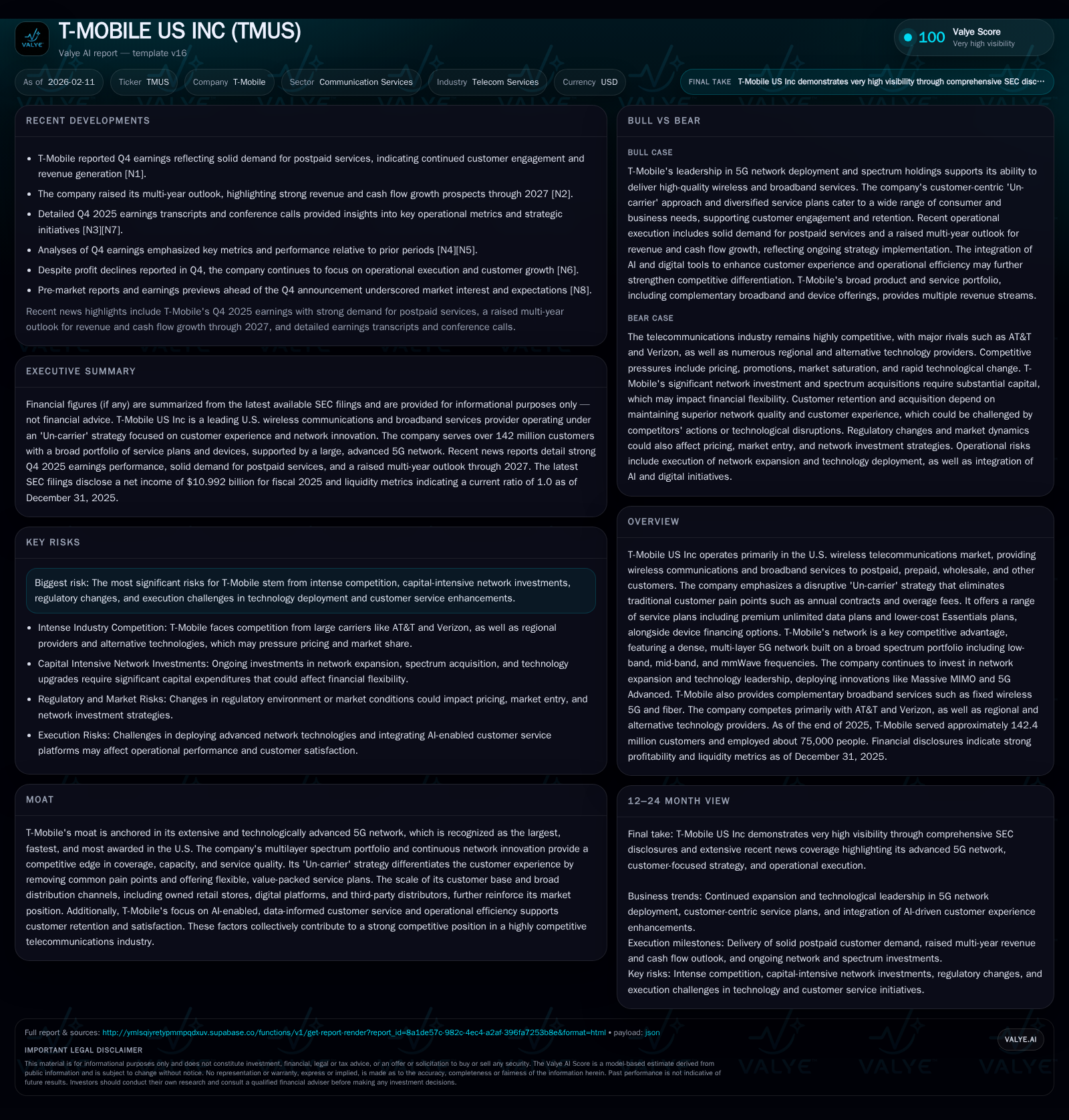
T-Mobile US continues to defy mature telecom market constraints by leveraging its pioneering 'Un-carrier' strategy and robust multi-spectrum 5G network. The company's recent strong earnings and raised guidance exemplify operational resilience fueled by investments in network expansion, technology innovation like 5G Advanced, and digital transformation centered on AI-driven customer experience. However, capital intensity, competition from entrenched operators and new entrants, plus evolving cybersecurity and regulatory risks pose ongoing challenges. T-Mobile’s strategic expansion into fixed wireless broadband complemented by select fiber partnerships highlights its efforts to diversify revenue streams while maintaining market-leading network performance.
The 'Un-carrier' Effect: Redefining Customer Experience
T-Mobile has long distinguished itself through its disruptive 'Un-carrier' model, which aims squarely at eliminating entrenched industry pain points such as annual contracts, overage fees, data buckets, and unpredictable roaming charges [S1]. This philosophy resonates deeply with consumers frustrated by opaque pricing and inflexible commitments typical of legacy telecom providers. The impact is evident in sustained strong demand for T-Mobile’s postpaid services—as highlighted by the recent Q4 earnings beat where postpaid subscriber growth outpaced expectations [N1].
The company’s relentless focus on value-packed plan offerings—ranging from premium unlimited data packages to competitively priced Essentials plans—and device financing options further democratizes access while driving customer retention. Moreover, T-Mobile's award-winning customer service underpins operational efficiencies that stabilize churn in an industry grappling with saturation [S1]. Its digital self-service innovations, specifically upgrades to the T-Life app ecosystem allowing customers seamless control over transactions including add-a-line or switching plans anytime, enhance satisfaction while reducing service costs [S1].
This continuous iteration of the 'Un-carrier' model forms a virtuous cycle: better experiences fuel subscriber additions and loyalty which justify further investments in network quality—a key promise of the brand.
Network Leadership: The Backbone of Competitive Advantage
Central to T-Mobile's moat is its claim to operate America’s largest, fastest, and most awarded 5G network. The foundation rests on a meticulous multi-layer spectrum strategy comprising low-band frequencies for broad coverage, mid-band bands balancing capacity and reach, and mmWave for ultra-high capacity in dense urban areas [S1][F1]. This spectrum diversity enables flexible optimization tailored to geography and user density.
Advanced technological deployments like Massive Multiple Input Multiple Output (Massive MIMO) antennas have significantly boosted throughput and spectral efficiency across its network layers [S1]. As per the latest disclosures, T-Mobile serves approximately 142 million customers leveraging this burgeoning footprint [S1].
The depth of this spectrum portfolio translates directly into sustained revenue stability by enhancing network experience—a compelling differentiator among a congested competitive field—fostering stickiness given customers’ unwillingness to compromise on connectivity quality.
Decoding T-Mobile's Financial Performance and Outlook
The Q4 2025 earnings release delivered multiple positive surprises. Revenues surpassed analyst estimates driven primarily by solid postpaid additions [N1][N5], reflecting the efficacy of both the 'Un-carrier' strategy and network investments attracting higher-value subscribers.
Notably, the company simultaneously raised its multi-year guidance for revenue growth and operating cash flow through fiscal year 2027 [N2], signaling confidence in its strategic trajectory despite ongoing industry headwinds.
Financial statements reveal net income of approximately $11 billion for the fiscal year ending December 31, 2025 [F1], supported by disciplined cost controls balancing aggressive capital expenditure programs. Liquidity remains robust with cash & equivalents north of $5.5 billion, though current assets slightly trail current liabilities yielding a current ratio hovering at unity—indicative of tight but adequate working capital management within substantial investment cycles [F1][S2].
Innovation in Technology Deployment: 5G Advanced and Beyond
T-Mobile maintains a forward-leaning posture in technology adoption. After pioneering initial nationwide 5G rollouts using layered spectrum assets including mmWave hotspots for cutting-edge capacity zones, it is now actively launching next-generation enhancements branded as '5G Advanced' [S1].
These innovations encompass software-defined radio improvements enabling dynamic resource allocation along with AI-powered network management tools accelerating fault detection and service quality adjustments. Massive MIMO advances continue rolling out widely enhancing spectral efficiency.
While incremental CAPEX remains capital-intensive—a noted risk factor—the payoff lies in maintaining leadership status that locks in a virtuous cycle of subscriber growth backed by superior experience.
Navigating Industry Competition and Market Saturation
The U.S telecom sector approaches near saturation across key segments including prepaid/postpaid consumer markets as well as enterprise/government accounts [S1]. Competitive dynamics remain intense with AT&T and Verizon heavily investing in their own spectrum assets, networks upgrades, promotional device offers, and bundled service models.
Moreover, non-traditional competitors alter battleground contours — prominent cable operators Comcast, Charter among others have entered wireless markets via Mobile Virtual Network Operator (MVNO) agreements adding pressure on pricing power especially at lower tiers [S1]. Satellite-based internet providers represent a potential wildcard adopting alternative connectivity technologies challenging coverage assumptions.
As conventional growth avenues narrow, all players contend with margin compression risks forcing innovation not just in product features but also operational efficiency.
Strategic Broadband Expansion: Fixed Wireless Meets Fiber
Recognizing shifting consumer demand toward integrated broadband solutions beyond mobile telephony alone, T-Mobile has expanded into fixed wireless broadband leveraging its dense 5G base stations enabling high-speed residential internet service particularly where deploying fiber is less economical or timely [S1]. This natural complement increases average revenue per user (ARPU) without cannibalizing mobile offerings.
Simultaneously, T-Mobile’s joint ventures targeting fiber wireline buildouts signal ambition to create hybrid networks combining fixed wireless reach with fiber reliability/scale giving it competitive parity versus incumbent ISPs focused exclusively on wired infrastructure [S1]. These partnerships carry integration risks but also long-term strategic value as converged services grow increasingly requisite against cable incumbents offering bundled TV/internet/mobile packages.
Risks on the Horizon: Capital Intensity, Cybersecurity, and Regulatory Pressures
The most tangible headwinds manifest through massive capital expenditure needs dictated by spectrum purchases/upgrades alongside densification necessary for maintaining service quality amid rising data traffic demands—areas vulnerable to cost overruns or deployment delays [S1].
Cybersecurity threats escalate given T-Mobile’s critical infrastructure status combined with growing attack sophistication from nation-state actors to financially motivated cybercriminals jeopardizing sensitive customer data or operational continuity; persistent mitigation efforts raise operational costs meanwhile raising reputational stakes if breached [S1].
Regulatory uncertainties loom large; evolving government policies around spectrum allocation rules, privacy mandates affecting customer data usage analytics deployed throughout its AI-enhanced systems could constrain some strategic initiatives or necessitate costly compliance adaptations.
Customer-Centric Digital Transformation via AI & Data Analytics
T-Mobile’s embrace of AI-driven digital-first operations marks significant evolution beyond traditional contact centers toward predictive service delivery platforms aiming at anticipating issues before customers notice them—a breakthrough enabled by comprehensive customer data analysis refined through machine learning algorithms [S1].
The T-Life app epitomizes this shift offering a unified channel for account management capable of authorized autonomous actions exemplifying seamless usability reflective of modern consumer expectations heightened by fintech/app ecosystems. Complementarily physical retail stores evolve into experiential hubs showcasing product innovations while supporting cross-generational user preferences.
Collectively these initiatives foster stronger engagement metrics translating indirectly into retention gains vital in saturated markets where acquisition costs rise exponentially.
Capital Structure and Liquidity: Preparing for Growth Headwinds
Despite hefty capital deployment resulting from accelerated network buildout cycles required to maintain a competitive moat in 5G technology leadership positions, T-Mobile reports a substantial cash balance approaching $5.6 billion as of end-2025 [F1]. This liquidity cushion enables ongoing infrastructure investments without immediate refinancing distress.
The company operates with current assets roughly matching current liabilities resulting in a current ratio near unity—indicative of prudent working capital management amid operating scale challenges [F1][S2]. Long-dated senior notes maturing across several tranches until the late 2030s support manageable debt profile allowing flexibility should macroeconomic shifts tighten financing conditions.
Maintaining this balance while pursuing simultaneous expansion initiatives will be critical as competition accelerates requiring both offensive technology spending alongside defensive customer acquisition expense management.
Disclaimer: This analysis is provided for informational purposes only based on publicly available sources without any recommendation regarding securities transactions. It integrates SEC filings and recent market data up to February 2026 without forecasting or investment advice. Readers should conduct their own due diligence before making financial decisions.
Disclaimer: This is research-only, informational analysis and not investment advice. It may include AI-generated interpretation and general industry context. Always verify important details using primary sources.

Comments