
Transcat Inc Expands Calibration Services Through Acquisitions While Managing Competitive Pressures
Recent acquisitions and operational excellence initiatives drive Transcat’s growth in regulated industries amid intensifying distribution competition.
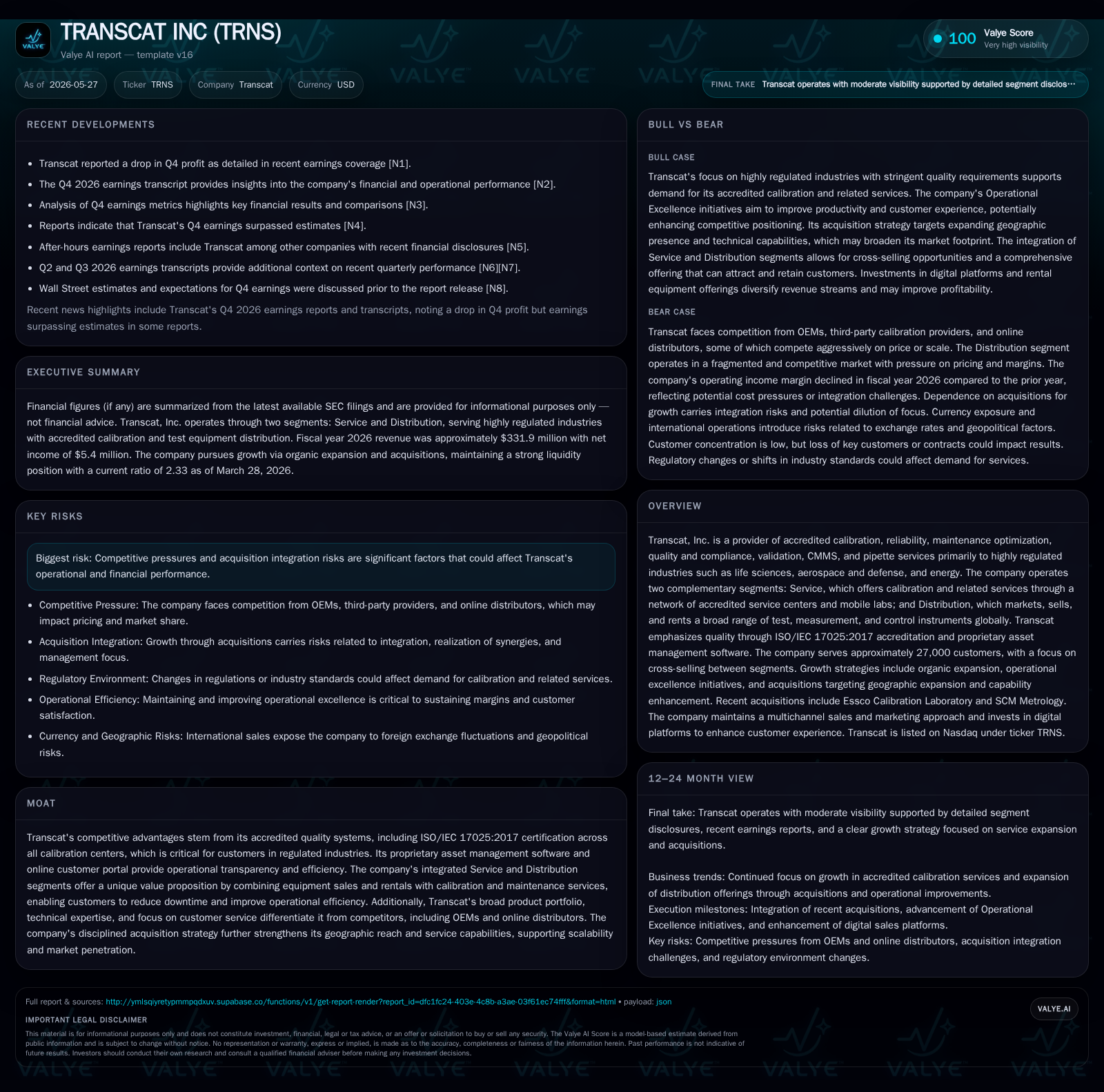
In its latest fiscal year ending March 28, 2026, Transcat, Inc. completed strategic acquisitions including SCM Metrology to bolster its calibration service footprint, while organic service segment growth accelerated in high-regulation sectors such as life sciences and aerospace. The company is navigating competitive pressures from online distributors by broadening product rental offerings and enhancing digital capabilities. Transcat’s integrated Service and Distribution segments underpin a resilient business model, though acquisition integration and evolving pricing dynamics remain watchpoints. Financially, leverage rose following acquisitions but remains manageable with healthy liquidity.
Recent Operating Developments Anchoring Transcat’s Trajectory
Transcat’s latest quarterly filing for the fiscal fourth quarter ended March 28, 2026 [S2], supplemented by the recent event filing [S3] highlights steady organic revenue growth alongside strategic acquisitions that broaden service geography and capabilities. The company reported fiscal year 2026 revenue of $331.9 million with operating income at $13.3 million [F1]. Of note is the April 2026 acquisition of SCM Metrology in Costa Rica which expands Transcat's presence in Latin America’s regulated calibration market [S21]. Organic Service segment revenue grew organically in the high single digits during Q3 and Q4 FY26 [S13], driven primarily by prevailing demand for calibration within life sciences and aerospace sectors.
The company also continued its Operational Excellence initiative — a multi-year program focused on enhancing productivity through technology adoption, automation, and process improvements — which resulted in faster turnaround times and differentiated customer experiences critical to retaining clients in highly regulated industries [S1]. These operational improvements ripple into margin enhancement especially for the Service segment where recurring revenue streams predominate.
Business Model Overview: Integrated Calibration Services and Instrument Distribution
Transcat operates through two synergistic segments: Service and Distribution [S18]. The Service segment delivers accredited calibration along with repair, inspection, preventative maintenance, validation consulting, Computerized Maintenance Management Systems (CMMS), pipette services, and related quality/compliance solutions. These offerings predominantly serve life sciences companies (including pharmaceutical and biotech), aerospace & defense firms, as well as energy utilities—all sectors subject to rigorous regulatory standards enforced by agencies like the FDA, FAA, and Department of Defense.
The company's calibration services hinge heavily on ISO/IEC 17025:2017 accreditation across all centers—a non-negotiable credential for customers who require traceability and precision testing for compliance [S1]. Transcat deploys a proprietary asset management platform, CalTrak®, paired with an online customer portal C3®, facilitating operational transparency, flexible service delivery models (mobile labs, embedded onsite teams), scheduling efficiency, work order management, asset tracking, and realtime reporting for clients [S18].
On the Distribution side, Transcat markets test, measurement, and control instruments across hundreds of suppliers’ brands globally. It sells new equipment as well as rents instruments—rentals having been identified as a higher-margin channel under active cultivation to offset ongoing commoditization pressures from online distributors such as Amazon that compete mainly on price alone [S18,S22]. Distribution also focuses on consumable products targeted largely towards life sciences customers for incremental revenue streams
Revenue generation depends on both segments attracting predominantly medium-to-large enterprise customers within regulated industries who pay for compliance assurance (Service) or instrument availability (Distribution). Price is driven by contract negotiations (often annual or multiyear agreements for calibration), volume usage of services/equipment rentals, product mix evolution favoring higher margin rentals or consumables, and efficiency gains from operational improvements.
Industry Structure and Competitive Positioning
The calibration services industry is fragmented but features significant barriers to entry due to accreditation requirements. Transcat’s ISO/IEC 17025:2017 certifications across all centers create a quality moat crucial for trust-dependent customers governed by strict regulatory mandates. Its integrated model combining sales/distribution with service differentiates it from stand-alone distributors or manufacturers who often do not offer comprehensive calibration or maintenance programs.
Competition arises chiefly from specialized local calibration providers lacking broad geographic coverage or integrated digital platforms as well as large OEMs selling instruments bundled with basic service packages. Online distributors create an additional competitive dimension but are limited mostly to non-value-added product sales at lower price points without accompanying calibration/pre-shipment services [S22]
Within distribution sales channels, Transcat competes with national distributors emphasizing inventory breadth and technical sales expertise; however strong vendor relationships (with about 400 suppliers) allow facilitated co-branded marketing programs enhancing reach [S22]. The investment in website functionality aligning with digital commerce trends serves as a defensive stance against e-commerce encroachment.
Operationally, the company maintains 33 calibration service centers strategically located in North America (USA including Puerto Rico, Canada), Ireland, plus now Costa Rica. Embedded onsite operations at customer locations provide enhanced convenience reducing downtime — referred to as "imbedded customer-site locations" — which increases switching costs due to integration within customers’ processes [S1,S14].
Distinct Growth Drivers
1. Regulatory Tightening: Increasing regulatory scrutiny around quality control testing drives organic demand growth for calibrated measurement devices and associated maintenance services among life sciences/pharma manufacturers especially.
2. Cross-Selling Synergies: Approximately 20-25% of customers engage both segments enabling cross-selling opportunities where instrument buyers also subscribe to calibration maintenance programs enhancing wallet share per client [S1].
3. Market Expansion through Acquisitions: Strategic acquisitions like Essco Calibration Laboratory in FY26 and SCM Metrology early FY27 expand geographic reach into new territories including Latin America while augmenting technical capabilities [S21]. Acquisition strategy remains pivotal given the fragmented nature of the industry.
4. Digital Platform Investment: Enhancements to its e-commerce presence coupled with efficient backend systems aim to capture shifting purchasing behaviors favoring online research plus ordering convenience while maintaining human technical support for complex needs [S22,S24].
5. Rental Fleet Growth: Growing rental offerings within Distribution provide smoother margin profiles relative to transactional equipment sale while meeting customer needs for flexible instrumentation use without upfront capital expenditures.
Risks and Growth Constraints
Despite its strengths, Transcat faces several notable risks:
- Acquisition Integration: Rapid expansion via deals carries execution risk particularly regarding cultural alignment, compliance standards maintenance across acquired centers, system integration delays impacting synergies [S1,S21].
- Competitive Pricing Pressure: Online low-cost competitors erode pricing power within Distribution’s more commoditized product segments requiring continuous innovation in value-add services or product portfolio recalibration toward consumables/rentals.
- Customer Concentration Dynamics: While no customer accounted for over 3% of revenue limiting material dependency risk [S8], economic cycles impacting key sectors like aerospace or energy could reduce discretionary spend on non-mandated maintenance/testing.
- Regulatory Changes: Evolving accreditation rules or standards changes may necessitate costly updates or re-certifications disrupting service delivery temporarily.
- Leveraged Balance Sheet: The company’s balance sheet shows net debt of approximately $95 million as of March 28, 2026, with a current ratio of 2.33 indicating a solid short-term liquidity position [F1]. Interest expense rose consistent with higher borrowing levels though overall coverage remained secure relative to EBITDA generation.
What To Watch Next
Key upcoming milestones include:
- Completion of initial accounting allocation for SCM acquisition expected soon after fiscal year-end statements release which will clarify goodwill/intangible asset values affecting amortization schedules [S21].
- Continued organic revenue trajectory especially within Service segment where high-single-digit growth was reported late FY26 provides a readout on sustainable demand trends following macroeconomic fluctuations.
- Progress updates on Operational Excellence metrics such as turnaround times improvement rates that underpin cost control efforts.
- Digital sales penetration rate improvements directing engagement conversion relative to traditional outbound sales efforts.
- Capital deployment pace within allowed acquisition funding limits ($50M annual cap) indicating ongoing M&A appetite.
- Monitoring debt covenants compliance amid expansion spending will be key given incrementally increased leverage versus prior periods.
Financial Profile Summary
As of March 28, 2026 [F1], Transcat reported total revenues of $331.9 million with operating income at $13.3 million reflecting modest margin compression relative to prior years due to acquisition-related expenses but partially offset by operational gains. Net income was $5.38 million supporting positive free cash flows despite sizable capital expenditures of approximately $15 million used mainly in property & equipment upgrades aligned with capacity expansion plans.
The company held cash & equivalents of approximately $4.94 million and total debt near $99.9 million as of March 28, 2026, resulting in net debt around $95 million; the current ratio measured 2.33, suggesting a comfortable short-term liquidity position [F1]. Interest expense rose consistent with higher borrowing levels though overall coverage remained secure relative to EBITDA generation.
This financial structure supports continued investment in organic growth drivers while enabling opportunistic acquisitions but warrants close monitoring given inevitable integration costs ahead.[F1]
Disclaimer: This analysis is based solely on publicly available information up through May 2026 filings and news. It does not constitute investment advice or forecasts but rather provides an informed business evaluation anchored on documented operating facts.
Disclaimer: This is research-only, informational analysis and not investment advice. It may include AI-generated interpretation and general industry context. Always verify important details using primary sources.

Comments