
Tesla Inc.: Navigating Growth Complexities in Electric Vehicles and Energy Systems
Tesla’s evolving business model integrates automotive innovation and energy solutions amid competitive and operational challenges.
Tesla remains a dominant player in electric vehicles (EVs) and energy products, backed by a vertically integrated system encompassing manufacturing, software, and sales. Recent financial and operational updates highlight robust revenue growth but reveal margin pressures and execution risks, especially around manufacturing footprint adjustments and supply constraints. Competitive dynamics intensify globally, while Tesla pursues emerging avenues like autonomous driving and robotics, demanding careful scrutiny of capital allocation and regulatory landscapes.
What Changed Recently
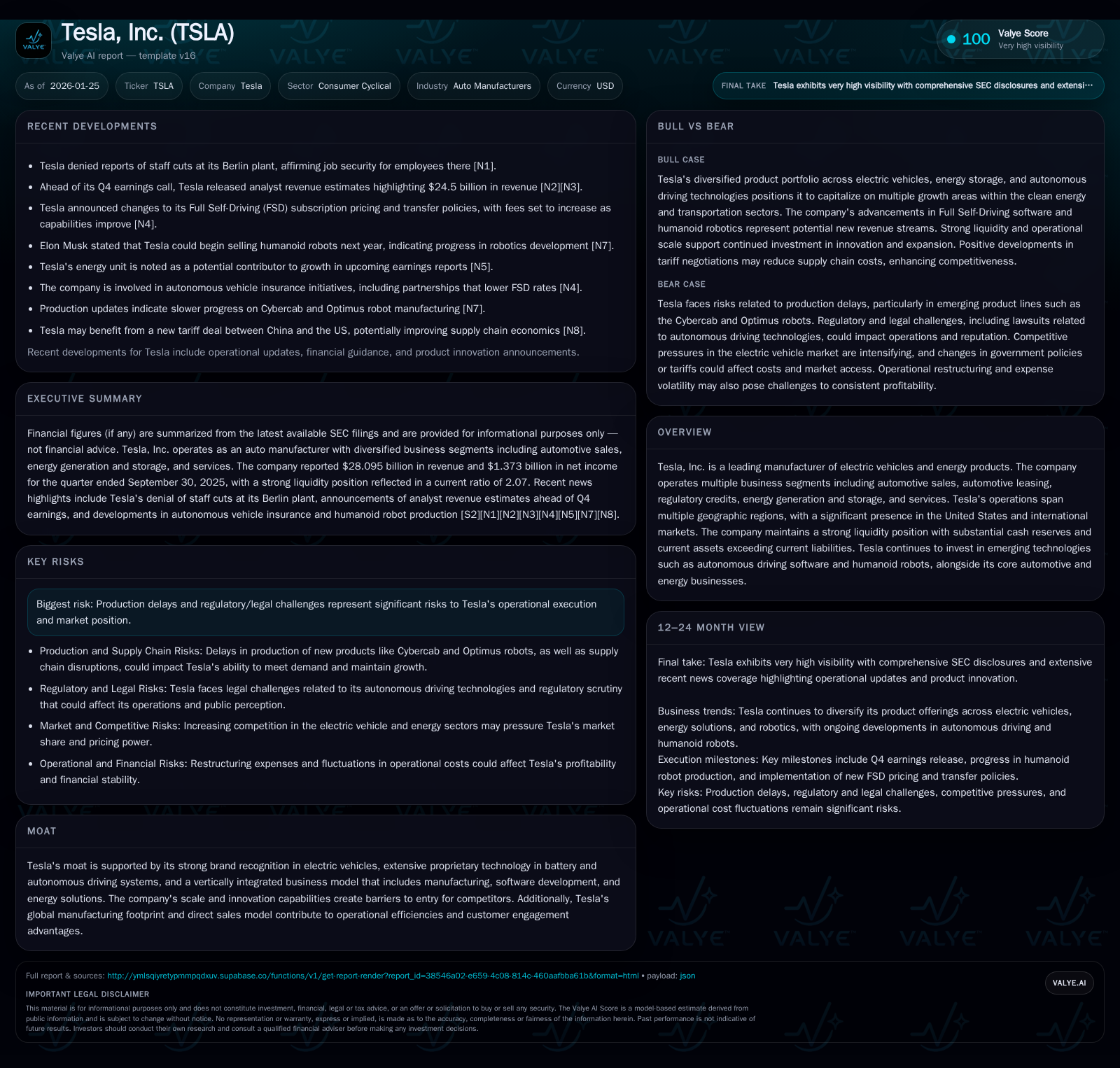
In the last 45 days, Tesla has publicly released optimistic revenue guidance ahead of its Q4 2025 earnings call, projecting approximately $24.5 billion in revenue, underscoring persistent demand across its automotive and energy segments [N1][N2]. However, consensus and analyst previews suggest an earnings decline for the quarter, attributed to rising input costs and operational scaling challenges [N6][N7]. Short sellers remain active, with put options on Tesla still attractive, indicating market skepticism about near-term profitability [N3].
Operationally, Tesla has faced scrutiny following reports of workforce reductions at its Berlin Gigafactory, which the company denied, affirming job security yet acknowledging some restructuring [N11]. Supply chain concerns have surfaced, particularly regarding graphite sourcing critical for battery production, with Tesla’s supplier Syrah Resources granted extensions to fulfill commitments [N10]. On the geopolitical front, Tesla stands to benefit from easing China-U.S. trade tensions, potentially lowering tariffs and improving cost competitiveness in a key manufacturing and sales region [N9].
Finally, Tesla continues pushing forward with emerging technology investments, notably in autonomous driving and robotaxi development, with market commentary highlighting the strategic importance of AI capabilities for future growth [N13].
Business Model as a System
Tesla’s business architecture integrates multiple interlinked components, spanning electric vehicle manufacturing, energy generation and storage, software development, and direct-to-consumer sales. According to disclosures, the company operates key segments: automotive sales and leasing, energy generation and storage, and services, each contributing to a diversified revenue base [S1][S2].
The automotive segment centers on designing, manufacturing, and selling electric vehicles with proprietary battery technology and in-house software for vehicle control and autonomous features. Tesla’s vertical integration extends to battery cell production, vehicle assembly, and supercharger infrastructure, reducing dependency on suppliers and enhancing cost control [S1]. Direct sales circumvent traditional dealership networks, enabling Tesla to capture retail margins and maintain customer data for software updates and service.
Energy generation and storage leverage Tesla’s battery expertise to offer solar panels, solar roofs, and large-scale energy storage solutions. This segment also includes leasing arrangements and projects that interface with utility grids, creating a platform for sustainable energy ecosystems [S1][S5].
Tesla invests heavily in research and development, focusing on battery chemistry, autonomous driving software, and robotics, positioning the company at the intersection of automotive and AI technology [S14]. Capital expenditures reflect this dual focus, supported by a strong liquidity position (cash and equivalents of approximately $18.3 billion and a current ratio of 2.07) that underpins expansion and innovation [S11][S12].
Industry Map & Competitive Battlefield
Tesla operates at the confluence of several high-growth sectors: electric vehicles, renewable energy, and autonomous driving. The automotive industry is undergoing rapid transformation with legacy manufacturers ramping EV production, Chinese startups aggressively expanding, and technology firms entering the autonomous vehicle space. Tesla’s strong brand and technology moat, including battery IP and full-stack software control, provide a competitive edge but face erosion as rivals scale.
Energy markets are fragmented and influenced by regulatory incentives, grid modernization trends, and fluctuating demand for storage solutions. Tesla competes with established energy companies and emerging startups offering residential and commercial solar plus storage packages.
New entrants and incumbents alike are scaling battery manufacturing capacity, often through partnerships or joint ventures, to lower costs. Tesla’s Gigafactory network is critical to maintaining scale advantages but requires continuous investment to fend off competitors.
Autonomous driving and robotaxi development represent a potential game-changer, with Tesla’s proprietary AI systems a key differentiator. However, regulatory approval, safety validation, and competitive advances from tech giants and specialized firms like Waymo add complexity and uncertainty to this segment.
Where the Economics Become Real
Tesla’s unit economics depend heavily on battery cost per kWh, manufacturing yield, and software monetization. Cost of goods sold and operating expenses have risen in recent periods due to inflationary pressures and supply chain tightness [S8]. Maintaining gross margins requires scaling production volumes rapidly while integrating cost-saving innovations like new cell formats.
The direct sales model eliminates dealership margins but imposes higher customer acquisition and service costs. Tesla’s energy segment margins are more volatile, contingent on project execution timelines and government incentives.
Regulatory credit sales have historically boosted profitability but are subject to policy changes and competitor behavior, making this a less predictable revenue stream.
Operating leverage materializes as R&D and SG&A expenses grow more slowly than revenues, but capital expenditures remain substantial given the dual focus on manufacturing capacity and emerging technology platforms [S14]. Tesla’s strong balance sheet allows it to sustain these investments but requires disciplined capital allocation to avoid margin erosion.
Diligence Questions / Disconfirming Signals
- How sustainable is Tesla’s current revenue growth amid intensifying competition and macroeconomic headwinds?
- What is the trajectory of margin expansion given reported earnings declines and input cost pressures?
- How effectively can Tesla manage operational risks at key factories, such as Berlin, where workforce adjustments may signal scaling challenges?
- Will supply chain constraints, particularly in battery raw materials like graphite, impede production ramp and cost targets?
- How credible are Tesla’s timelines and technological promises for autonomous driving and robotaxi deployment?
- To what extent do regulatory credit sales continue to support earnings, and how might policy shifts affect this?
- How resilient is Tesla’s direct sales and service model against evolving consumer preferences and regulatory environments?
- Are investor hedging activities indicative of broader market skepticism about Tesla’s near-term financial performance?
Tesla’s multifaceted business model positions it at the forefront of automotive electrification and energy innovation, but operational execution and competitive pressures require vigilant monitoring. The company’s capital strength and innovation pipeline remain key assets, while recent market signals urge caution on profitability and operational stability.
Disclaimer: This analysis is based on publicly available information and news sources as of January 2026 and Tesla’s SEC filings up to Q3 2025. It does not constitute investment advice or recommendations. Investors should conduct their own due diligence and consider multiple factors before making decisions.
Disclaimer: This is research-only, informational analysis and not investment advice. It may include AI-generated interpretation and general industry context. Always verify important details using primary sources.

Comments