
Texas Ventures Acquisition III Corp’s SPAC Structure and Progress Toward Business Combination
As a blank check company, Texas Ventures Acquisition III Corp continues its search for a business combination while navigating SPAC-specific risks and evolving regulatory requirements.
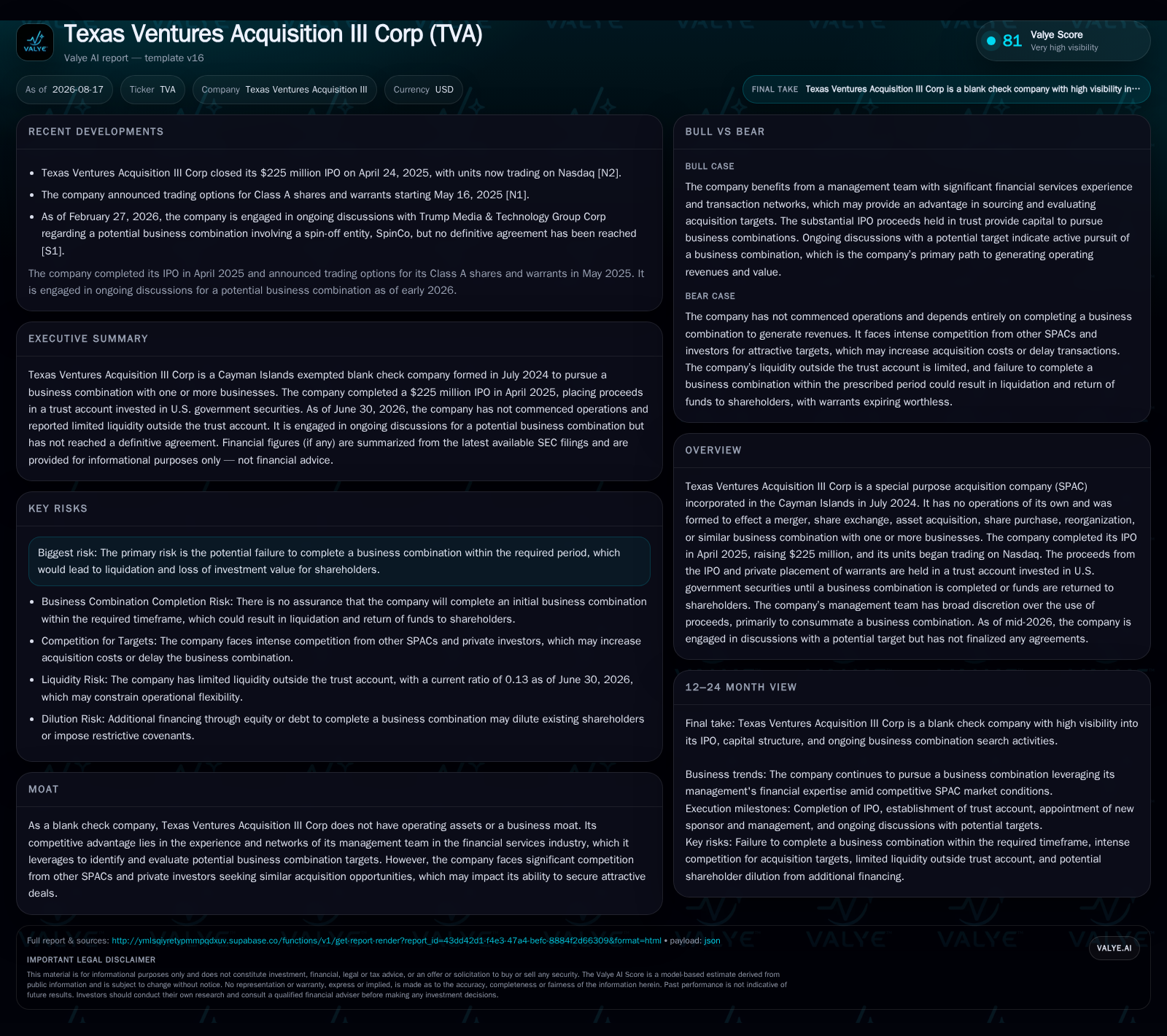
Texas Ventures Acquisition III Corp (TVA), a Cayman Islands-based blank check company formed in mid-2024, raised $225 million in its April 2025 IPO. It holds these proceeds primarily in a trust invested in U.S. government securities while actively evaluating acquisition targets but has yet to finalize any deal as of mid-2026. Recent filings reveal liquidity pressures outside the trust account due to search and administrative expenses, alongside indemnity obligations that could reduce redemption proceeds available to public shareholders. With approximately two years remaining under Nasdaq’s 36-month deadline to complete a business combination, execution risk remains elevated amid competitive deal sourcing and regulatory complexities.
Recent Operating Update and Its Implications
Texas Ventures Acquisition III Corp’s latest quarterly filing dated August 14, 2026 confirms it remains in the pre-combination phase typical of SPACs: it has not generated operating revenues since inception and continues to rely on interest income from IPO proceeds held in trust [S2][S1]. As of June 30, 2026, approximately $237 million is invested in mutual funds within the trust account—a slight increase from year-end reflecting accrued earnings—ensuring preservation of capital earmarked for an initial business combination or shareholder redemptions.
Outside the trust account, TVA reported a substantial working capital deficit exceeding $2.4 million by mid-2026 driven by expenses related to target evaluation, due diligence travel, legal fees, and administrative overhead [S22]. This liquidity strain illustrates typical operational cash flow pressure during the search period when costs accumulate without offsetting revenues.
The filing also highlights indemnity obligations linked to potential third-party claims against the Sponsor. Should such claims be successfully asserted beyond reserves currently held, funds available in the trust account could be reduced below the anticipated $10.05 per share redemption amount payable to public shareholders [S2]. This contingent liability underscores legal exposure risks inherent in SPAC structures prior to deal completion.
Management remains engaged in discussions with prospective targets but has not entered into any binding agreements [S2]. With roughly two years left before the Nasdaq-mandated 36-month deadline from IPO date expires [S1], timely execution is critical. Failure to consummate a qualifying business combination within this timeframe would likely result in forced liquidation, returning trust assets less expenses to shareholders.
Business Model Overview: Capital Vehicle Without Operations
TVA operates as a classic SPAC: it raised $225 million through an IPO in April 2025 by selling units comprising one Class A ordinary share plus half a redeemable warrant at $10 per unit [S1]. These proceeds are conservatively invested in U.S. government securities held in a segregated trust account until deployed toward an acquisition or returned upon liquidation.
Pre-business combination, TVA earns nominal interest income on these funds but does not generate operating revenues or conduct commercial activities. Monetization materializes only upon completing an initial business combination (de-SPAC transaction), whereby TVA merges with or acquires a private company—effectively taking it public outside traditional IPO channels.
Economic value post-combination depends on equity stakes acquired via share exchanges or asset purchases funded by trust proceeds combined with possible PIPE financing arranged concurrently. Margins shift significantly once commercial operations commence under the merged entity.
Founder shares issued at nominal cost convert into ordinary shares upon closing an acquisition and serve as sponsor incentives aligned with successful deal completion [S1]. Warrants introduce potential dilution contingent on exercise rates after combination.
Operationally, revenue generation hinges entirely on successful deal sourcing and execution. Management’s financial services background supports pipeline development across industries without sector constraints.
Industry Context and Competitive Positioning
SPACs like TVA act as capital intermediaries connecting public investors with private companies seeking expedited public market access without traditional IPO complexities. As Cayman Islands exempted entities lacking operations pre-combination, their value proposition relies heavily on governance quality, sponsor alignment, capital preservation strategies via trust accounts, and adherence to exchange deadlines.
The SPAC landscape is crowded with numerous blank check vehicles competing for attractive acquisition targets alongside private equity firms pursuing buyouts or growth investments. Sponsors’ relationships within financial services ecosystems often influence access to proprietary deal flow and PIPE investors.
Notable peers such as Pershing Square Tontine Holdings or Churchill Capital illustrate experienced sponsor-led models focusing on select sectors or megadeals. TVA adopts a flexible investment mandate spanning industries, increasing sourcing challenges amid competitive pressures [S23].
Growth Drivers: Sponsor Expertise and Market Dynamics
TVA’s primary growth driver pre-business combination lies in its management team’s financial services expertise and extensive networks facilitating target identification [S23]. This intangible advantage differentiates it from less active SPAC entrants but must translate into timely deal execution amid intense competition.
Investor demand for alternative public listing vehicles remains robust as regulatory scrutiny lengthens traditional IPO timelines. Private companies often prefer SPAC mergers for negotiated valuations, flexible structuring including PIPE support, and faster Nasdaq listings under established rules.
Recent accounting standards updates effective post-2026 may enhance transparency around operating expense disclosures pre-combination, potentially improving investor confidence regarding search cost efficiency [S24]
Risks and Watchpoints: Execution Timing and Liquidity Challenges
With approximately two years remaining before expiration of its Nasdaq-mandated 36-month combination period starting April 24, 2025 [S1], TVA faces significant timing pressure to identify, negotiate, and close an initial business combination. Failure triggers liquidation distributing trust assets less expenses back to shareholders—likely below original investment levels if indemnity claims materialize [S2].
Indemnification liabilities related to third-party litigation against the Sponsor pose contingent risks that could erode funds dedicated exclusively for shareholders via the Trust Account [S2]
Liquidity challenges outside the trust account compound operational risk during this search phase; quarterly filings reveal growing working capital deficits as non-trust expenses accumulate without operating cash inflows [S22]. While sponsor-provided Working Capital Loans offer some flexibility, no firm commitments have been disclosed.
Shareholder redemption rights following any announced deal can unpredictably reduce acquisition funding available post-announcement—complicating deal structuring scenarios involving variable ownership stakes.
Regulatory developments increasing sponsor accountability around disclosures and valuation methodologies further constrain deal flexibility relative to earlier SPAC cycles.
What To Watch Next
Key upcoming events include:
- Announcement of any definitive agreement regarding an initial Business Combination subject to shareholder approval and regulatory clearance [S2];
- Shareholder vote outcomes influencing approval likelihood and timing extensions;
- Redemption levels indicating investor confidence affecting available acquisition capital;
- Quarterly liquidity updates monitoring working capital sufficiency outside Trust Account given ongoing search costs;
- Developments regarding indemnity claim exposures impacting Trust Account availability;
- Changes in sponsor management or strategic direction;
- Adoption progress of ASU 2024-03 improving expense disclosure transparency post-quarter-end;
- Market conditions influencing competitive dynamics for attractive acquisition targets.
Disclaimer: This is research-only, informational analysis and not investment advice. It may include AI-generated interpretation and general industry context. Always verify important details using primary sources.

Comments