
Twist Bioscience's Silicon-Driven Innovation Confronts Profitability Challenges
Twist Bioscience leverages its proprietary silicon chip DNA synthesis to anchor a technological moat, yet sustained losses highlight financial headwinds amid sector competition.
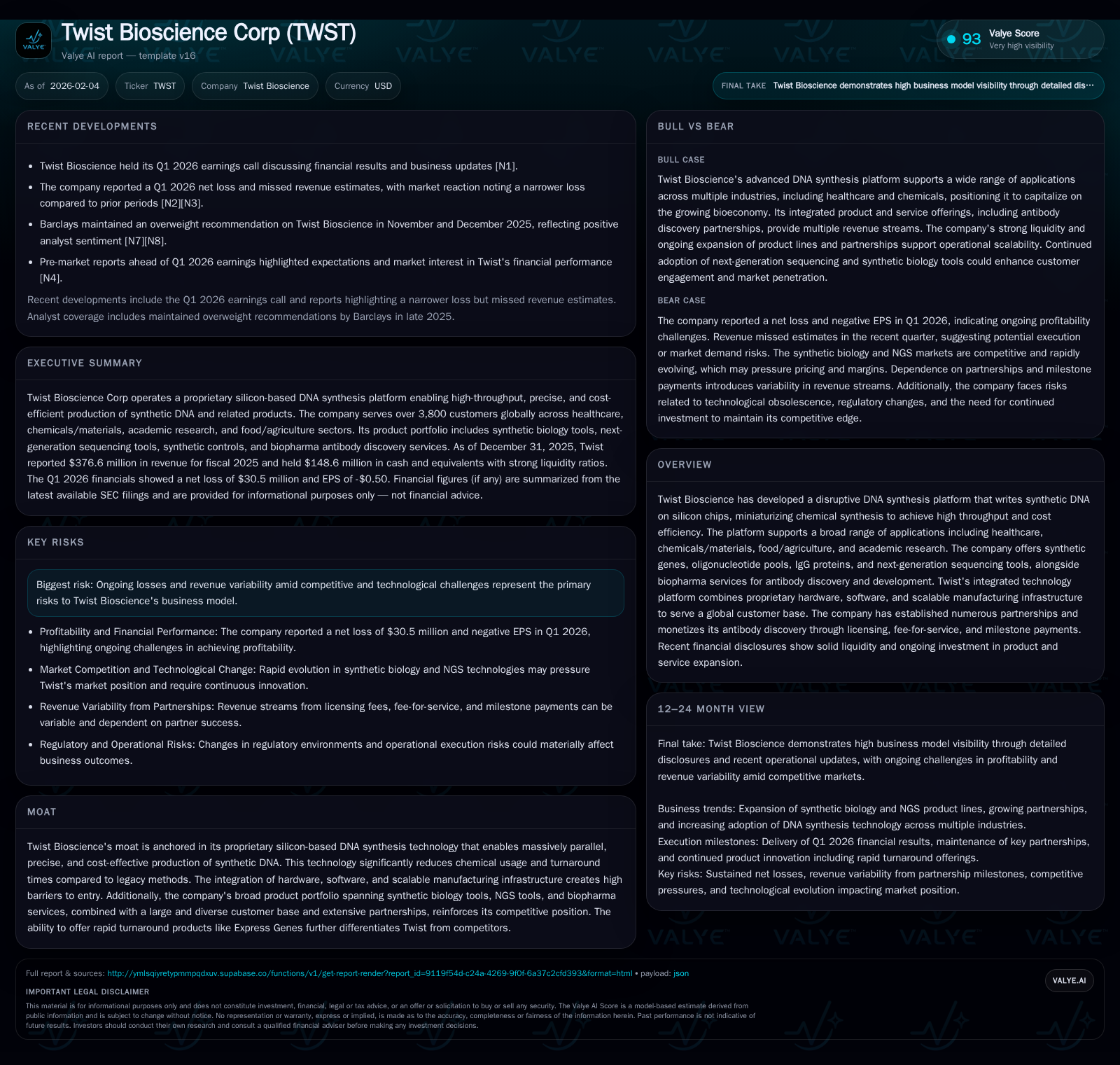
Twist Bioscience’s silicon chip-based platform represents a transformative advance in synthetic DNA manufacturing, enabling precise, scalable, and environmentally efficient gene synthesis. While this cutting-edge technology underpins a wide product portfolio serving over 3,800 global customers spanning healthcare, chemicals, and academia, the company continues to face recurring net losses and revenue variability. Its integrated approach—melding proprietary hardware, software, and manufacturing infrastructure—creates robust competitive barriers but also demands substantial investment. Persistent financial pressures amid heightened competition and supplier dependencies shape an intricate path forward for balancing innovation leadership with sustainable profitability.
Innovation at the Core: The Silicon Chip DNA Revolution
At the heart of Twist Bioscience's value proposition lies a truly disruptive technology platform that shifts synthetic DNA manufacturing from traditional plate-based processes onto silicon chips roughly the size of a large smartphone [S1]. This radical miniaturization allows chemical DNA synthesis to be conducted in massively parallelized arrays—writing over one million oligonucleotides per chip with lengths up to 500 bases. The impact is profound: chemical consumption per gene is slashed by an estimated 99.8%, markedly reducing costs and environmental footprint relative to legacy methods [valye_report_excerpt].
This silicon platform isn’t just about scale; it offers precision manufacturing embedded within proprietary hardware that controls synthesis fidelity. The ability to customize DNA sequences quickly feeds downstream applications from synthetic genes to next-generation sequencing tools. Importantly, this aligns Twist as an industrializing force in what might be called the writing of biology—the synthetic engineering of life’s code transitioning from artisanal lab procedures into scalable manufacturing science.
Scaling Science: From Miniaturization to Market Reach
Beyond the core chemistry innovation sits an ecosystem integrating proprietary software orchestration and a fully automated manufacturing infrastructure [S1]. Twist’s e-commerce enabled platform serves customers worldwide efficiently by streamlining ordering processes and expediting delivery.
This vertically integrated approach supports production volumes necessary to serve a customer base exceeding 3,800 entities spanning healthcare research institutions, industrial chemical firms, academic labs, and agricultural innovators [valye_report_excerpt]. Automation reduces manual interventions enhancing throughput while maintaining consistency—a crucial factor given the precision required for synthetic biology products.
Such operational scale enables Twist not merely to produce novel molecules but to commercialize them rapidly across diverse markets.
Financial Snapshot: Liquidity, Losses, and Operational Realities
Despite these technological advantages and operational integrations, Twist Bioscience’s recent financial disclosures reveal persistent profitability challenges [F1]. As of December 31, 2025, cash and equivalents stood solidly at approximately $149 million supporting liquidity comfortably against current liabilities ($80 million), yielding a notably healthy current ratio near 3.78x [F1].
However, net losses remain entrenched; the company posted a loss of around $30.5 million for the quarter ending late 2025 [F1]. In its Q1 2026 earnings report (February 2026), Twist missed revenue targets while signaling narrower losses compared to prior periods—an incremental positive but further underscoring ongoing operating expenses outpacing income [N2][N3][N7].
Revenue variability coupled with continued investment in capacity expansion and R&D reflects typical pressures faced by innovative biotechnology manufacturers scaling complex technology platforms.
Market Footprint: Diverse Customers Across Sectors
Twist’s product suite spans multiple sectors effectively translating its synthetic biology platform into economic value across fields:
- Healthcare dominates revenue contributions (~$215 million in FY2025), driven notably by biopharma services including antibody discovery and optimization [S1][valye_report_excerpt].
- Chemicals/materials sectors follow (~$93 million), utilizing synthetic biology products for specialty materials such as spider silk analogues, bioengineered nylon alternatives, rubber substitutes, fragrance compounds, flavors, and food additives.
- Academic research accounts for approximately $66 million in sales—underlining significant penetration in enabling scientific discovery tools.
- Food/agriculture sectors represent nascent opportunities (~$2.4 million) focusing on sustainable crop production technologies [valye_report_excerpt].
This broad market footprint ensures diversification mitigating cyclical dependencies inherent in biotech sectors while positioning Twist at intersections where biology meets industrial innovation.
Moat Mechanics: Proprietary Tech as a Competitive Advantage
The cornerstone of Twist’s competitive advantage resides in its silicon-based DNA writing platform married with scalable manufacturing capabilities [valye_report_excerpt]. The dramatic reduction in chemical inputs (estimated at nearly 100%) signifies not only cost efficiency but aligns with global trends demanding greener biotechnologies.
Its portfolio extends beyond basic synthetic genes to encompass next-generation sequencing tools and express gene services which promise accelerated turnaround—building customer stickiness through responsiveness unmatched by competitors reliant on older plate-based methods.
The integration of proprietary hardware with bespoke software controls creates complexity that raises barriers for entrants lacking comparable technological depth or capital commitment.
Further reinforcing this moat are strategic partnerships facilitating expanded service offerings especially within antibody drug discovery—a high-value segment where licensing revenues augment transactional sales [valye_report_excerpt].
Persistent Risks: Navigating Losses, Competition, and Supply Dependencies
While the technology defends market position well, embededded risks persist that could adversely affect future prospects as detailed in SEC filings [S1][S2]:
- The company has incurred losses every reporting period to date with no assurance of achieving sustained profitability soon.
- Revenue growth has demonstrated variability; failure to maintain or accelerate growth would damage business viability.
- Dependency on one single-source supplier critical for DNA synthesis components exposes operational risk despite existing contingencies.
- Intense competition from both established biotech firms and emerging synthetic biology startups could erode pricing power or market share.
- Cybersecurity threats pose potential disruption risks especially given reliance on digital infrastructure for integrated manufacturing operations.
- Retention of senior management and specialized personnel remains vital given technical complexity; turnover could impair development pace or execution.
- Intellectual property protection is crucial yet uncertain; rivals potentially replicating key innovations may challenge market exclusivity.
Hence risks combine financial endurance pressures alongside operational vulnerabilities inherent in early-stage frontier biotech enterprises.
Strategic Trajectories: Partnerships, Licensing and Growth Prospects
To mitigate raw transactional exposure common to product-only models, Twist actively monetizes its antibody discovery capabilities through diversified streams including licensing agreements accompanied by milestone payments plus fee-for-service contracts [valye_report_excerpt].
This multi-pronged model aligns well with broader industry movement toward collaborative drug discovery frameworks leveraging externalized biopharma assets rather than solely internal pipelines [analysis]. Recent partnerships fuel this trajectory opening channels for recurring revenue beyond simple DNA oligo sales.
Moreover, expansion into adjacent markets like specialty chemicals through synthetic biology provides optionality tied closely to sustainability trends incentivizing bio-based replacements for petrochemical-derived inputs.
Continued platform innovation supported by R&D investment remains fundamental to safeguarding relevance amid rapidly evolving synthetic biology landscapes.
Investor Sentiment and Recent Market Reaction
Upon announcement of Q1 2026 results—including narrower net losses despite missing top-line revenue estimates—TWST stock experienced an approximate 7% uptick signaling cautious optimism tempered by lingering concerns over growth visibility [N7].
Simultaneously broader thematic ETF flows evidenced notable outflows consistent with volatile investor appetite in biotech innovation spaces linked to macroeconomic uncertainties [N8]. This divergence highlights nuanced market views balancing long-term technology promise against near-term profitability hurdles.
Hence investor behavior reflects recognition of foundational strengths while demanding clearer profit pathway demonstrability before endorsing higher valuations robustly.
Conclusion: Balancing Scientific Breakthroughs with Financial Viability
Twist Bioscience stands at an inflection shaped by pioneering technology capable of rewriting how synthetic DNA is fabricated—not mere incremental evolution but paradigm-shifting miniaturization yielding cost-effective scalability. This entrenched technological moat sets it apart decisively from many peers relying on conventional chemistries or less integrated platforms.
Yet these breakthroughs come against a backdrop of persistent operating losses defined by heavy reinvestment cycles necessary for capacity buildout alongside competitive pressures inherent in synthetic biology ventures. As of early 2026 reports show narrower losses but revenue softness flagging ongoing execution complexities.
Navigating this terrain requires blending continued innovation leadership—expanding express gene offerings and biopharma licensing—with prudent financial discipline seeking paths toward sustainable margins. Maintaining robust cash reserves provides runway enabling strategic maneuvering amid market fluctuations but does not obviate underlying challenges associated with converting strong top-line traction into consistent profitability.
In sum, Twist Bio exemplifies the classic innovation-growth tradeoff endemic to frontier life sciences firms endeavoring both to industrialize complex biological engineering while balancing investor expectations geared toward financial viability benchmarks found more commonly outside cutting-edge domains.
Disclaimer: This is research-only, informational analysis and not investment advice. It may include AI-generated interpretation and general industry context. Always verify important details using primary sources.

Comments