
TXNM Energy Inc’s Shifting Profitability and Heavy Capex Roadmap
TXNM Energy's financial results reflect robust revenue growth coupled with margin pressures amid substantial capital investments and evolving regulatory demands.
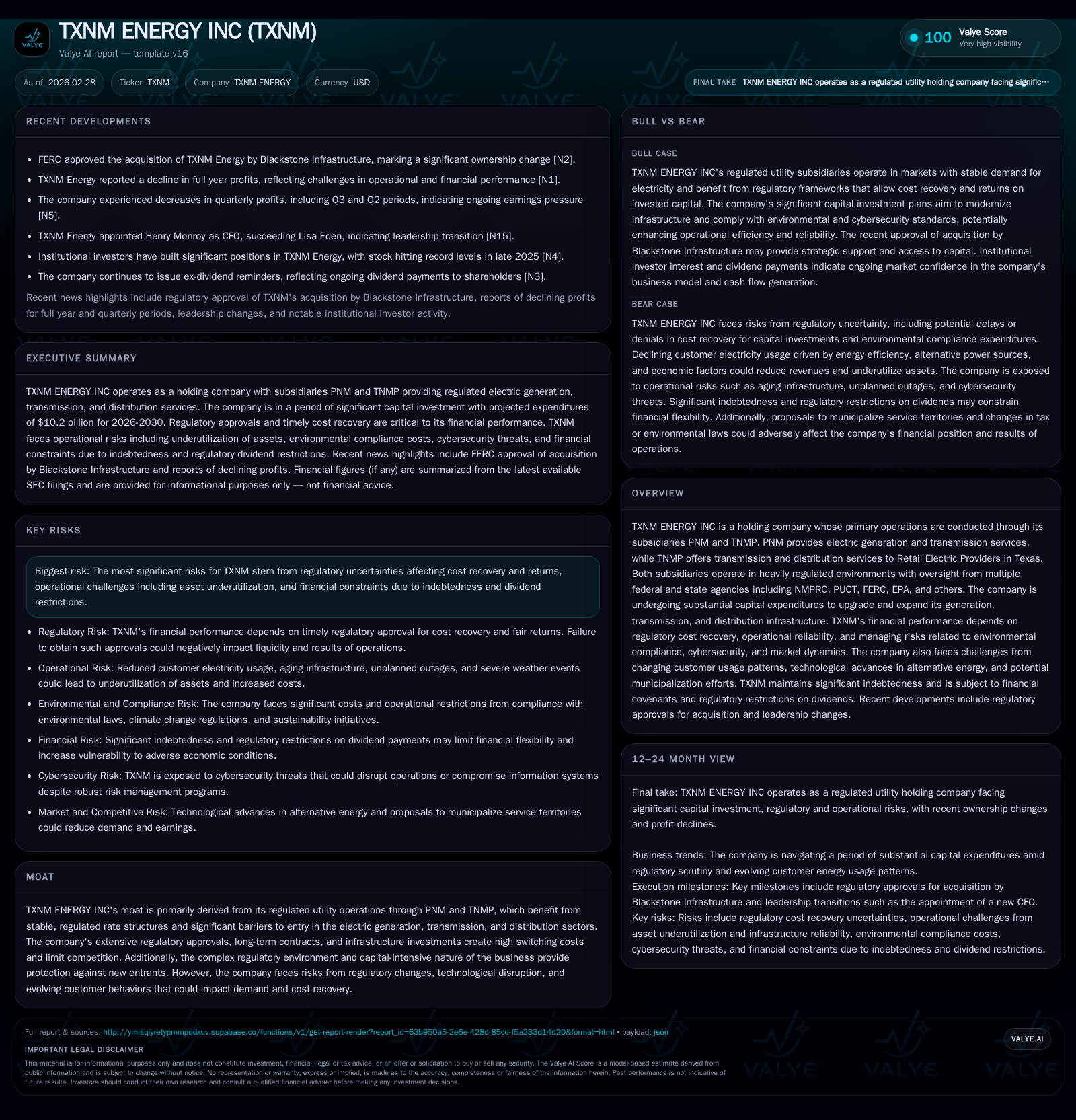
TXNM Energy demonstrated nearly 10% annual revenue growth in 2025 driven by its regulated utility subsidiaries, PNM and TNMP. However, profitability was constrained, with operating income declining slightly and net income showing a steep drop compared to prior reported years, pressured by rising costs related to infrastructure upgrades, environmental compliance, and increased interest expenses. The company is embarking on a $10.2 billion capital expenditure program through 2030 to modernize its electric generation, transmission, and distribution networks. Regulatory approvals for cost recovery remain pivotal risks affecting future cash flow and earnings sustainability. Post-merger restrictions and significant indebtedness add complexity to capital allocation decisions as TXNM balances dividend payments with modest share buybacks under tight liquidity conditions.
Revenue Growth Drives Top-Line Momentum Despite Market Pressures
TXNM Energy Inc’s consolidated revenues reached approximately $2.17 billion in fiscal year 2025, marking a near 10% increase from $1.97 billion in 2024 [F1]. This steady top-line expansion stems primarily from the regulated electric utility operations of its subsidiaries: Public Service Company of New Mexico (PNM), offering generation and transmission services in New Mexico, and Texas-New Mexico Power Company (TNMP), providing transmission and distribution services in Texas [S1][S9]. The company's revenues benefit from cost-of-service regulatory rate structures overseen by multiple agencies—most notably the New Mexico Public Regulation Commission (NMPRC), Federal Energy Regulatory Commission (FERC), and Public Utility Commission of Texas (PUCT)—which provide stable cash inflows tied to prudent investments.
Despite competitive market dynamics including shifts in customer consumption patterns and technology disruption, TXNM’s rate-regulated model sustains revenue growth through ongoing rate cases permitting cost recovery on capital investments [S9]. This growth reflects the fundamental barrier to entry created by licensed infrastructure rights-of-way and long-term contracts with Retail Electric Providers (REPs) leveraging TNMP’s facilities.
Historical performance (annual)
| FY | Rev ($bn) | CFO ($mm) | OpInc ($mm) | Capex ($mm) | Rev YoY |
|---|---|---|---|---|---|
| 2025 | 2.2 | 584 | 441 | 1196 | +9.9% |
| 2024 | 2.0 | 508 | 453 | 1247 | +1.7% |
| 2023 | 1.9 | 551 | 231 | 1076 | -13.8% |
| 2022 | 2.2 | 567 | 394 | 913 |
Source: SEC companyfacts cache [F1].
Capital returns and efficiency (annual)
| FY | Div ($mm) | Buybacks ($mm) | FCF ($mm) |
|---|---|---|---|
| 2025 | 163 | 12 | -611 |
| 2024 | 140 | 8 | -739 |
| 2023 | 127 | 10 | -525 |
| 2022 | 120 | 8 | -345 |
Source: SEC companyfacts cache [F1].
Note: Latest net income data available is from fiscal year 2020 per [F1].
Eroding Operating Income Amid Rising Costs
While revenue expansion signals ongoing demand for TXNM’s regulated services, operating income contracted by approximately 2.7% year-over-year to $441 million in fiscal year ending December 2025 [F1]. Net income data for recent years is not available; however earlier years showed substantially lower profitability levels [F1]. The operating income decline reflects increasing operational costs detailed in company disclosures [S1]. These include investments required for environmental compliance at generating facilities—including aging coal-fired plants—and cybersecurity enhancements protecting critical infrastructure from evolving threats [S18]. Rising interest expenses associated with financing large-scale capital programs also weigh on margins [S4][S7].
Non-cash charges related to pension risk transfers completed late in calendar year 2025 further impacted reported earnings without immediate cash effect [S27]. These factors jointly illustrate the margin pressures facing TXNM despite stable regulatory frameworks.
Capital Expenditure Surge: Backbone of Operational Capability
TXNM is undergoing a significant infrastructure investment phase with projected capital expenditures totaling approximately $10.2 billion between fiscal years 2026 through 2030 [S1]. These investments are vital for modernizing generation assets—including integration of renewable sources—expanding transmission capacity especially in Texas, replacing aging distribution equipment vulnerable to outages or wildfire risk, and complying with evolving federal/state environmental regulations.
In fiscal year 2025 alone, TXNM allocated about $1.2 billion towards capex—a slight decrease from $1.25 billion spent in fiscal year 2024—as initial project phases mature [F1]. Spending encompasses new substations along TNMP load corridors, maintenance of PNM’s nuclear generation interest at Palo Verde Nuclear Generating Station (PVNGS), and deployment of battery energy storage systems aimed at enhancing grid reliability during peak demand intervals [S1][S14].
Capital intensity relates directly to expected future performance but raises leverage concerns given substantial financing needs amid covenant constraints following the pending Blackstone acquisition [S4][S5]. Timely regulatory approvals for cost recovery are critical for sustaining these investments.
Regulatory Environment: Cost Recovery Hurdles and Compliance Challenges
TXNM’s operational viability depends heavily on regulators granting timely approvals that enable recovery of investment costs plus a reasonable return on equity [S9]. PNM operates under NMPRC/FERC jurisdiction while TNMP is regulated by PUCT.
The company faces risks if regulators delay or deny recovery of undepreciated assets upon plant retirements or disallow increased operational expenses related to cybersecurity or nuclear safety mandates—each potentially impacting rate designs materially [S12][S8]. For example, TNMP's pending base rate review requests approval for over $2.8 billion of new rate base additions alongside an intended return on equity near 10.4% with an equity ratio around half the capital structure [S12].
Regulators must balance upward pressure on rates against demand-side restraints stemming from energy efficiency initiatives and adoption of distributed energy resources such as rooftop solar—challenges complicating load growth forecasts used in tariff settings [S1][N1]. Failure to secure cost recovery compresses margins given fixed overheads amidst declining volumetric sales.
Future Outlook: Infrastructure Projects Amid Demand Challenges
Beyond executing modernization projects lies uncertainty about long-term electricity demand due to changing consumer behaviors influenced by decarbonization policies and technology adoption such as electric vehicles which present both opportunities and complexities for load management [S1][N1]. Regulatory support for renewable mandates imposes additional integration costs while climate change impacts may accelerate resilience requirements.
The Blackstone Infrastructure acquisition approved early in calendar year 2026 introduces strategic considerations where project prioritization might shift according to private equity timelines though immediate operational changes remain limited pending formal integration [N1].
Economic cyclicality or increasing rates could exacerbate risks of underutilized generation capacity requiring portfolio adjustments.
Balance Sheet and Liquidity: Managing Indebtedness Post-Blackstone Deal
Heavy capital spending has driven TXNM’s consolidated debt upward; however current senior debt ratings remain investment grade with covenants restricting leverage above defined thresholds near two-thirds capitalization ratios [S4][S5][F1].
Liquidity is supported by access to credit facilities supplemented by internally generated cash flows which grew approximately 15% year-over-year reaching $584 million operating cash flow in fiscal year 2025 [F1]. Yet free cash flow remains negative due to elevated capex outlays amid tight working capital management.
Merger agreement terms limit shareholder distributions outside routine quarterly dividends preventing opportunistic share repurchases until conditions improve; dividend payments are subject to regulatory oversight particularly at subsidiary levels such as PNM where upstream dividends depend on maintaining investment grade ratings per NMPRC mandates [S6][S13].
Contingent liabilities related to legacy coal mine reclamation letters of credit add potential liquidity strain if adverse events occur unexpectedly [S7].
Shareholder Returns: Dividends and Return on Equity Analysis
TXNM maintained a modest upward trajectory in dividend payouts totaling about $163 million in fiscal year ending December 2025, representing an incremental increase over prior years; share repurchases remain minimal reflecting prudent capital retention within operations budgets [F1][N3].
Return on equity approximates only around 0.3%, typical among heavily regulated utilities where profit is subordinate to stable cash yield characteristics rather than aggressive earnings growth drivers [F1]. This subdued figure underscores constrained profitability due primarily to high depreciation charges on massive asset bases combined with rising interest costs reducing retained earnings available for reinvestment or shareholder returns.
Investors should consider these metrics within the context of an infrastructure-dependent business model constrained by regulatory frameworks dictating allowable returns.
Key Risks: Regulatory, Credit Ratings, and Operational Uncertainties to Watch
Key risks detailed extensively include:
- Pending regulatory decisions impacting cost recovery trajectories especially TNMP's current rate case requesting multibillion-dollar rate base increases alongside stipulated ROE targets [S8][S12];
- Potential downgrade pressures driven by indebtedness levels conflicting with financial covenants restricting flexibility [S4][N2];
- Environmental compliance uncertainties impacted by evolving federal climate policies introducing potential unapproved incremental costs especially regarding PVNGS nuclear decommissioning or accelerated fossil asset retirements [S21][S25];
- Merger-related litigation risks that could delay or impose additional transaction costs affecting near-term profitability [N2][S10];
- Operational vulnerabilities including cybersecurity threats requiring costly mitigation plus asset reliability issues due to aging infrastructure exposed during extreme weather events causing unplanned outages reducing revenues [S16][S18];
- Integration challenges post-acquisition potentially causing strategic inertia or workforce disruptions impacting execution while awaiting full closure effects beyond Q1/26 .
While TXNM benefits from substantial regulatory moats created by captive service territories secured through PNM and TNMP operations—with barriers limiting new entrants—the company must manage intersecting financial headwinds alongside evolving customer usage dynamics.
Disclaimer: This analysis is based exclusively on publicly available data from SEC filings ([F1],[S#]) and reputable news sources ([N#]) as referenced herein as of February 28, 2026. It does not constitute investment advice but aims solely at an objective review of TXNM Energy Inc.’s historical performance and outlook within its industry context.
Disclaimer: This is research-only, informational analysis and not investment advice. It may include AI-generated interpretation and general industry context. Always verify important details using primary sources.

Comments