
Textron Inc's 2025 Earnings Surge Highlights Cybersecurity Governance and Aerospace Leadership
Textron’s disciplined cybersecurity integration and diversified aerospace strategy underpin its robust 2025 financial performance amid evolving sector challenges.
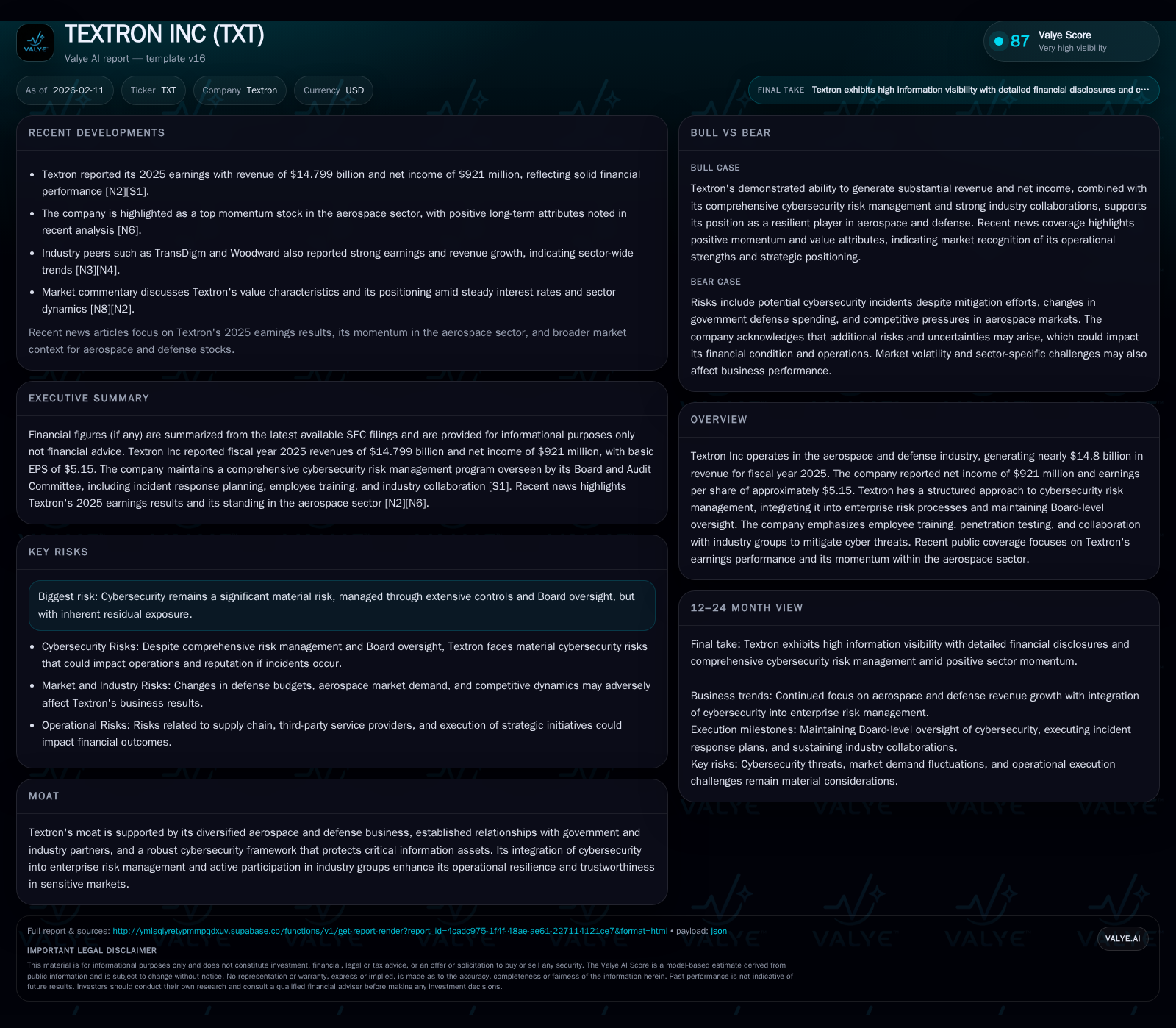
In fiscal year 2025, Textron Inc delivered a strong earnings beat with $14.8 billion in revenue and $921 million in net income, reflecting an EPS of approximately $5.15. This performance stems not only from the company’s broad aerospace and defense diversification but also from its rigorous cybersecurity governance embedded at every organizational level, from Board oversight to employee training. As Textron navigates complex industry risks, their comprehensive approach to cyber risk management and strategic partnerships provide resilience that sets it apart within the competitive aerospace landscape.
2025 Earnings Beat: Beyond the Numbers
Textron’s fiscal 2025 results reveal a significant earnings beat, underscoring the company's resilience in a volatile aerospace environment. With revenues approaching $14.8 billion and net income of $921 million, the reported earnings per share around $5.15 reinforce Textron’s operational strength [F1]. Market reactions noted in recent analyst coverage highlight the company as a standout performer in terms of momentum and value characteristics within aerospace [N1][N8][N10]. These numbers are more than mere statistics; they crystallize an effective integration of diverse business streams from rotary-wing aircraft manufacturing to advanced defense systems.
Investor confidence has been buoyed by this clear demonstration of financial health amidst global economic uncertainties. The ability to sustain profitability gains while managing risk factors signals robust underlying fundamentals, setting a baseline for deeper exploration into how corporate strategies align to drive these outcomes.
Navigating Aerospace Momentum: Textron’s Strategic Differentiators
Textron operates at the nexus of commercial aerospace growth and critical defense contracting — sectors characterized by cyclical swings yet sustained long-term demand. Its diversified portfolio spans Bell helicopters, Textron Systems, and other aviation-related segments, allowing risk dispersion unlike single-focus competitors [Valye excerpt]. Strategic government partnerships strengthen contractual pipelines, providing a moat reinforced by longstanding relationships and technological collaboration [N4][N7].
Industry peers such as TransDigm and Woodward also demonstrate earnings resilience [N2][N3], but Textron's breadth offers an added cushion against narrow market disruptions. This diversification supports organic growth trajectories bolstered by commercial aerospace tailwinds while buffering downturns in defense spending or supply chain shocks.
Such positioning enables Textron to capitalize on synergistic innovation across platforms, sustaining competitive advantage beyond product-level differentiation.
Cybersecurity as a Core Competency, Not Just Compliance
Textron distinguishes itself through cybersecurity practices that transcend typical regulatory checkboxes — embedding cyber risk management centrally within enterprise-level strategy [S1][Valye excerpt]. The company’s Information Services organization, spearheaded by a CIO with deep segmental experience since 2008, ensures alignment across Bell and Textron Systems IT operations.
Supported by a highly qualified CISO recognized for advanced certifications in information security, Textron's defenses focus on proactive threat detection, comprehensive policy enforcement, and continuous engineering improvements [S1]. This layered approach includes robust incident response plans designed to rapidly identify, assess, contain, and remediate intrusions before significant damage can occur.
Importantly, ongoing collaboration with external industry groups fosters knowledge exchange on emergent threats—amplifying Textron's defensive posture beyond internal capabilities.
Boardroom to Battlefield: Governance Deep Dive on Cyber Risk Oversight
Crucial to translating cybersecurity from policy into action is Textron's governance framework. The full Board receives detailed annual briefings from the CIO covering information security controls with supplemental meetings as needed to address critical developments [S1]. This high frequency of engagement evidences a culture of transparency and prioritization rare even within aerospace heavyweights.
The Audit Committee plays an instrumental role overseeing enterprise risk management (ERM), including cyber exposure—helping ensure alignment between technical execution and corporate risk appetite [S1]. Such integration underlines how cybersecurity is not siloed but infused within strategic planning processes—a differentiator enhancing operational agility in crisis scenarios.
This governance model arguably provides greater resilience against increasingly sophisticated cyber threats compared to peers where oversight may be less formalized or episodic.
Employee Culture & Training: The Human Firewall
Recognizing technology alone cannot eliminate all risk vectors, Textron invests heavily in cultivating employee awareness through its security culture initiatives [S1][Valye excerpt]. Mandatory annual cyber safety training educates users on best practices and threat recognition alike.
Simulated phishing campaigns serve as practical drills sharpening vigilance among personnel—directly reducing human error vulnerabilities that often underpin breaches. Penetration testing extends this rigor by stress-testing technical defenses under simulated adversarial conditions with external consultants integrating latest attack methodologies.
Additionally, tabletop exercises prepare cross-functional teams to execute response protocols methodically during actual incidents—fostering coordination that minimizes downtime and reputational harm.
Together these elements form a human firewall complementing technological safeguards—a holistic defense rarely emphasized with such consistency elsewhere in the sector.
Peer Context: How Textron Stands Among Aerospace Giants
Benchmarking Textron against industry leaders highlights nuanced distinctions shaping its current market narrative. GE Aerospace has surged over 50% in stock gains over the past year amid catalytic investments [N7], while TransDigm posted solid quarterly beats driven by aftermarket sales growth [N2]. Woodward similarly exceeded expectations fueled by strong operational execution [N3].
Compared to these peers, Textron's blend of momentum and perceived value stands out. Its multi-industry approach tempers volatility more effectively than single-segment players while still capturing growth segments—allocating returns across commercial aviation innovation and stable government contracts [F1][N4][N8].
This balanced strategy suggests superior adaptability though it may not command the highest immediate price appreciation versus some pure-play competitors; instead rewarding longer-term investors seeking steadiness amid evolving aerospace dynamics.
Risks in Focus: Managing Residual Cyber Threats Amid Growth
Despite extensive controls, residual cybersecurity risks constitute a material concern acknowledged explicitly by Textron’s disclosures [S1][Valye excerpt][S2]. Sophisticated threat actors continually evolve tactics targeting sensitive aerospace IP and defense technology assets.
Textron mitigates these exposures via layered protections yet does not discount potential impacts ranging from data compromise to operational disruption—risks that could affect customer trust or contract viability should incidents escalate beyond containment capabilities.
The Board’s proactive oversight coupled with ongoing investment in defense mechanisms attempts to balance risk acceptance with vigilant mitigation. Investors must weigh these realities alongside growth opportunities as part of comprehensive risk-return assessments.
Valuation Perspectives and Long-Term Investment Thesis
Recent analyst commentary frames Textron as simultaneously an attractive momentum candidate due primarily to its strong recent financial performance and as a value proposition benefiting from disciplined execution amid sector cyclicality [N1][N8][N10].
Its valuation merits derive from sound fundamentals anchored by diversification plus cybersecurity robustness that heightens trust among government buyers—critical during periods of geopolitical uncertainty affecting the aerospace-defense space.
While acknowledging inherent residual risks notably around cyber threats, the company’s governance depth and cultural investment provide credible buffers supporting sustainable positioning over time.
This sets the stage for measured optimism without disregarding prudent skepticism required when navigating complex industrial ecosystems exposed to evolving technological challenges.
This analysis is meant solely for informational purposes based on publicly available data as of early 2026. It does not constitute investment advice or recommendations. Readers should conduct their own due diligence considering personal circumstances before making financial decisions related to Textron or its industry peers.
Disclaimer: This is research-only, informational analysis and not investment advice. It may include AI-generated interpretation and general industry context. Always verify important details using primary sources.

Comments