
United Airlines Leverages Strong Yields to Offset Fuel Cost Pressures in Q2
In Q2 2026, UAL balanced rising fuel costs with effective yield management and capacity discipline, underscoring its operational resilience.
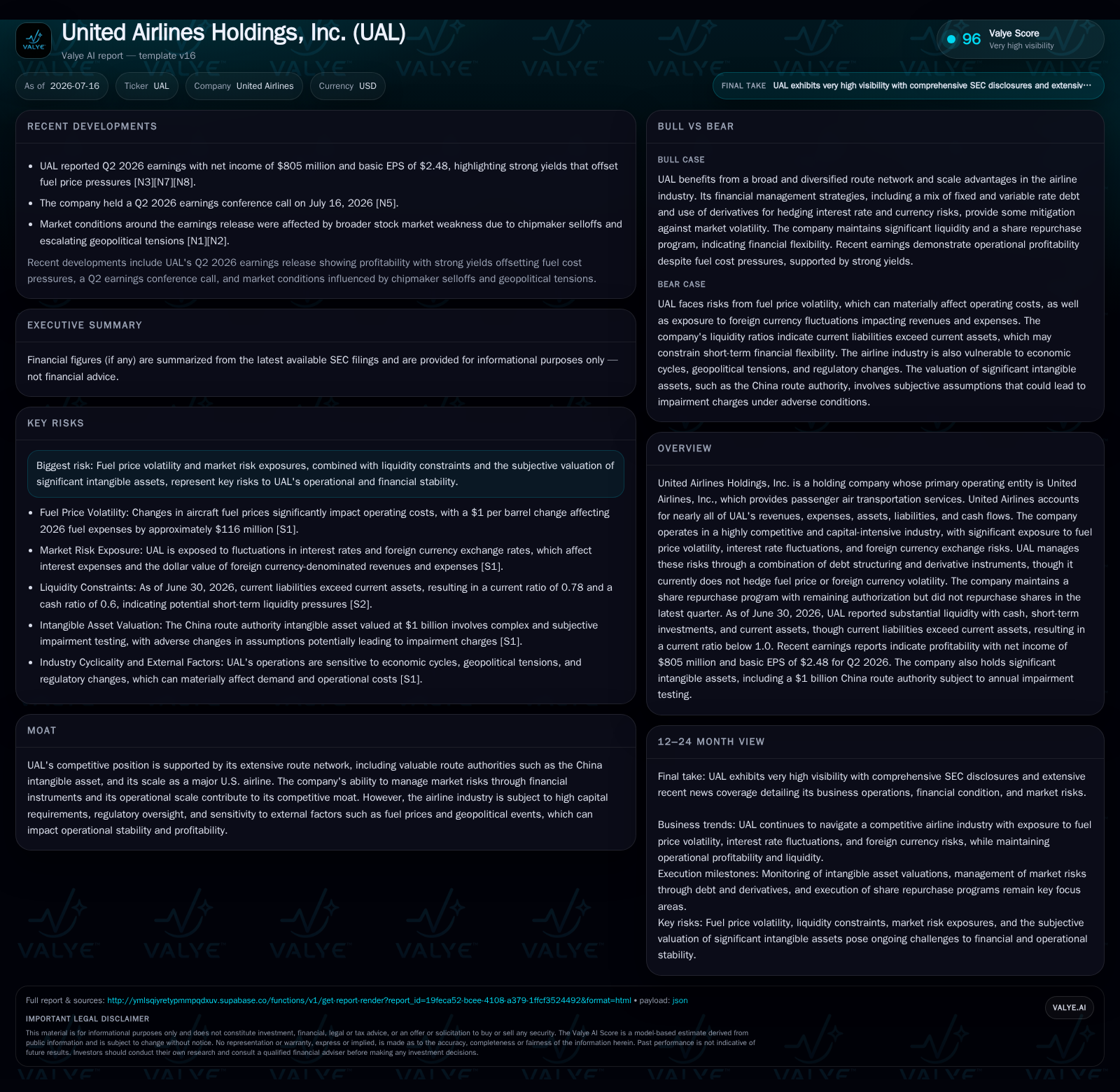
United Airlines Holdings reported a second quarter marked by robust yield per passenger mile that helped counteract escalating fuel expenses. The absence of fuel hedging left the company exposed to volatile commodity prices, but disciplined capacity adjustments and growth in ancillary revenue streams contributed to margin support. United's extensive hub-and-spoke network and valuable route authorities underpin its competitive moat, while ongoing fleet modernization and global expansion present growth avenues amidst operational challenges. Liquidity remains solid though current ratios indicate working capital tightness typical for the sector.
Q2 Dynamics: Balancing Yield Strength against Rising Fuel Costs
United Airlines Holdings, Inc. reported a complex operational landscape in Q2 2026, where yield management played a critical role in offsetting rising fuel expenses. The company achieved an increase in yield per passenger mile, a key airline KPI that measures revenue generated per mile flown by paying passengers, signaling effective fare pricing and premium cabin load optimization [S2]. This yield improvement partially counterbalanced the significant escalation in jet fuel costs, which surged amid the company's strategic decision to forgo fuel price hedging during the quarter [S1]. While this no-hedging stance exposes United to spot market volatility, it also preserves upside potential if fuel prices decline. The combined effect of higher fuel prices and yield gains compressed operating margins but did not fully negate the benefits of disciplined capacity management. United adjusted its available seat miles (ASM) in response to evolving demand patterns, reflecting its ongoing capacity discipline aimed at optimizing fleet utilization and maintaining cost efficiency [S2].
Revenue Composition: Ancillary Streams Bolstering Passenger Ticket Growth
United's revenue model extends beyond base ticket sales to include significant ancillary revenue streams, a vital component of profitability in the legacy airline sector. These ancillary revenues encompass baggage fees, preferred seating charges, and MileagePlus loyalty program partnerships, which enhance revenue per passenger without proportionally increasing variable costs [S1]. Such diversification supports EBITDAR margins by mitigating fare commoditization pressures and competitive discounting. This approach aligns with strategies employed by peers like American Airlines Group and Delta Air Lines, who similarly leverage ancillary products to strengthen unit economics and customer segmentation. Ancillary revenue per passenger remains a critical metric for United, contributing to revenue resilience amid fluctuating passenger load factors and competitive fare environments.
Network Advantage: Route Authorities and Hub Scale Maintain Moat
United operates a capital-intensive hub-and-spoke network centered on major U.S. hubs including Chicago O'Hare and Newark Liberty, which drives high operational leverage through optimized fleet utilization and connecting traffic flows [S1]. The airline's competitive moat is reinforced by valuable airport slots and exclusive route authorities, notably its rights to key international markets such as China, which enable premium long-haul service offerings with higher yield potential [F1][S1]. These intangible assets limit competitor access and enhance United's pricing power on strategic routes. However, the absence of fuel hedging means that sudden spikes in jet fuel prices directly increase the cost per available seat mile (CASM), a critical efficiency benchmark. While some legacy carriers hedge portions of their fuel exposure to stabilize costs, United's current policy reflects a calculated trade-off between risk and flexibility [S1]. This strategy requires vigilant monitoring of fuel price trends and their impact on operating margins relative to peers.
Growth Opportunities: Expanding Global Routes and Fleet Modernization
United's growth strategy focuses on expanding its international footprint, capitalizing on rising global travel demand driven by expanding middle-class populations and regulatory liberalization that facilitates new route openings [S1]. The airline is actively modernizing its fleet through supplemental purchase agreements with Airbus for the A320 family and Boeing for widebody aircraft, aiming to enhance fuel efficiency and reduce operating costs per ASM [S2]. These investments are expected to improve fleet utilization and lower fuel consumption per mile, supporting margin expansion and environmental sustainability goals. The fleet renewal also provides capacity flexibility to adjust to demand fluctuations and competitive dynamics.
Operational Watchpoints: Capacity Discipline, Labor Relations, and Regulatory Factors
Labor relations remain a critical operational risk given United's unionized workforce, with potential impacts on wage inflation, operational continuity, and labor negotiations [S1]. Capacity planning is challenged by the cyclical nature of travel demand and external uncertainties such as geopolitical events and macroeconomic shifts that influence booking trends [S2]. Additionally, evolving environmental regulations impose compliance costs related to carbon emissions reduction, which United addresses through sustainability initiatives and fleet upgrades. These factors collectively influence cost structure and operational stability.
Forward-Looking Indicators: Booking Trends, Cost Controls, and Capital Allocation
Key metrics to watch include early booking curve shifts that signal demand changes, CASM trends reflecting cost management effectiveness amid fuel price volatility, and progress on fleet delivery schedules that underpin modernization efforts [S3]. Notably, United did not execute any share repurchases in Q2 despite having approximately $755 million authorized under its ongoing buyback program, indicating a cautious capital allocation stance amid margin pressures [S2]. Future adjustments to share repurchase activity or fuel hedging policies would provide insight into management's confidence in the operating environment and risk appetite.
Financial Profile: Liquidity Cushion Amid Capital Intensity
As of June 30, 2026, United Airlines Holdings maintained a strong liquidity position with cash and cash equivalents exceeding $10.1 billion, providing a substantial buffer to support ongoing capital expenditures typical of the airline industry [F1]. However, the company's current ratio stood at approximately 0.78, reflecting working capital tightness driven by sizable current liabilities, including lease obligations and short-term debt [F1]. Total debt remained elevated at over $21 billion as of December 31, 2025, though mitigated by available revolving credit facilities and a balanced mix of fixed and variable rate debt instruments designed to manage interest rate exposure [F1][S1]. The company employs financial derivatives primarily for currency risk management but continues to accept fuel price risk unhedged, which remains a significant operating leverage factor. This financial flexibility supports United's strategic investments in fleet renewal and network expansion while providing resilience against short-term market disruptions.
In summary, United Airlines Holdings demonstrated operational resilience in Q2 2026 by leveraging strong yield per passenger mile growth and disciplined capacity management to partially offset the impact of rising jet fuel costs amid an unhedged fuel price environment. Its extensive hub-and-spoke network and exclusive route authorities underpin a defensible competitive position within the legacy carrier segment. The company's liquidity and capital structure provide a solid foundation for continued fleet modernization and global expansion initiatives. Monitoring booking trends, CASM dynamics, labor relations, and capital allocation decisions will be essential to assessing the sustainability of margin recovery and overall financial health beyond the quarter.
Disclaimer: This analysis incorporates information from publicly filed SEC documents through July 16, 2026 ([S1]-[S3], [F1]) combined with general industry knowledge without constituting investment advice or research views.
Disclaimer: This is research-only, informational analysis and not investment advice. It may include AI-generated interpretation and general industry context. Always verify important details using primary sources.

Comments