
DBV Technologies Advances Manufacturing and Regulatory Pathway for VIASKIN® Peanut Patch
Recent operational updates highlight DBV Technologies’ progress toward commercial-scale manufacturing and the advancing regulatory dossier for its lead immunotherapy product.
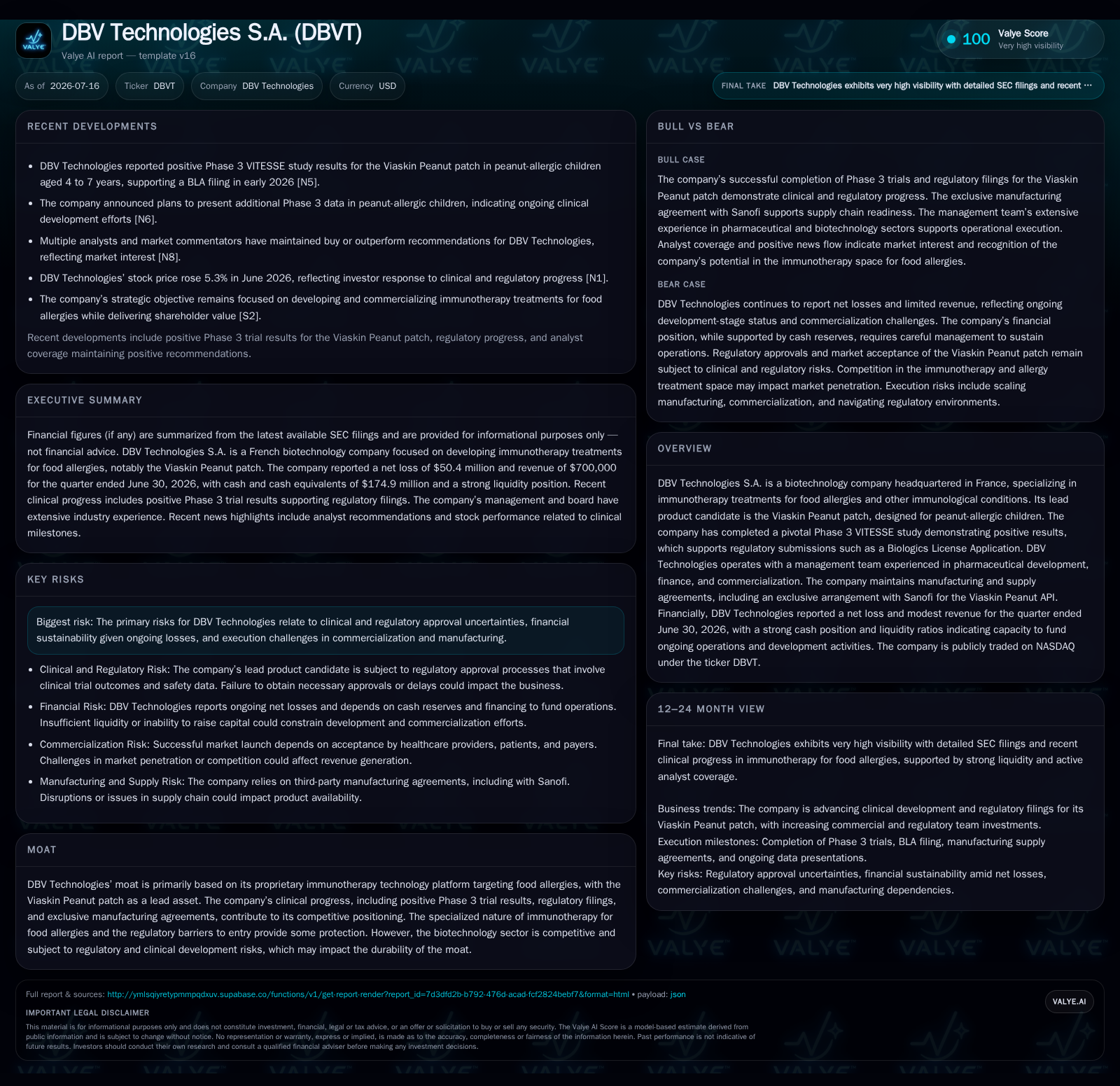
DBV Technologies is a clinical-stage biotechnology firm focused on epicutaneous immunotherapy with its flagship Viaskin Peanut patch for peanut-allergic children. The company recently signed a letter of intent with Fareva Amboise for commercial manufacturing readiness, signaling infrastructure expansion ahead of potential product launch. The successful Phase 3 VITESSE trial supports DBV’s ongoing regulatory engagement, including FDA Biologics License Application preparations targeting pediatric age groups. While DBV remains in an investment phase with operating losses, its cash runway extends beyond twelve months supported by strong liquidity. Execution risks remain primarily related to regulatory approvals, manufacturing scale-up, and commercialization readiness.
Recent Operating Update
DBV Technologies S.A., headquartered in France, reported its latest quarterly results as of June 30, 2026, accompanied by a material event filing dated July 16, 2026 [S2][S3]. The foremost operational highlight is the execution of a letter of intent with Fareva Amboise to undertake commercial-scale manufacturing preparation for the VIASKIN® Peanut patch [S2]. This agreement encompasses infrastructure upgrades, workforce expansion, and manufacturing readiness activities. Formalization into a definitive commercial manufacturing and supply contract is underway. This move underscores DBV's transition from clinical-stage to potential commercial launch readiness.
Concurrently, DBV emphasizes ongoing regulatory engagement supported by favorable Phase 3 VITESSE trial data which underpins its Biologics License Application (BLA) preparation for VIASKIN Peanut [S1][S9]. The company is targeting approvals encompassing peanut-allergic children aged 4-7 years as well as toddlers aged 1-3 years through anticipated accelerated pathways. Initiation of confirmatory effectiveness studies in the toddler population is expected to further solidify the clinical case.
Business Model Analysis
DBV Technologies operates within the biotechnology archetype focused on discovery, development, and commercialization of novel immunotherapy products. Its lead asset is the VIASKIN Peanut patch—a proprietary epicutaneous immunotherapy platform designed to desensitize peanut-allergic children by delivering allergenic compounds through intact skin to modulate immune response [S1].
Revenue streams are not yet established from product sales since VIASKIN remains investigational with pending regulatory approvals. Current revenues are limited primarily to licensing agreements or milestone payments if any; however, the filings do not indicate significant revenue recognition to date [F1]. Instead, DBV incurs substantial research & development (R&D) and operating expenses linked to clinical trials, regulatory interactions, manufacturing scale-up preparations, and growing commercial infrastructure.
Manufacturing represents a critical element given the delicate formulation of epicutaneous patches requiring specialized handling. Partnering initially with Sanofi for active pharmaceutical ingredient (API) supply helped secure critical supply chain elements [S1]. The recent letter of intent with Fareva signals scaling manufacturing capacity for commercial demand post-approval [S2]. Transitioning from pilot-scale clinical batches to large-scale consistent production demands operational expertise and capital investment.
Commercialization dynamics will involve building sales channels addressing allergists and pediatricians who manage food allergy patients. Pricing models often combine insurer reimbursement frameworks with potential patient assistance programs given the pediatric patient base. Early investments in market education and payer engagement are anticipated once approvals finalize.
Industry Structure and Competitive Position
Within biotechnology specializing in immunotherapy modalities for allergic diseases, DBV occupies a niche focused on epicutaneous delivery. Peers like Regeneron Pharmaceuticals in immune-related biologics or Allergan in allergy therapeutics offer broader portfolios but less direct overlap in delivery methodology. Novel oral immunotherapies or biologic monoclonal antibodies for food allergy represent alternative competitive landscapes.
Regulatory barriers loom large given safety concerns inherent to immunotherapy involving allergens in children. Moreover, the requirement for robust Phase 3 data complemented by confirmatory post-marketing studies creates elongated development cycles requiring significant capital commitments.
Manufacturing partnerships akin to DBV's Fareva collaboration mirror industry trends where small-to-mid sized biotechs outsource large-scale production capabilities to contract manufacturing organizations (CMOs) with specialized expertise ensuring compliance with good manufacturing practices (cGMP). These alliances reduce upfront fixed costs but introduce execution dependency risks.
Growth Drivers
- Regulatory Milestones: Approval of the VIASKIN Peanut patch via FDA BLA will shift DBV into commercial revenue generation mode; label expansions into younger toddlers could broaden addressable market.
- Manufacturing Scale-Up: Successful validation of Fareva’s commercial manufacturing site will be critical for uninterrupted supply reliability during launch phase.
- Pipeline Expansion: While the current filings focus on VIASKIN Peanut, pipeline diversification into other allergens or immunological conditions could mitigate single-product dependency risk.
- Market Adoption: Physician acceptance driven by demonstrated safety-efficacy profiles combined with payer reimbursement success will underpin revenue ramp.
- Strategic Partnerships: Licensing or co-commercialization deals could accelerate geographical penetration especially outside primary markets.
Risks and Watchpoints
- Regulatory Approval Risks: Despite positive Phase 3 data, there remains inherent uncertainty around FDA approval timing or label scope that could delay or limit commercialization opportunity [S9].
- Manufacturing Execution Risks: Scaling complex patch technology poses risks related to batch consistency, quality control issues or supply chain disruptions that could impact launch readiness [S2].
- Financial Sustainability: Operating losses remain substantial with net cash used in operations increasing year-over-year due to clinical development intensification and buildout of commercial functions [S26]. Further capital raises may be necessary depending on final approval dates and market entry dynamics.
- Commercial Execution Challenges: As a relatively small biotech moving toward market launch, risks include limited salesforce scale relative to larger competitors and navigating uncertain reimbursement environments.
- Competition: Emerging oral immunotherapies or alternative biologic treatments may erode market share or pricing power post-launch.
What to Watch Next
Upcoming milestones include:
- Definitive signing of the commercial manufacturing agreement with Fareva establishing committed production capacity [S2].
- Submission and FDA review outcomes of the BLA for VIASKIN Peanut covering children aged 4-7 years [S9].
- Initiation timing of confirmatory effectiveness Trial in toddlers aged 1-3 that could support accelerated approval pathways [S9].
- Quarterly operating metrics detailing R&D spend allocation shifts reflecting clinical enrollment rates or new indications pursuit [S24].
- Expansion updates on sales & marketing staffing indicative of launch-readiness progress [S24].
Financial Profile Discussion
As of June 30, 2026, DBV Technologies holds approximately $175 million in cash and cash equivalents against current liabilities near $54 million yielding a robust current ratio around 3.72 — indicating solid short-term liquidity adequate to fund continuing operations well into late 2027 under current assumptions [F1][S2][S26]. Total debt appears minimal relative to cash buffers, limiting leverage risk.
Operating losses are expected given aggressive investment in late-stage clinical development and preparatory commercialization activities. Cash used for operating and investing activities reached about $103 million over six months ended June 30, reflecting step-ups in clinical trial enrollment costs, manufacturing readiness upgrades—including property plant & equipment investments—and expansion of medical affairs and commercial functions [S26][S24]
The company’s forecast accounts for planned alignment measures intended to modulate spending pace consistent with revised regulatory timelines but acknowledges potential variability based on external factors such as regulator feedback speed or currency fluctuations [S26]. Capital raising strategies remain open options contingent on evolving needs but past successful financings (e.g., March 2025 PIPE) provide precedent demonstrating access to equity markets when required [S25][S26].
DBV Technologies sits at a pivotal inflection point typical of specialty biotech transitioning from development-heavy R&D expense profiles toward commercialization-driven operational complexities. The company’s focus on an innovative epicutaneous platform addresses a clear unmet medical need in pediatric food allergy immunotherapy providing differentiation yet exposing it to classic biotech sector risks around regulation, capital intensity, manufacturing scale-up challenges, and competitive innovation pipelines. Monitoring upcoming regulatory interactions alongside execution at partner manufacturing sites will be critical signals determining trajectory toward sustainable value creation beyond the developmental stage.
This analysis synthesizes publicly available filings without offering investment advice or forecasts tailored research views.
Disclaimer: This is research-only, informational analysis and not investment advice. It may include AI-generated interpretation and general industry context. Always verify important details using primary sources.

Comments