
JFB Construction Doubles Q1 Revenue Boosted by Franchise Growth and Capital-Fueled Expansion
Strong franchise demand and recent capital raises support JFB’s workforce and real estate ventures despite margin pressures from labor and material cost increases.
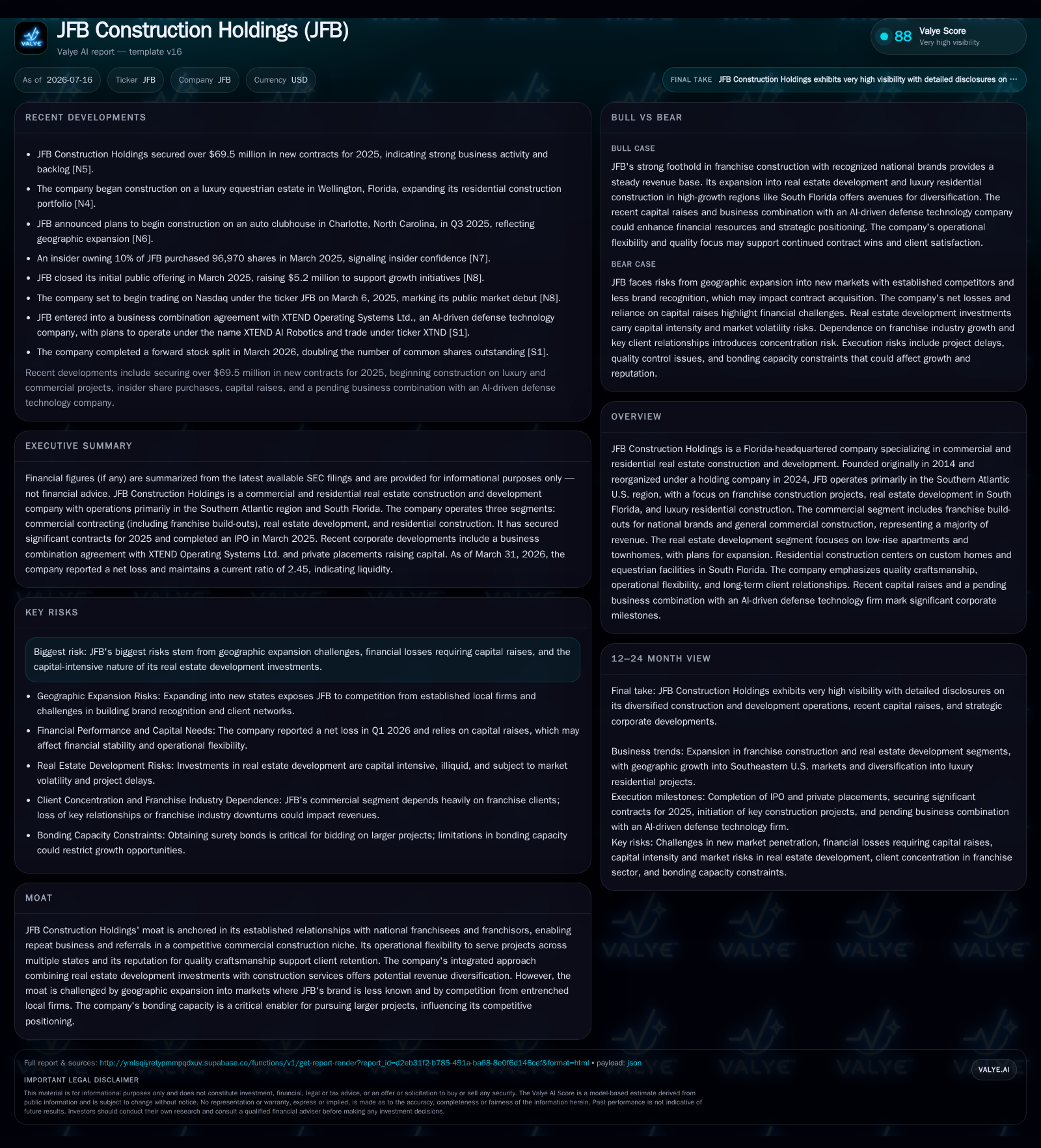
JFB Construction Holdings reported 115% revenue growth in Q1 2026 driven primarily by its commercial franchise build-out segment, reflecting solid demand and client retention in the Southern Atlantic region and beyond. The company's strategic capital raises are funding workforce expansion and real estate development projects, supporting growth ambitions despite near-term margin pressures from labor and material cost increases. JFB is leveraging operational flexibility across multiple states and intends to expand its real estate footprint with joint ventures, balancing project backlog growth against execution risks related to geographic brand recognition and capacity scaling. Monitoring backlog health, bonding capacity utilization, and cost variance will be key to validating its path forward.
Latest Quarterly Operating Momentum and What It Signals for JFB’s Strategy
JFB Construction Holdings reported a dramatic revenue increase of 115% in the first quarter of 2026 compared with the same period in 2025, signaling robust demand particularly within its commercial franchise build-out segment [S2][S18]. This surge reflects not only strong underlying franchisor-franchisee relationships but also an expanding project backlog that benefits from JFB’s national operational flexibility. Completed franchise retail space now exceeds two million square feet across 36 states, underscoring JFB's broad geographic footprint beyond its traditional Southern Atlantic base [S1]. Despite this top-line momentum, operating expenses have risen sharply due to increased labor wages and material costs, which is compressing margins.
Management's plans to hire additional project managers and bolster sales teams reveal a strategic emphasis on scaling capacity to handle multiple simultaneous projects efficiently; these moves are funded by recent capital raises totaling approximately $53 million from stock issuances early in 2026 [S1][S22]. This wage inflation and workforce expansion create a tradeoff between revenue growth and margin preservation that will require close monitoring of labor utilization rates and cost variance against project budgets — standard KPIs within construction contracting.
Furthermore, ongoing merger discussions with Xtend AI Robotics introduce another dimension of operational complexity but potentially broaden JFB's technological capabilities post-combination. The amended merger agreement anticipates closing by late 2026 subject to customary conditions [S3][S25]
Integrating Commercial Franchise Buildouts With Real Estate Development — The Business Model Synergy Questioned
JFB operates across three strategic segments: commercial franchise build-outs representing the majority of current revenues nationally; a South Florida concentrated real estate development business focusing on multifamily housing such as apartment complexes and townhouses; and a niche luxury residential construction division specializing in custom homes and equestrian facilities [S1][S23]. This diversification offers rational revenue streams but equally introduces capital allocation complexities.
The real estate development arm employs joint ventures to share investment risk amid its gradual geographic expansion ambitions. While this lowers capital intensity per project relative to wholly owned developments, the business remains sensitive to local market conditions and regulatory factors. It also presents different cash-conversion dynamics compared with contracting work, influenced by property sales or leasing cycles.
Luxury residential projects deliver premium per-unit contributions but are constrained by regional concentration in South Florida without immediate plans for broader rollout. This segment contrasts with the high-repeat-volume nature of franchise build-outs that benefit from long-term client loyalty and established approval pipelines.
Overall, the integration of these segments aims at building a resilient business model blending recurring contracting revenues with periodic real estate development income streams; however, managing diverse operating rhythms across these units will test execution capabilities.
Operational Flexibility Across States Supports JFB’s Multi-Segment Footprint Amid Competitive Pressures
JFB’s capability to serve franchise build-outs in varied U.S. markets reflects meaningful operational agility supported by scalable subcontractor networks and bonding capacity—which allow it to bid competitively outside its core Southern Atlantic stronghold [S1]. This flexibility is pivotal given competition from entrenched regional contractors who often possess local reputational advantages.
By contrast, competitors like Turner Construction exemplify national general contractors with large-scale infrastructure expertise beyond franchising niches; while D.R. Horton or Toll Brothers provide relevant comparators for residential development scale but operate with different capital structures.
The labor market tightness prevalent across states imposes staffing challenges that influence project timelines and cost structures. JFB’s reported headcount of only 22 full-time employees supplemented by subcontractors indicates reliance on flexible labor sourcing but exposes potential capacity constraints if rapid scaling fails to match backlog growth [S1]. Successfully managing this balance is crucial for maintaining client satisfaction and retention rates that underpin repeat franchise business.
Capital Raise Dynamics and Bonding Capacity: How JFB Enables Growth but Faces Execution Risks
Capital raised through private placements—$43.9 million raised via Series C preferred stock along with additional shares issued earlier in 2026—funds pivotal initiatives including hiring project managers, sales staff, executive professionals, and financing real estate investments [S1][S22]. This infusion underlines confidence from accredited investors while highlighting capital-intensive growth phases typical for firms simultaneously scaling construction services alongside property development.
Bonding capacity represents a limiting factor in bidding larger contracts or supporting multi-state expansions. Although precise bonding metrics were not disclosed openly, industry norms suggest that increased bonding limits correlate directly with potential contract size capture. Monitoring utilization trends will indicate whether JFB can leverage its expanded capital base into proportional increases in guaranteed project pipeline volume.
However, rising labor wages coupled with supply chain volatility in steel, aluminum, lumber, and other construction materials translate into margin erosion risks if not offset by productivity gains or pricing renegotiations. Cost variance metrics relative to budgets will serve as key indicators going forward.
Growth Drivers: Leveraging Client Loyalty and Regional Real Estate Trends While Managing Labor Costs
Demand drivers include sustained franchisor confidence reflected in steady re-engagements for retail build-outs nationally—demonstrating elevated client stickiness uncommon in generic commercial contracting sectors—and demographic-driven housing needs fueling South Florida real estate development [S1]. Urbanization trends favor multifamily community construction while affluent consumer preference supports luxury custom home orders.
Real estate segment growth may accelerate via joint ventures identified as risk-mitigating avenues allowing access to new markets without full capital burdens. Meanwhile, effective labor utilization amidst wage inflation requires enhanced project management discipline.
In this environment, JFB's ability to forecast labor needs accurately amid uncertain contract award timings becomes critical—excess staffing could induce cost overruns due to idle payroll while shortages may delay completions.
Watchpoints Going Forward: Project Backlog Health, Geographic Expansion Execution, and Cost Control Metrics
Additionally, successful penetration of targeted new markets relies on overcoming brand recognition hurdles through phased rollouts supported by increased marketing investments and local subcontractor alliances per management commentary [S1][S23]. Failure here would constrain growth despite an expanded resource base.
Cost control remains under scrutiny given documented operating losses ending FY2025; favorable cost variance maintenance against volatile materials prices would signal operational agility necessary for sustainable profit improvement.
Financial Profile Discussion: Liquidity Cushion Versus Capital-Intensive Growth Tradeoffs
JFB maintains a current ratio of 2.45 at March 31, 2026, supported by current assets of approximately $20.6 million against current liabilities near $8.4 million, indicating comfortable short-term obligations coverage [F1]
However, ongoing losses underscore the importance of disciplined capital allocation especially when balancing expenditures between contracting workforce scale-up versus slow-turning real estate assets. The success of pending mergers or partnerships could materially affect financial flexibility going forward.
This analysis uses publicly filed quarterly (10-Q), annual (10-K/A), Form 8-K disclosures from May through July 2026 combined with relevant companyfacts data as of Q1 2026 to provide an informed perspective on JFB Construction Holdings’ operational performance within its industry context. Peer comparisons serve illustrative framing rather than direct competition benchmarks due to lack of explicit market share data.
Disclaimer: This is research-only, informational analysis and not investment advice. It may include AI-generated interpretation and general industry context. Always verify important details using primary sources.

Comments