
Blue Star Foods’ Integration and Sustainability Drive RAS Expansion Amid Liquidity Challenges
Blue Star Foods focuses on sustainably sourced seafood and aquaculture growth while navigating significant financial constraints.
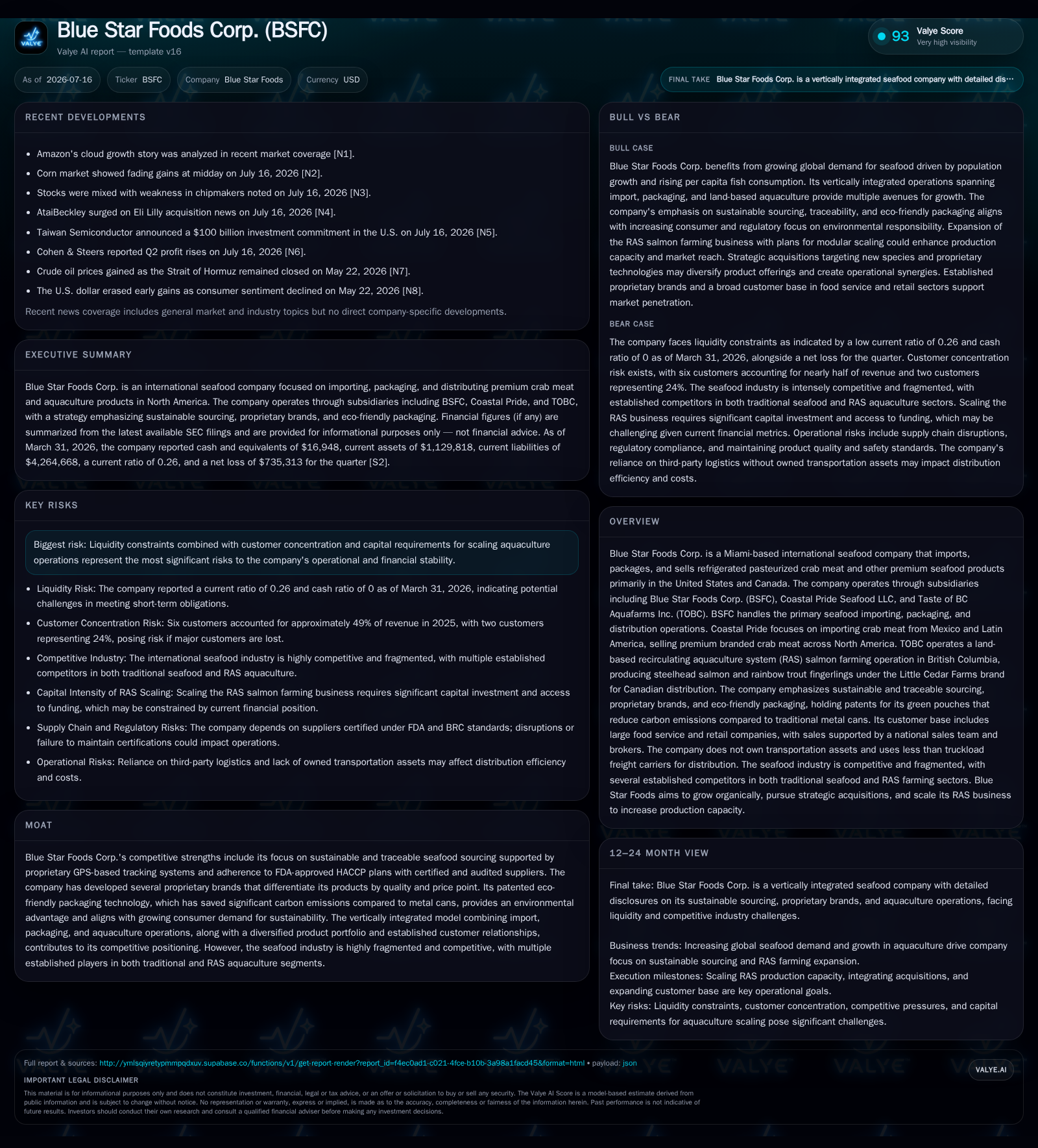
Blue Star Foods Corp., headquartered in Miami, operates a vertically integrated seafood business importing pasteurized crab meat and farming steelhead salmon using land-based recirculating aquaculture systems (RAS). The latest quarterly filings reveal ongoing efforts to scale RAS production toward a 21,000-ton target by 2028 through modular facility expansion in British Columbia, contingent on securing capital. While proprietary brands, eco-friendly packaging, and traceability strengthen positioning amidst fragmented competition, significant liquidity constraints and high customer concentration pose notable risks. Financial metrics suggest tight working capital with a low current ratio of 0.26 and persistent operating losses weighing on sustainability.
Recent Operating Update: Scaling Aquaculture Amid Capital Constraints
Blue Star Foods Corp. continues to advance its land-based recirculating aquaculture system (RAS) operations through its subsidiary Taste of BC Aquafarms (TOBC), which currently operates a pilot facility in Nanaimo, British Columbia, with an annual production capacity of approximately 100 metric tons of steelhead salmon and rainbow trout fingerlings marketed under the Little Cedar Farms brand to Canadian distributors [S1][S3]. This facility serves as a prototype for Blue Star’s modular expansion strategy, aiming to replicate standardized 150-ton production modules to scale output efficiently. The company plans to build a series of larger facilities, each comprising multiple such modules, targeting a cumulative production capacity of 21,000 metric tons of steelhead salmon by 2028, contingent on securing sufficient equity and debt financing [S1][S4]. This land-based RAS approach offers controlled bio-secure environments that mitigate risks common in ocean net-pen aquaculture, such as disease outbreaks, environmental contamination, and wild stock interactions, thereby supporting consistent production volumes and improved fish health management.
Business Model: Vertical Integration with Emphasis on Quality, Traceability, and Sustainability
Blue Star’s vertically integrated seafood business operates primarily through three subsidiaries: Blue Star Foods Corp. (BSFC), which manages importation, packaging, and distribution; Coastal Pride Seafood LLC, specializing in importing premium pasteurized crab meat from Mexico and Latin America under proprietary brands including First Choice, Good Stuff, and Coastal Pride Fresh; and TOBC, which oversees the RAS salmon farming operations [S1][S20]. The company’s product portfolio combines imported refrigerated pasteurized blue and red swimming crab meat sourced mainly from Southeast Asia, Mexico, and Latin America with domestically farmed steelhead salmon and rainbow trout fingerlings produced via RAS technology.
Revenue generation primarily derives from sales to food service wholesalers, retail establishments including wholesale clubs, and seafood distributors across the U.S. and Canada [S7][S12]. Transactions are predominantly executed through purchase orders rather than long-term contracts, exposing the company to demand variability and execution risk. Customer concentration is significant, with six customers accounting for approximately 49% of revenue in 2025, and two customers alone representing 24%, underscoring vulnerability to customer loss [S7].
Sustainability and traceability are core competitive differentiators. Blue Star employs FDA-approved Hazard Analysis and Critical Control Points (HACCP) plans, supplier certifications such as BRC audits, and GPS-based tracking technology throughout its supply chain to ensure product safety and provenance [S17]. The company’s patented eco-friendly plastic packaging, in use since 2003, reportedly reduces carbon emissions by over one million metric tons compared to traditional metal cans, aligning with growing consumer demand for environmentally responsible seafood products [S4]. This packaging innovation also supports improved product yield rates and shelf life, critical KPIs in seafood processing and distribution.
The vertical integration from import through processing to land-based aquaculture farming enables tighter control over quality metrics, supply reliability, and traceability compliance rates, which are essential for maintaining relationships with major foodservice accounts and retail channels. However, operational challenges remain, including exposure to biomass fluctuations in crab fisheries and potential product contamination risks despite stringent food safety protocols [S1][S13].
Industry Structure and Competitive Position
The international seafood and aquaculture industry is highly fragmented, with competitors ranging from specialized importers and distributors like High Liner Foods to large-scale aquaculture producers such as Atlantic Sapphire and Mowi ASA. Blue Star differentiates itself by spanning multiple nodes in the seafood value chain—from Southeast Asian crab meat sourcing and co-packing through proprietary branded marketing to emerging high-tech land-based RAS salmon farming [S1][S20].
In the imported crab meat segment, Blue Star competes with companies such as Tri Union Frozen Products (Chicken of the Sea Frozen Foods), Phillips Foods, Harbor Seafood, Newport International, and Twin Tails Seafood Corp. In the RAS salmon farming segment, competitors include Atlantic Sapphire, Aquaco, Nordic Aquafarms, Whole Oceans, Kuterra, and Pure Salmon [S7]. The company’s focus on premium branded products and sustainability credentials aims to capture market share in North American food service and retail channels, where consumer preferences increasingly favor traceable and eco-conscious seafood.
Price pressures and commodity volatility affect the imported crab meat business, while the capital-intensive and technically complex nature of RAS aquaculture presents barriers to entry and scaling challenges. Regulatory complexity, including FDA oversight in the U.S. and Canadian fisheries regulations, adds further operational risk [S13][S24].
Growth Drivers: Sustainability, Premiumization, and Technological Advances
Blue Star’s growth strategy is supported by several structural industry trends. Rising global demand for animal-based protein, particularly in developing markets, incentivizes increased aquaculture production as wild fisheries plateau or decline [S4]. Consumer preferences in developed markets increasingly reward certified sustainability and traceability, enabling premium pricing and margin expansion. Technological advances in RAS systems improve scalability and biosecurity, allowing year-round production with reduced environmental impact.
Strategic acquisitions aim to diversify species offerings and geographic reach, leveraging operational synergies and integrating sustainability models into traditionally operated companies to enhance margins through premium eco-conscious product introductions [S4]. Organic growth focuses on expanding the customer base within retail clubs, foodservice wholesalers, and seafood distributors, while introducing new high-value product lines that meet evolving sustainability standards [S1][S4][S7].
Innovation in eco-friendly packaging resonates strongly with environmentally conscious consumers, particularly in premium market segments, supporting brand differentiation and customer loyalty.
Risks and Watchpoints: Liquidity Constraints and Operational Challenges
Capital expenditures required to scale RAS facilities are substantial and contingent on successful equity or debt financing, with management emphasizing reliance on external capital markets to fund growth beyond the pilot phase [S4][S8]. Failure to secure adequate funding could delay or curtail expansion plans, increasing execution risk.
Operational risks include biomass fluctuations in crab fisheries, which can affect supply volumes and pricing, as well as potential product contamination and food safety incidents despite compliance with HACCP and other regulatory standards [S1][S13][S24]. Legal disputes related to aquaculture licensing and lease agreements in British Columbia introduce further uncertainty around operational continuity [S5].
Customer concentration remains a critical vulnerability, with the loss of key customers potentially causing material adverse impacts on revenue and cash flow [S7]. Supply chain volatility, including import/export restrictions and commodity price fluctuations, also pose ongoing challenges.
Financial Profile and Outlook
Capital expenditures for RAS facility expansion represent a significant cash outflow, with management explicitly linking growth plans to successful capital raises via equity or debt markets [S4][S8]. Monitoring cash flow from operations, working capital trends, and production volume ramp-up will be essential to assess execution progress.
Overall, Blue Star’s vertically integrated model, sustainability focus, and multi-segment presence position it to capitalize on favorable industry trends. However, material execution risks tied to liquidity constraints, customer concentration, regulatory complexity, and operational scaling remain key watchpoints.
Disclaimer: This analysis is for informational purposes only and does not constitute investment advice. All financial and operational data are sourced from company filings and publicly available documents.
Disclaimer: This is research-only, informational analysis and not investment advice. It may include AI-generated interpretation and general industry context. Always verify important details using primary sources.

Comments