
Zoomcar’s Shift to Asset-Light Platform Highlights Indian Peer-to-Peer Car Sharing Challenges
Zoomcar continues navigating liquidity constraints while expanding its AI-driven peer-to-peer car sharing platform focused on India’s emerging markets.
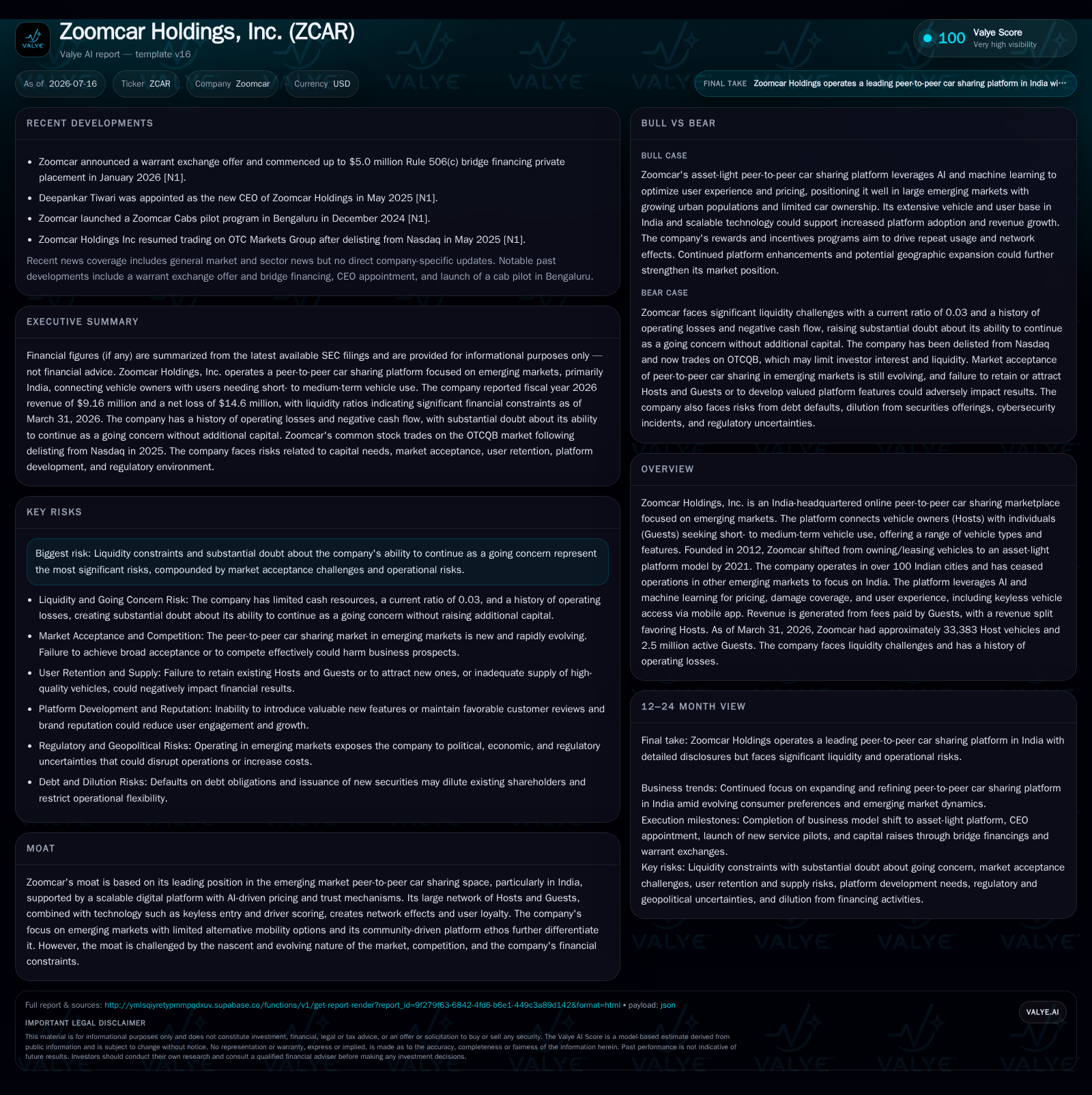
Zoomcar Holdings, Inc. operates a peer-to-peer car sharing marketplace in India, connecting vehicle owners (Hosts) with renters (Guests) via a digital platform leveraging AI-powered pricing and keyless access. Its transition from owning vehicles to an asset-light marketplace has enabled scale with over 33,000 Host vehicles and 2.5 million active Guests as of early 2026. However, the company faces substantial liquidity challenges, trading on OTCQB after Nasdaq delisting, and persistent operating losses with defaulted debt obligations. Going forward, sustainable growth relies heavily on improving platform engagement and securing capital to support operations amid a competitive and nascent market environment.
Recent Operating Update
Zoomcar Holdings, Inc. reported its quarterly results for the period ending December 31, 2025, underscoring its full transition to an asset-light peer-to-peer car sharing platform focused exclusively on India’s urban markets [S2][S1]. The company no longer owns or leases vehicles but instead operates a digital marketplace connecting private vehicle owners (“Hosts”) with renters (“Guests”) seeking flexible, short- to medium-term mobility solutions. This strategic shift aims to leverage network effects by scaling both sides of the marketplace while minimizing capital expenditure.
As of early 2026, Zoomcar’s platform supports approximately 33,383 active Host vehicles and serves around 2.5 million active Guests, reflecting significant scale in India’s peer-to-peer car sharing segment [S1]. However, the company has not publicly disclosed vehicle utilization rates or average booking durations, which are critical operational KPIs in this sector to gauge marketplace liquidity and revenue efficiency.
Zoomcar’s technology stack incorporates AI-driven dynamic pricing algorithms designed to optimize vehicle utilization and balance Host earnings with Guest affordability. The platform also integrates damage coverage modeling to mitigate trust and safety risks inherent in peer-to-peer rentals. A notable competitive differentiator is its keyless vehicle access system, controlled via a mobile app, which streamlines the rental process by eliminating physical key exchanges and enhancing user convenience [S1]. These features align with global peer-to-peer car sharing leaders such as Getaround, which similarly leverage technology to improve operational scalability and user experience.
The company’s equity market position remains challenged following its May 2025 delisting from Nasdaq due to failure to meet minimum listing standards, including market capitalization thresholds [S1][S2]. Since then, Zoomcar’s shares have traded on the OTCQB platform under the ticker "ZCAR," a transition that typically reduces trading liquidity and investor access. Additionally, penny stock regulations discourage broker-dealers from facilitating transactions, further limiting secondary market activity
Business Model Assessment
Zoomcar operates a digital intermediary platform that monetizes primarily through booking fees charged to Guests, with a revenue-sharing model that compensates Hosts for vehicle rentals. This asset-light approach contrasts with traditional car rental companies that own fleets or leasing firms that rely on long-term contracts. The business model’s scalability depends heavily on maintaining a balanced and engaged base of Hosts and Guests to ensure high vehicle utilization and frequent bookings.
Key operating variables influencing revenue generation include:
- Number of active Hosts supplying vehicles;
- Number of active Guests booking rentals;
- Average booking duration, which affects turnover and revenue velocity;
- Dynamic pricing effectiveness impacting average revenue per booking;
- Platform take rate, or the percentage fee retained by Zoomcar on each transaction.
While Zoomcar has disclosed its active Host and Guest counts, it has yet to reveal utilization rates or take rates, which are standard KPIs in peer-to-peer car sharing to assess marketplace health and monetization efficiency [S1]
Management highlights post-booking user engagement as a critical growth lever, aiming to convert Guests from one-time or sporadic users into repeat customers by expanding use cases and deepening platform interaction beyond discrete trip planning [S1]. Enhancing retention and lifetime value through improved app features or loyalty programs could materially increase gross booking value (GBV) and net revenue over time.
Industry Structure and Competitive Position
Zoomcar operates within the emerging market peer-to-peer car sharing industry, where digital platforms connect private vehicle owners with renters seeking flexible transportation. This model is particularly relevant in India, where public transit infrastructure is often insufficient and vehicle ownership costs remain high.
Globally, Zoomcar’s competitive set includes US-based platforms like Turo and Getaround, which operate in more mature markets but face similar challenges around trust, safety, and network liquidity. Getaround’s adoption of keyless access technology parallels Zoomcar’s approach, underscoring the importance of seamless digital experiences in scaling peer-to-peer rentals.
In India, Zoomcar competes not only with traditional car rental companies such as Avis Budget Group, which maintain fleet ownership but are increasingly integrating digital booking capabilities, but also with ride-hailing firms like Ola and Uber. These mobility-as-a-service providers offer vehicle rentals or subscription services that overlap with peer-to-peer offerings but differ in asset ownership and operational models.
The competitive landscape is shaped by factors including technology innovation, network scale, regulatory compliance, and user trust mechanisms. Zoomcar’s focus on AI-driven pricing and damage coverage aims to differentiate its platform, but it must continuously balance Host supply with Guest demand to maintain marketplace liquidity and user satisfaction.
Growth Drivers
Several structural and strategic factors underpin Zoomcar’s growth potential:
- Rapid urbanization and increasing demand for flexible, on-demand transportation solutions in India;
- Rising smartphone and internet penetration facilitating platform access for Guests and Hosts;
- Cost advantages of peer-to-peer rentals compared to car ownership or traditional leasing, appealing to price-sensitive consumers;
- Continued investment in AI-powered pricing and damage coverage to improve utilization and reduce operational risks;
- Focused efforts to enhance post-booking engagement, aiming to increase repeat usage and customer lifetime value;
- Geographic concentration in over 100 Indian cities, allowing deeper market penetration and operational focus;
- Potential regulatory support for shared mobility initiatives that could lower barriers and encourage adoption.
Risks and Watchpoints
Zoomcar faces significant risks primarily related to its financial condition and market environment. The company’s liquidity is severely constrained, with cash and equivalents of approximately $328,586 against current liabilities exceeding $37.5 million as of March 31, 2026, resulting in a critically low current ratio of about 0.03 [F1]. This liquidity crunch is compounded by defaulted debt obligations carrying high-interest rates—up to 22% default interest—and ongoing payment delays, which restrict operational flexibility and increase refinancing risk [S2].
Market acceptance of peer-to-peer car sharing in India remains nascent, with cultural preferences for vehicle ownership and informal transport options posing adoption challenges. Building trust through damage coverage and reliable service is essential but requires sustained investment.
Regulatory uncertainties around insurance liability, vehicle sharing compliance, and data privacy in emerging markets add complexity and potential cost burdens. Additionally, technology risks such as cybersecurity breaches or platform outages could undermine user confidence and disrupt operations.
Operationally, maintaining a balanced supply of Hosts relative to Guest demand is critical. Host shortages in key urban centers would reduce vehicle availability, negatively impacting Guest satisfaction and platform liquidity, potentially triggering adverse network effects.
Finally, the company’s delisting from Nasdaq and subsequent OTCQB trading status limit capital market access, increasing dependence on private financing and heightening dilution risk.
What To Watch Next
Key indicators to monitor include enhancements in post-booking engagement metrics, which management identifies as a pivotal growth lever. Improvements in Guest retention rates and average bookings per Guest would signal progress in monetizing the existing user base [S1]
Tracking the size and activity of the Host fleet alongside vehicle utilization rates will provide insight into marketplace liquidity and operational efficiency.
Capital raising or refinancing developments will be critical to assess Zoomcar’s ability to sustain operations beyond its limited cash runway, which under conservative assumptions extends only into the second quarter of calendar year 2026 [S2][F1]
Regulatory developments in India concerning shared mobility policies, insurance frameworks, and digital transaction oversight warrant close attention for their potential impact on operating costs and compliance requirements.
Finally, monitoring secondary market liquidity and investor interest post-Nasdaq delisting will offer indirect signals about the company’s access to public capital markets.
Financial Profile Discussion
Zoomcar’s financial position remains precarious. As of March 31, 2026, the company reported cash and cash equivalents of approximately $328,586 against current liabilities of $37,535,986, resulting in a current ratio of roughly 0.03, indicating a severe shortfall in liquid assets to cover near-term obligations [F1]
Total debt stood at approximately $2.51 million as of March 31, 2025, with net debt (total debt minus cash) around $2.18 million, though actual indebtedness may be higher due to default interest penalties and unreported accruals [F1]
The company’s history of operating losses continues, with operating income of negative $6.77 million and net income of negative $14.62 million for the latest reported period, underscoring the urgent need for capital infusion and operational improvements to achieve sustainable profitability [F1]
Zoomcar’s ability to improve gross booking value and platform take rates through enhanced user engagement and supply growth will be critical to narrowing losses and stabilizing cash flow.
Disclaimer: This analysis is for informational purposes only and does not constitute investment advice. Readers should consult primary sources and financial professionals before making investment decisions.
Disclaimer: This is research-only, informational analysis and not investment advice. It may include AI-generated interpretation and general industry context. Always verify important details using primary sources.

Comments