
United States Gasoline Fund's Financial Volatility and Strategic Positioning in Gasoline Futures
UGA’s financial swings mirror gasoline futures volatility and regulatory constraints, shaping its role as a niche commodity exposure vehicle.
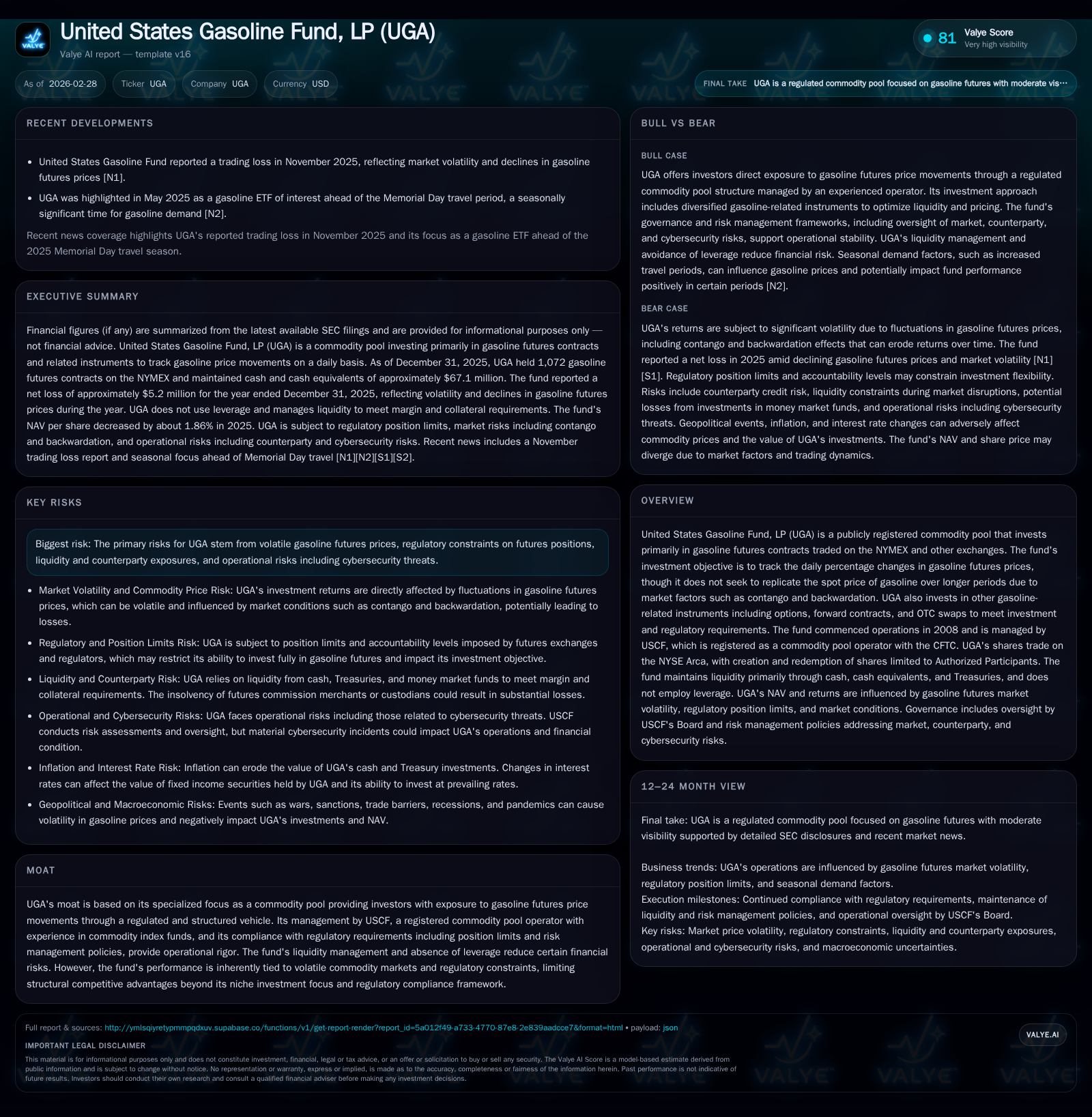
United States Gasoline Fund, LP (UGA) offers targeted exposure to gasoline futures prices through a regulated commodity pool structure that inherently bears significant price volatility. Its historical earnings profile has shown pronounced swings aligned with underlying futures market dynamics, including contango and backwardation effects that complicate tracking spot prices. Regulatory position limits and daily price fluctuation caps constrain its operational flexibility, while a no-leverage policy and prudent liquidity management underline its capital allocation discipline. Looking forward, investors should monitor geopolitical risks, regulatory changes, and futures curve structure shifts alongside tax law developments that may affect net returns.
UGA’s Historical Earnings Volatility and Market Drivers
United States Gasoline Fund's (UGA) financial results vividly illustrate the inherent volatility of gasoline futures markets. From 2022 through 2025, top-line revenue swung dramatically: positive near $9.6 million in 2022 and $7.5 million in 2024, but negative $8.2 million in 2023 and negative $5 million in 2025 [F1]. Likewise, net income followed this pattern with substantial profits in favorable years (approximately $9.4 million in 2022; $7.2 million in 2024) offset by sharp losses in downturn years (~-$8.4 million in 2023; -$5.2 million in 2025) [F1]. Operating cash flow also varied significantly, peaking above $19 million in 2022 before declining below zero in the most recent year [F1].
This cyclical earnings pattern parallels fluctuations in gasoline futures prices influenced by supply-demand shocks, seasonality impacts on demand for transportation fuels, geopolitical events altering crude oil inputs, and broader macroeconomic trends. UGA’s revenue is derived principally from changes in futures contract valuations rather than cash sales of a product; thus, gains or losses reflect mark-to-market valuations driven by volatile derivatives markets rather than traditional operating income.
Historical performance (annual)
| FY | Rev ($mm) | Net ($mm) | CFO ($mm) | Rev YoY | Net YoY |
|---|---|---|---|---|---|
| 2025 | -5 | -5 | -2 | -166.5% | -172.0% |
| 2024 | 8 | 7 | 1 | +191.3% | +185.9% |
| 2023 | -8 | -8 | 14 | -185.3% | -189.5% |
| 2022 | 10 | 9 | 19 |
Source: SEC companyfacts cache [F1].
The volatility is emblematic of commodity futures investments where marked-to-market results fluctuate widely due to price volatility rather than stable cash flows.
Impact of Market Structure: Contango, Backwardation, and Tracking Challenges
UGA’s task of replicating gasoline price movements is complicated by structural phenomena prevalent in futures markets: contango (future prices exceed spot prices) and backwardation (spot prices exceed future prices). The fund aims to track the daily percentage changes in benchmark gasoline futures contracts; however these natural market conditions induce roll yield impacts as contracts nearing expiration must be rolled into longer-dated contracts with differing price levels [S1].
The roll yield effect causes systematic tracking error between UGA’s NAV changes and the actual spot price of gasoline over longer durations. When the curve is in contango—which often results from storage costs or supply glut—rolling involves selling cheaper expiring contracts and buying more expensive longer-dated ones causing negative returns beyond spot movements. Conversely backwardation can enhance returns but adds complexity to timing.
This dynamic forces asset managers like USCF to carefully execute daily roll strategies within tight windows to mitigate tracking discrepancies—yet structural inefficiencies remain an inherent limitation for commodity-focused funds unlike physically-backed ETFs.
Regulatory Environment: Exchange Limits and CFTC Oversight
Regulatory constraints imposed by exchanges NYMEX/ICE Futures and overseen by the Commodity Futures Trading Commission (CFTC) shape UGA’s operating latitude through accountability levels and position limits on authorized contract holdings [S1][S6]. Accountability levels—thresholds for large exposures—trigger enhanced scrutiny but are not hard limits; for example, NYMEX sets a current accountability level of 5,000 contracts per month for benchmark gasoline futures [S1]. Position limits are statutory ceilings that cannot be exceeded without CFTC approval.
These rules protect market integrity by preventing dominant speculative positions yet restrict UGA from aggressively scaling positions which might reduce tracking error or amplify returns during certain market conditions. Daily price fluctuation limits cap how much daily moves futures can register on exchanges preventing extreme moves but potentially impeding rapid hedging or repositioning.
As of December 31st, 2025 UGA held roughly 1,072 NYMEX gasoline futures contracts without breaching any position or accountability thresholds [S1], demonstrating ongoing compliance but indicating headroom constraints should it seek scale expansion.
Capital Structure and Liquidity Management: No Leverage Approach
UGA’s capital deployment strategy reflects operational prudence common among commodity pools prioritizing risk containment over return enhancement via leverage [S4][S5][F1]. The fund does not utilize borrowing or lines of credit to finance purchases of futures contracts or margin requirements but relies on sizable holdings of cash equivalents and Treasuries serving dual roles as margin collateral and liquidity buffer.
As of end-2025 it held over $67 million in cash and equivalents earmarked both for margin calls related to derivative positions and to meet redemption needs per its creation/redemption basket mechanics wherein shares are issued or redeemed typically in blocks of 50,000 shares [S4][S5][F1]. This ensures it can meet contractual obligations without forced asset sales amid adverse market conditions.
Operating expenses including management fees paid to USCF run at approximately a fixed annualized rate of 0.60% of average net assets paid monthly as disclosed [S17], balanced against investment income generated from cash/Treasury holdings.[F1]
The no-leverage stance contains counterparty credit risk while limiting upside enhancements yet aligns with regulatory expectations for prudent margin/asset coverage ratios governing registered commodity pools.
Performance Outlook: Key Risks and What to Monitor
Looking ahead investors should monitor several pivotal variables influencing UGA’s performance trajectory:
- Commodity price volatility: Sharp swings driven by rapidly evolving geopolitical developments impacting oil supply chains or fuel demand trends present ongoing uncertainty affecting valuation marks.
- Regulatory evolution: Potential tightening under CFTC or SEC rules could introduce further restrictions on speculative positions or margin requirements limiting trading agility.[S6]
- Tax code developments: Uncertainties around federal tax regulations governing limited partnerships investing in commodities carry risk for investor after-tax returns.[S1][S2]
- Counterparty risk: Although mitigated by trading only with creditworthy entities for OTC swaps there remains residual bankruptcy/default risk impacting valuation certainty.[S14]
- Market structure shifts: Changes from contango to backwardation states or vice versa materially alter roll yield profiles impacting long-term gains/losses.[F1]
- Inflationary pressures may erode value held as cash equivalents adding modest headwinds.[S2]
Key metrics include monitoring shifts in NYMEX gasoline futures curves for term structures signaling future pricing trends plus review of SEC/CFTC filings announcing changes affecting fund operations.
Taxation Complexity and Investor Implications
UGA operates as a limited partnership imposing distinct tax treatment complexities uncommon among registered mutual funds [S1][S2]. Shareholders do not receive clean pass-through economic result-based allocations but rather taxable income/loss allocations that may diverge significantly from realized economic gains owing to IRS conventions applied by the fund.
There are substantial risks if IRS audits challenge these allocations possibly resulting in reallocation assessments adverse to investors—or worse classification of UGA as a corporation triggering double taxation layers. Moreover legislative proposals at federal levels targeting commodity funds’ taxation frameworks create uncertainty augmenting investor tax planning challenges.[S2]
Investors should anticipate possible timing differences where taxable events arise before cash distributions occur leading to out-of-pocket tax liabilities exceeding distributions received. Use of professional tax advice remains critical given these nuances coupled with state-level filing complexities regarding partnerships engaged chiefly in commodity trading activities.
Risk Management Systems including Cybersecurity Measures
Operational resilience hinges on rigorous risk control systems administered by USCF managing UGA’s affairs under contractual management agreements [S10][S11]. Since UGA itself lacks independent IT infrastructure the overarching onus falls on USCF who employ a multifaceted cybersecurity framework tailored for commodity fund governance standards.
This includes third-party cybersecurity service audits focusing on data confidentiality integrity—especially concerning sensitive trading data interfaces—and ensuring compliance with CFTC segregation provisions requiring client asset separation maintained through federally regulated Futures Commission Merchants (FCMs).[S10][S11]
A comprehensive periodic risk assessment encompassing threat actor characterization functional impact analyses informs executive-level reporting mechanisms ensuring prompt remediation action when necessary maintaining continuity amid evolving cyber threat landscapes.
Synthesis: Positioning UGA Amid Gasoline Futures Market Dynamics
In synthesis United States Gasoline Fund epitomizes a highly specialized investment vehicle delivering direct exposure exclusively tied to fluctuations in gasoline futures prices underpinned by structurally volatile energy derivatives markets [F1][N1][S1][S4]. Its historical performance footprint illustrates the wide amplitude swings typical within this segment compounded by roll yield effects arising from contango/backwardation curves constraining precise tracking capabilities.
Overlaying this is a stringent regulatory framework governing position sizing coupled with stringent liquidity-focused capital allocation policies eschewing leverage illustrating conservative operational discipline aimed at mitigating credit counterparty risks.[S6] The fund’s complex taxation model introduces layered hurdles typical among LP-style vehicles demanding tailored strategies addressing taxable income unpredictability versus realized economic value.[S2][S14]
For portfolio architects contemplating commodity allocation buckets with non-correlated characteristics relative to equities or bonds UGA represents a niche option offering pure play exposure devoid of leverage inducements yet exposed inherently to fundamental energy market volatility drivers from global supply-demand dislocations through geopolitical flux periods.[N1] Monitoring changes spanning regulatory edicts especially those promulgated by CFTC/SEC plus evolving fiscal taxation environments will be paramount given their outsized influence on net investor outcomes post-market movement impacts.
This analysis leverages publicly filed financial data through fiscal years ending December each year alongside detailed regulatory disclosures without projection nor investment advice. All insights reflect the specific operational realities defining United States Gasoline Fund's unique positioning within the energy commodities derivatives landscape.
Disclaimer: This is research-only, informational analysis and not investment advice. It may include AI-generated interpretation and general industry context. Always verify important details using primary sources.

Comments