
U-Haul Holding Co: Navigating a Q3 Loss Amid Enduring Market Leadership
An in-depth review of U-Haul’s entrenched market position, recent quarterly setback, and prospects amid sector challenges.
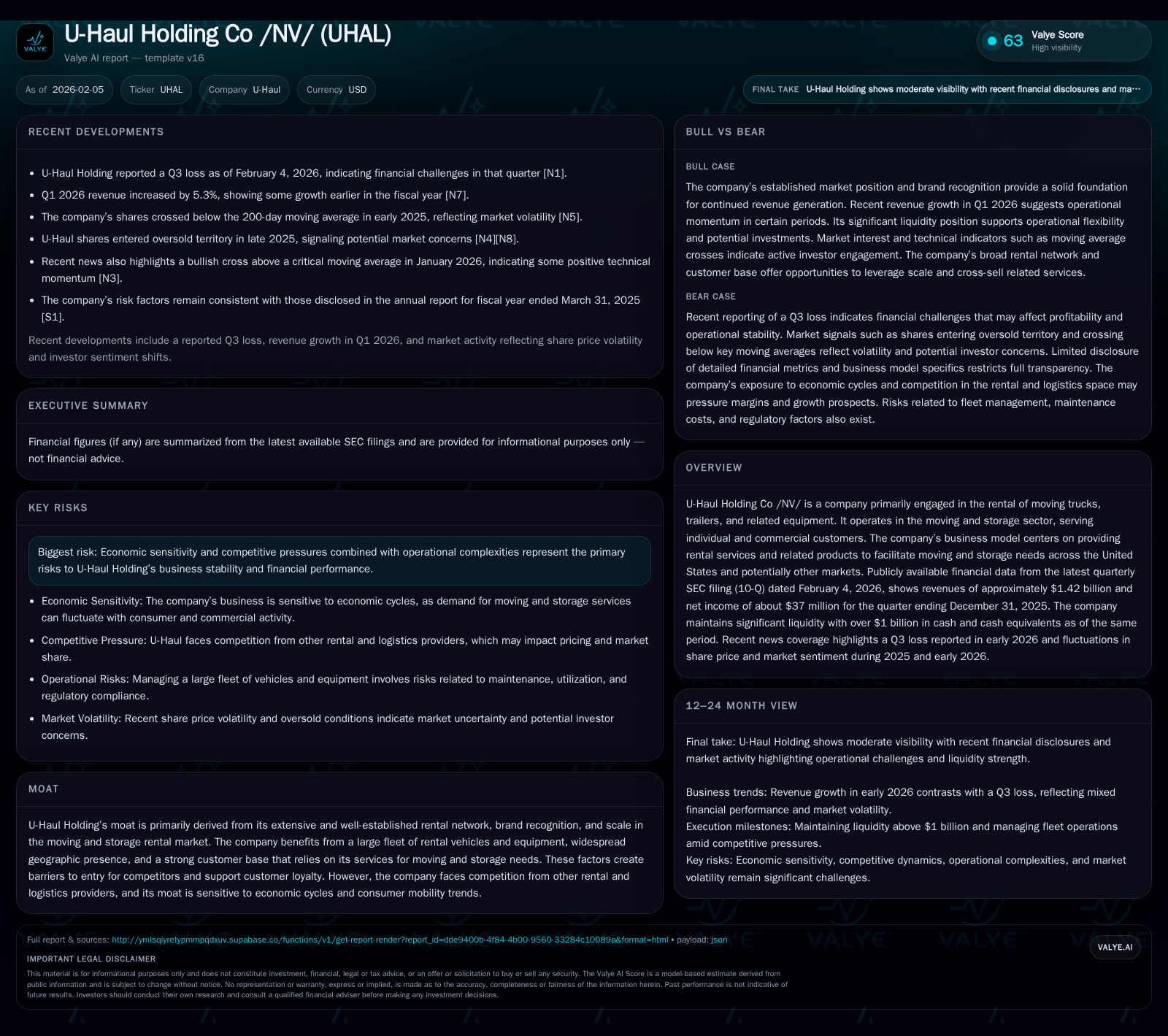
U-Haul Holding Co maintains a formidable competitive moat through its extensive rental network and brand recognition within the moving and storage industry. Despite reporting a surprising Q3 loss in early 2026, the company’s robust liquidity and scale provide a cushion to weather economic headwinds. Share price movements and investor sentiment reflect mixed views as U-Haul balances operational pressures with strategic opportunities. Ongoing risks related to economic cycles and competition underscore the importance of adaptive strategies moving forward.
Legacy of Scale: U-Haul’s Moat in the Moving Market
Few companies have entrenched themselves as deeply in the American moving landscape as U-Haul Holding Co. Renowned for its widespread network of rental trucks, trailers, and self-storage solutions, the company leverages scale not just as an operational metric but as a strategic fortress. This infrastructure extends across thousands of physical locations nationwide, supported by a fleet size that few competitors can match. Beyond sheer numbers, the brand recognition cultivated over decades fosters customer loyalty among both individual consumers embarking on residential moves and commercial clients navigating logistical needs.
This extensive footprint creates formidable barriers for new entrants contending with high capital requirements and logistical complexities. Despite inevitable cyclical downturns tied to macroeconomic mobility trends, U-Haul’s broad presence enables it to capture incremental volume wherever migration flows concentrate. The company’s moat thus rests on tangible assets—vehicles, physical outlets—and intangible ones like trust and recall—cementing its role as a go-to provider in a fragmented market [valye_report_excerpt.moat].
Decoding the Q3 Loss: Numbers and Nuance
The announcement of a quarterly loss for Q3 2025 startled some investors accustomed to steady profitability from this sector stalwart [N1]. Parsing the financial data reveals a revenue figure holding firm at approximately $1.42 billion, signaling that demand may not have weakened broadly [F1]. However, net income contracted sharply to about $37 million—a notable deceleration against prior periods.
Deeper examination suggests that rising operational costs played a central role. Factors likely include increased maintenance expenses on an aging fleet and inflationary pressures on fuel and labor costs. Additionally, revenues potentially bore the brunt of pricing pressures as competitive offers intensified amid slower-than-expected mobility rates.
The absence of extraordinary income or expense items implies these results are reflective of underlying business dynamics rather than one-off events [S2]. This nuance shifts focus from headline losses toward structural shifts influencing margins. It underscores that sustaining profitability requires attention not only to top-line growth but also tighter cost controls and fleet optimization.
Liquidity Strength: A Cushion in Turbulent Times
Offsetting the short-term earnings pressure is U-Haul’s robust liquidity position. As of December 31, 2025, cash and cash equivalents stood above $1 billion [F1], providing substantial runway for strategic flexibility. Such reserves enable investment in newer, more efficient vehicles or technology upgrades without immediate refinancing concerns.
This financial buffer is critical amid uncertainties in consumer mobility patterns influenced by remote work trends, housing affordability constraints, and shifting demographics. Moreover, armed with such cash, U-Haul can navigate competitive pressures more confidently—whether by selectively expanding services or enduring periods of margin compression during market softness.
Market Sentiment and Stock Momentum Signals
Investor reaction throughout 2025 into early 2026 has been nuanced. The Q3 loss announcement initially triggered bearish sentiment due to concerns over sustainability of earnings [N1]. Yet technical indicators painted a more optimistic picture shortly thereafter; notably, the stock made a bullish cross above key moving averages around January 2026 [N3].
This divergence suggests differing narratives at play: fundamental worries coexisting with technical optimism hinting at potential stability or recovery prospects. Traders may be factoring in U-Haul’s underlying strengths or anticipating strategic pivots to address margin pressures.
Together, these forces encapsulate a classic tension prevalent in established industries facing short-term disruptions—a balancing act between caution prompted by recent weakness and confidence rooted in entrenched business models.
Navigating Economic Sensitivity and Competitive Pressures
U-Haul’s management candidly acknowledges persistent risks entwined with economic cyclicality and the competitive landscape [S2; valye_report_excerpt.risks]. Consumer mobility directly influences demand for moving trucks and storage rentals; downturns or stagnation compress utilization rates thereby pressuring profit metrics.
Moreover, competition intensifies beyond traditional rivals to include alternative logistics providers offering flexible pricing or digital-first customer experiences—trends increasingly relevant for younger demographic segments less attached to legacy brands.
Operational complexity further compounds challenges: managing fleet upkeep while maximizing availability requires precision logistics, especially amid price sensitivity among renters. These factors converge to create an environment where strategic missteps carry heightened consequences.
Strategic Outlook: Adaptations or Risks Ahead?
Given this landscape, U-Haul faces pivotal choices regarding future direction. Potential avenues include accelerating technology integration such as enhanced online reservation systems or telematics-driven fleet management aimed at reducing downtime.
Additionally, diversification into adjacent service offerings—perhaps tapping into last-mile delivery solutions or expanded storage formats—could provide new revenue streams enhancing resilience. Capital market dynamics highlighted in recent IPO trend analyses indicate broader appetite for logistics firms innovating along these lines [N2].
However, executing such transitions entails investment risk amid operating margin pressures—underscoring why maintaining liquidity remains paramount while test piloting new initiatives.
Conclusion: Balancing Opportunity and Vulnerability
U-Haul Holding Co stands at an inflection point emblematic of many entrenched service firms confronting evolving markets. Its longstanding strengths—ranging from comprehensive scale to brand stature—continue constituting meaningful competitive moats mitigating outright disruption.
Yet recent quarterly setbacks spotlight vulnerabilities tied to economic sensitivity, operational complexity, and intensifying competition—factors requiring nuanced navigation rather than reactive knee-jerk maneuvers. The company’s solid cash position serves as a stabilizing force enabling measured adaptation rather than wholesale overhaul.
Ultimately, success will likely hinge on balancing preservation of core assets with targeted innovation designed to meet shifting customer preferences without diluting foundational advantages. For stakeholders observing closely, this period offers both cautionary lessons and subtle signals hinting at possible renewal within U-Haul’s enduring move-and-store franchise.
Disclaimer: This analysis is for informational purposes only and does not constitute investment advice or recommendations.
Disclaimer: This is research-only, informational analysis and not investment advice. It may include AI-generated interpretation and general industry context. Always verify important details using primary sources.

Comments