
UMB Financial Corp Amplifies Scale and Profitability via Heartland Acquisition
Strategic acquisition expands UMB's footprint, boosts financial metrics, and refines capital allocation across key banking segments.
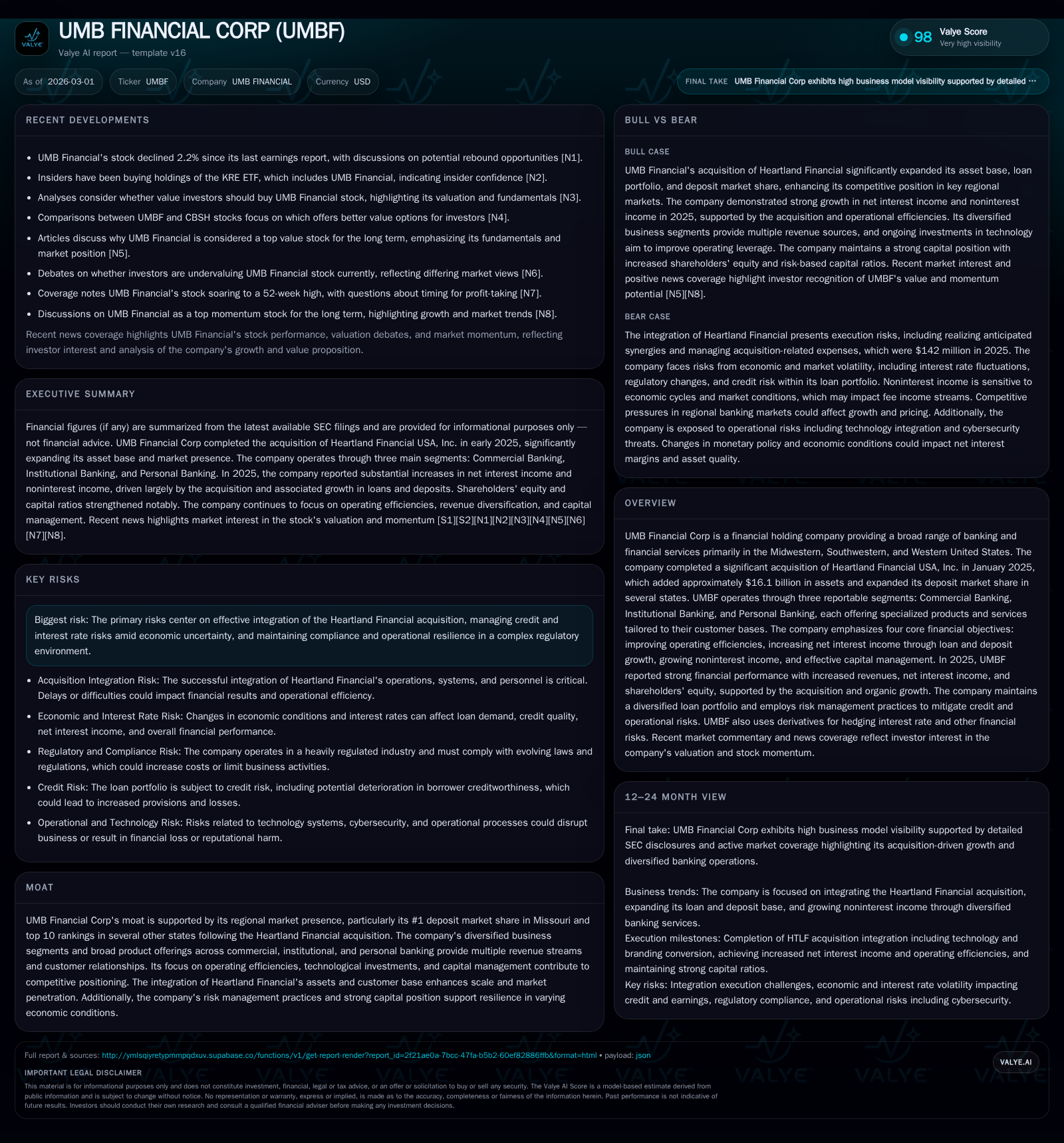
UMB Financial Corp experienced a transformative period between 2022 and 2025, highlighted by its January 2025 acquisition of Heartland Financial USA, Inc. This $16.1 billion asset deal significantly increased UMB’s deposits market share and loan portfolio, catalyzing a 59.2% year-over-year net income surge in 2025 and tripling operating cash flow. The integration enhanced its commercial, institutional, and personal banking platforms through broadened service offerings and geographic reach. Going forward, UMB faces the challenge of sustaining organic growth amid interest rate volatility and post-merger integration risks while maintaining disciplined capital returns emphasizing dividend growth over aggressive buybacks.
From Steady Performance to Leap: Historical Growth and Earnings Drivers
UMB Financial demonstrated significant financial growth from FY2022 through FY2025 anchored by its strategic acquisition completed in January 2025. Net income advanced from $431.7 million in 2022 to $702.4 million in 2025—a 59.2% year-over-year increase post-acquisition [F1]. Operating cash flow (CFO) grew substantially from $225 million in FY2024 to nearly $1.03 billion in FY2025, a gain of 355.7%, highlighting improved earnings conversion into liquidity.
Capital expenditures doubled to $48.6 million in FY2025 from $24.2 million the previous year, supporting operational scaling and technology integration efforts [F1]. Shareholders’ equity nearly doubled from approximately $3.47 billion at FY2024-end to over $7.69 billion by end-2025, reflecting equity issued related to the Heartland transaction [F1].
Historical performance (annual)
| FY | Net ($mm) | CFO ($mm) | Capex ($mm) | Net YoY |
|---|---|---|---|---|
| 2025 | 702 | 1027 | 49 | +59.2% |
| 2024 | 441 | 225 | 24 | +26.1% |
| 2023 | 350 | 473 | 27 | -18.9% |
| 2022 | 432 | 770 | 52 |
Source: SEC companyfacts cache [F1].
Capital returns and efficiency (annual)
| FY | Div ($mm) | Buybacks ($mm) | FCF ($mm) |
|---|---|---|---|
| 2025 | 136 | 18 | 978 |
| 2024 | 77 | 8 | 201 |
| 2023 | 74 | 8 | 446 |
| 2022 | 72 | 32 | 718 |
Source: SEC companyfacts cache [F1].
This performance leap underscores how the Heartland Financial USA acquisition redefined UMB’s scale and earnings base with immediate accretive effects.
How the Heartland Acquisition Transformed UMB’s Market Reach and Loan Portfolio
The January 31, 2025 merger with Heartland added approximately $16.1 billion in assets and expanded UMB’s deposit market presence significantly, positioning it as the top deposit holder in Missouri and among the top ten in surrounding states [N4][S1]. Equity issuance for this acquisition was valued near $2.8 billion supporting the capital base expansion [S19].
Accounting for acquired loans classifies them into Non-Purchased Credit Deteriorated (Non-PCD) loans and Purchased Credit Deteriorated (PCD) loans based on credit deterioration at acquisition date [S2]. Non-PCD loans are accreted into interest income over their contractual lives using the effective interest method; PCD loans receive immediate allowance provisions impacting net interest yields conservatively.
The enlarged loan portfolio contributed notably to net interest income gains post-acquisition amid favorable repricing dynamics under prevailing interest rates [N4][S23]. The company employs a funds transfer pricing (FTP) framework allocating internal funding costs across business segments based on market conditions—facilitating granular profitability analysis after integration [S4].
Analyzing Segment Contributions: Commercial, Institutional, and Personal Banking Dynamics
UMB's operations align into three reportable segments: Commercial Banking, Institutional Banking, and Personal Banking [S4][S15], each catering to distinct client bases with tailored products.
Commercial Banking serves small-to-mid-market businesses offering commercial loans including asset-based lending secured primarily by collateral valuation rather than borrower credit alone [S6][S8]. Since Q3 2025, Non-Depository Financial Institutions have been included under this segment reflecting broader financing activities beyond deposit-taking entities [S6].
Institutional Banking provides fund administration services including custody and trust operations alongside corporate bond underwriting and fixed income sales [S4][S15], generating fee-based revenues from long-term contracts such as fund accounting and healthcare payment solutions.
Personal Banking covers retail deposits plus wealth management services ranging from mortgage lending to trust services delivered through branches combined with digital channels [S4], diversifying revenue sources against market volatilities.
These segments utilize FTP-driven cost allocations enabling clear insights into net interest margin contributions sourced variably across portfolios with differing risk-return profiles.
Future Outlook: Growth Trajectories, Interest Rate Sensitivities, and Integration Risks
While explicit formal guidance is not published [N1][S1], investor communications reflect cautious optimism balancing macroeconomic uncertainties including shifting monetary policies affecting loan demand or deposit behavior [N8][S18]. Post-merger integration remains critical with management focusing on operational synergies realization timelines and cost controls necessary for full value capture from the Heartland merger [S18].
Interest rate volatility presents risks that could compress margins if deposit repricing lags loan yield increases or slow credit origination amid tightening conditions [N1]. Credit risk management incorporates ongoing risk grading and collateral monitoring but remains vulnerable during economic downturns [S17][S20]. Regulatory complexity increases with expanded geographic footprint necessitating compliance across multiple jurisdictions [S18].
Key drivers for future performance include sustaining organic loan growth beyond merger lifts while preserving credit quality amid evolving economic cycles.
Capital Allocation Strategy: Dividends, Buybacks, and Maintaining Robust Capital Ratios
UMB pursues balanced capital deployment emphasizing shareholder returns alongside growth investments [S25]. Dividends paid rose sharply to approximately $135.6 million in FY2025—a gain exceeding 75% compared to earlier years—reflecting strong commitment to income distribution aligned with profit expansion [F1]. Share repurchases were modest at about $17.6 million primarily related to employee incentive programs rather than aggressive open-market buybacks indicating prudent capital stewardship amid merger integration challenges.
Shareholders’ equity reached nearly $7.7 billion by end-2025 from $3.5 billion pre-acquisition supporting an approximate return on equity of 9.1%, evidencing efficient capital use despite enlarged equity base post-transaction [F1]. Liquidity is reinforced by Federal Home Loan Bank advances providing supplemental borrowing capacity of about $1.8 billion as of September 30, 2025 alongside core deposits supporting lending activities [S5].
What Investors Should Monitor Next: Milestones and Potential Challenges Ahead
Investors should watch quarterly trends in portfolio credit quality especially within newly acquired balances including nonperforming loan ratios alongside noninterest income streams such as trust fees or payment processing revenues indicative of cross-selling success post-integration [N6][N10][S1]. Expense growth relative to technology investments will be key for efficiency gains while insider buying activity may signal sentiment shifts around earnings releases [N5]. Regulatory filings will reveal progress on purchase accounting adjustments impacting loan loss reserves or goodwill valuations during ongoing integration phases.
Overall vigilance towards external economic factors such as Fed policy changes or regional slowdowns combined with internal execution on integrating diverse businesses at scale will determine whether UMB sustains momentum established after the Heartland transaction.
This report synthesizes publicly available information without providing investment advice or recommendations regarding UMB Financial Corp securities or strategies.
Disclaimer: This is research-only, informational analysis and not investment advice. It may include AI-generated interpretation and general industry context. Always verify important details using primary sources.

Comments