
United States Natural Gas Fund’s Volatility and Value: A 2025 Review and Outlook
UNG’s unique role as a commodity pool tracking natural gas futures presents sharply volatile returns amid strict regulatory constraints and non-leveraged capital management.
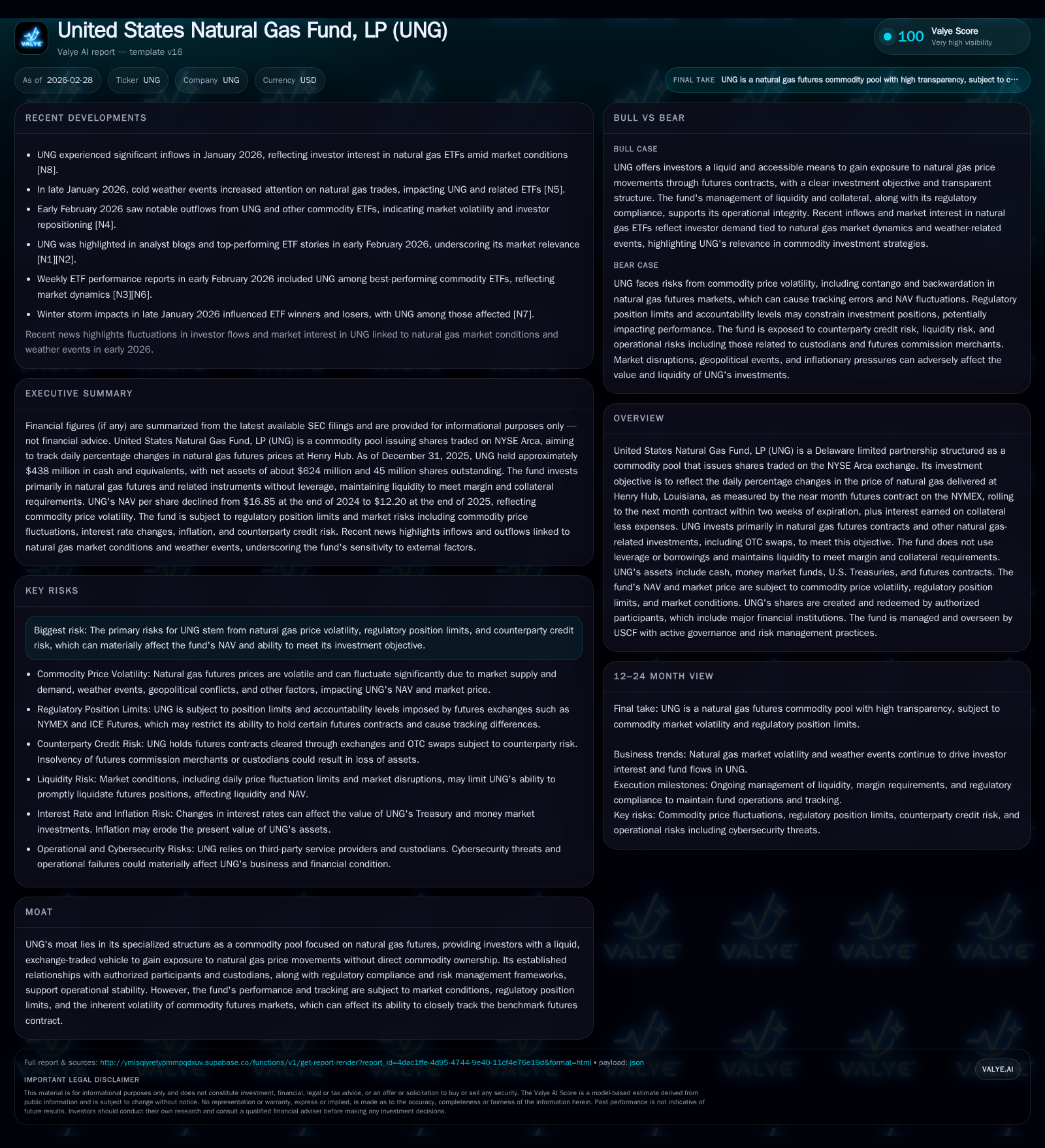
United States Natural Gas Fund, LP (UNG) operates as an exchange-traded commodity pool that seeks to mirror daily price changes in Henry Hub natural gas futures. Its historical financials from FY2022 through FY2025 reveal dramatic revenue and net income swings driven by volatile natural gas futures pricing and market structure factors such as contango and backwardation. Restrictive position limits and daily price fluctuation caps imposed by NYMEX and ICE Futures introduce tracking error risks, while UNG’s disciplined capital allocation avoids leverage, balancing liquidity with collateral demands. Near-term growth will hinge on natural gas price drivers—including weather patterns and demand shifts—and potential regulatory adjustments influencing fund positioning.
UNG's Investment Mechanism: A Liquid Commodity Pool Focused on Natural Gas Futures
United States Natural Gas Fund, LP (UNG) offers investors a unique vehicle to gain exposure to natural gas price dynamics without directly owning the physical commodity. Structured as a Delaware limited partnership traded on the NYSE Arca exchange since its IPO in 2007 [S1], UNG aims to reflect the daily percentage price movement of natural gas delivered at Henry Hub, Louisiana. It achieves this primarily through investments in near-month futures contracts traded on the New York Mercantile Exchange (NYMEX), rolling positions typically within two weeks of contract expiration to maintain continuity.
Complementing futures contracts are over-the-counter (OTC) swaps linked to natural gas prices. Importantly, UNG maintains a strictly non-leveraged posture; it does not borrow or employ debt financing but rather holds significant cash equivalents—including money market funds and U.S. Treasury securities—to meet margin requirements mandated by exchanges [S4][S5][F1]. This structure makes UNG operationally distinct from leveraged commodity funds but also subjects it to particular challenges around tracking error given market mechanics.
Navigating UNG’s Historical Performance and Key Growth Drivers
Analysis of fiscal year financial results from FY2022 through FY2025 reveals the pronounced volatility intrinsic to a fund exposed solely to commodity futures pricing:
Historical performance (annual)
| FY | Rev ($mm) | Net ($mm) | CFO ($mm) | Rev YoY | Net YoY |
|---|---|---|---|---|---|
| 2025 | 5 | 4 | 127 | -90.4% | -93.1% |
| 2024 | 56 | 54 | 48 | +122.4% | +121.2% |
| 2023 | -251 | -254 | -865 | -29.6% | -30.0% |
| 2022 | -194 | -195 | 216 |
Source: SEC companyfacts cache [F1].
Revenue plunged precipitously in FY2025 compared with FY2024 (-90.4% YoY), mirrored by an even steeper drop in net income (-93.1% YoY). Yet operating cash flow delivered a strong recovery (+167.5% YoY), reflecting effective liquidity management amidst volatile mark-to-market earnings on futures positions [F1]. Such swings underscore how closely fund metrics track day-to-day natural gas futures pricing combined with the complexities introduced by rolling contracts.
Dissecting the Impact of Market Volatility on UNG’s Returns
Commodity futures markets inherently deviate from spot markets due to factors known as contango (when futures prices are higher than the spot price) and backwardation (when they are lower). These structures create "roll yield" that can either benefit or detract from total return depending on market conditions. For UNG—exclusively holding near month NYMEX Henry Hub contracts—persistent contango leads to negative roll returns that erode NAV gains relative to spot movements.
Furthermore, NYMEX imposes daily price fluctuation limits restricting how much a contract’s price can move up or down each trading day. Once these caps bind during volatile periods—as seen intermittently—UNG cannot instantly liquidate or reposition contracts at prices beyond set thresholds if desired [S1][S8].
Together these factors explain why daily percentage changes in UNG’s NAV may not correlate precisely with spot natural gas prices nor fully reflect benchmark near month futures moves.
Regulatory Boundaries and Position Limits Shaping Future Performance
UNG’s ability to hold large positions is curtailed by accountability levels and position limits established by NYMEX and ICE Futures exchanges. Accountability levels serve as thresholds beyond which exchanges increase scrutiny of positions; current rules limit any person or group under common control to holding up to 6,000 net contracts for a single month and aggregate limits of 12,000 net contracts across all months [S1].
During FY2025 UNG reportedly exceeded some of these accountability levels for NYMEX NG futures but did not breach ICE Futures limits; however no exchange-mandated reduction was required indicating regulatory tolerance provided oversight information is supplied [S1]. These caps inherently constrain scaling large bullish or bearish allocations in pursuit of benchmark tracking fidelity.
Investors should note that these constraints may amplify tracking error risks during high volatility phases when full benchmark exposure becomes impractical due to positional ceilings.
Near-Term Outlook: What to Watch in Natural Gas Prices and UNG's Positioning
Recent news highlights demonstrated ETF inflows following winter cold snaps—increased heating demand prompted January inflows into commodities including natural gas ETFs like UNG—but were followed by outflows amid warmer forecasts depressing prices [N1][N4][N5][N6][N9]. These fluctuations epitomize how weather patterns act as critical short-term demand-supply shocks impacting investor sentiment toward natural gas derivatives.
Regulatory developments regarding position limit adjustments remain an open variable affecting future fund flexibility. Investors will benefit from monitoring exchanges for any announcements altering accountability or position ceiling thresholds which could affect fund exposure capabilities.
Capital Structure and Liquidity Management: Balancing Cash, Collateral, and Leverage Avoidance
UNG follows a conservative liquidity model focused on maintaining sufficient cash reserves predominantly through cash equivalents invested in U.S. Treasuries and institutional money market funds totaling approximately $438 million at December 31, 2025 [F1][S4][S5]. These assets cover margin deposits required by futures clearinghouses protecting against counterparty default risk without resorting to borrowing or leveraging.
The fund systematically generates cash via sales of “Creation Baskets” — units of 100k shares sold primarily to authorized participants facilitating secondary market liquidity — alongside interest income earned on collateral assets [S4][S5]. This strategy stabilizes liquidity allowing timely redemptions of “Redemption Baskets” while ensuring margin obligations under highly regulated futures trading environments are met promptly without incurring debt.
Investor Returns: Income Generation Amid Price Fluctuations
Unlike many equity funds issuing dividends or repurchasing shares for capital return enhancement, UNG does not currently distribute cash dividends nor engage in buybacks; returns emanate almost entirely from underlying commodity price movements filtered through complex roll dynamics impacting NAV [F1][S16].
Traditional return measures such as Return on Equity (ROE) lack direct applicability given UNG’s structure and volatile earnings driven by mark-to-market valuations fluctuating widely day-to-day. Consequently investors must consider return profiles rooted in understanding volatility risks inherent to a pure-play natural gas futures investment vehicle rather than stable income streams.
Risk Factors Unique to Commodity Pools Focusing on Natural Gas Futures
UNG faces multifaceted risks explicitly documented within its SEC filings:
- Price Volatility: The net asset value is highly sensitive to fluctuations in benchmark future prices which can cause material losses including possible total loss [S1].
- Regulatory: Position limits impose structural ceilings challenging precise benchmark replication; periodic review by exchanges may compel portfolio adjustments reducing performance predictability [S1][S8].
- Counterparty Credit Risk: OTC swap counterparties could default impairing expected payoffs; although mitigated via collateral agreements this risk persists [S11].
- Tax Complexity: Being structured as an LP entails tax reporting intricacies including potential mismatches between economic investment outcomes vs taxable events affecting investors’ liabilities beyond distributions received [S1].
- Cybersecurity Threats: While UNG lacks proprietary computing systems its reliance on third-party administrators presents operational vulnerabilities that could disrupt transactions or compromise data security [S8].
- External Shocks: Natural disasters or geopolitical conflicts influencing supply-demand fundamentals can unpredictably impact valuations disproportionately given concentration in single-commodity exposure [S1].
Conclusion
UNG represents one of the few vehicles offering retail-accessible direct exposure to Henry Hub natural gas futures priced daily through an exchange-traded structure without leverage usage. Its historical financial volatility illustrates both the opportunity embodied within near-month futures positions alongside structural limitations arising from market mechanics like contango/backwardation and regulatory position limits imposed chiefly by NYMEX and ICE Futures exchanges.
Careful capital management has fostered resilience via substantial liquid collateral holdings enabling margin requirements satisfaction without debt reliance. However investors should remain attentive to evolving natural gas demand drivers—particularly seasonal weather variability—and regulatory boundary modifications that may influence future fund performance consistency.
Disclaimer: This analysis is provided for informational purposes only based strictly on disclosed financial data and regulatory filings. It does not constitute investment advice nor an endorsement of securities discussed herein.
Disclaimer: This is research-only, informational analysis and not investment advice. It may include AI-generated interpretation and general industry context. Always verify important details using primary sources.

Comments