
United States 12 Month Natural Gas Fund: Volatility and Strategy in a Futures-Based ETF
UNL delivers targeted exposure to natural gas prices through a rolling 12-month futures portfolio, balancing liquidity and regulatory constraints.
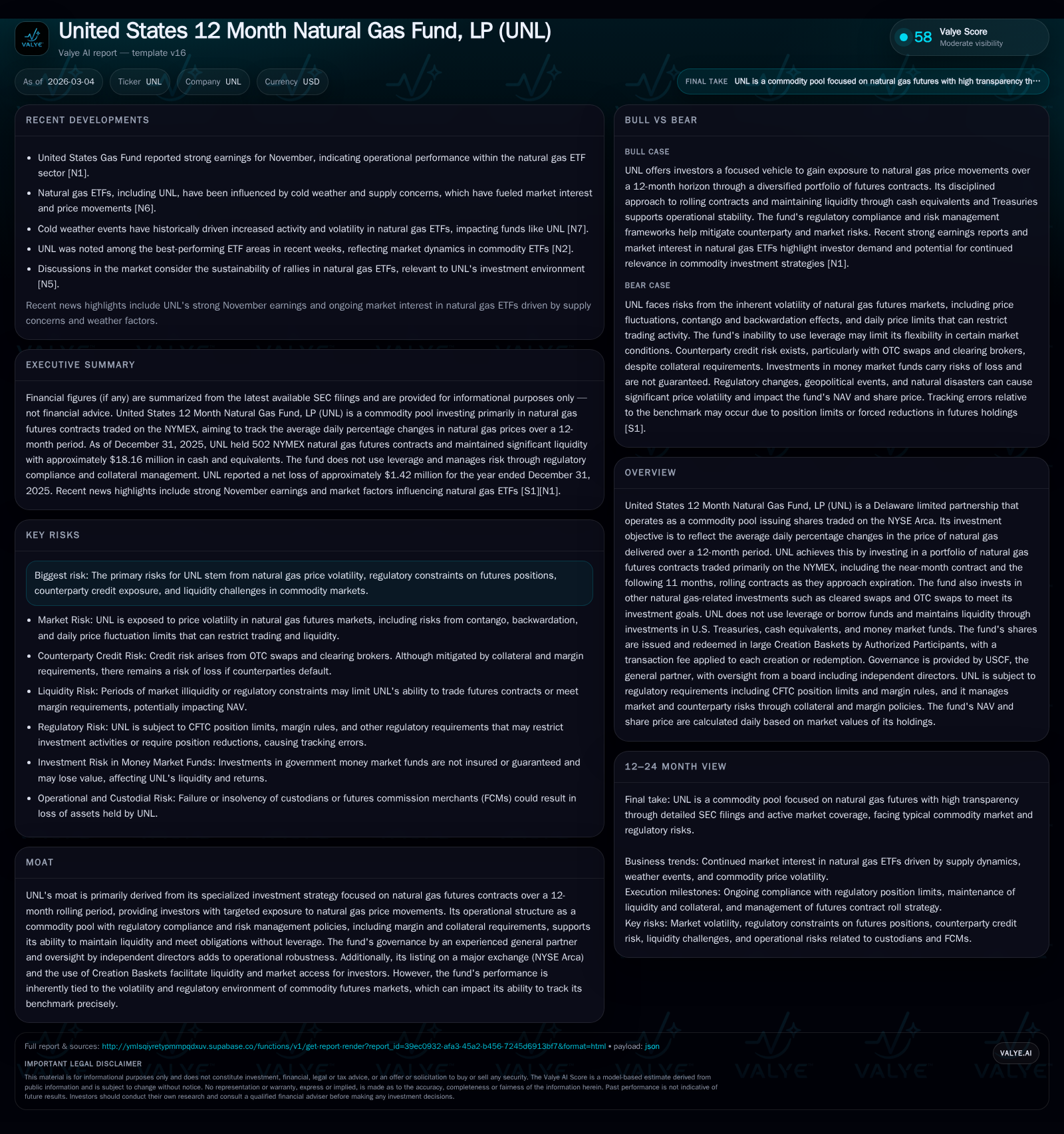
United States 12 Month Natural Gas Fund, LP (UNL) pursues an investment objective reflecting average daily percentage changes in natural gas prices over the next year via a diversified set of NYMEX futures contracts and related instruments. The fund maintains a conservative, non-leveraged capital structure emphasizing liquidity through cash equivalents and U.S. Treasuries to satisfy margin requirements and redemptions. UNL's financial results demonstrate significant volatility correlated with natural gas price swings, with net income fluctuating between losses and modest gains in recent years. Regulatory accountability levels impose position limits that guide contract holdings, while risk factors include volatile commodity pricing, counterparty credit risk, and operational risks such as cybersecurity. Investors should monitor futures market conditions and creation/redemption activity for signals of the fund’s dynamic performance.
Investment Model and Strategy: Targeting 12-Month Natural Gas Price Exposure
United States 12 Month Natural Gas Fund, LP (UNL) operates as a commodity pool structured as a Delaware limited partnership whose shares trade on the NYSE Arca. The Fund aims to replicate the average daily percentage changes in natural gas prices over a rolling twelve-month horizon. This objective is achieved by investing in a portfolio consisting predominantly of near-month plus eleven successive monthly NYMEX natural gas futures contracts — collectively known as Benchmark Futures Contracts — which are systematically rolled forward as they approach expiration to maintain continuous exposure over a year [S1][F1].
In addition to exchange-traded futures, UNL may also invest in cleared swaps or OTC swap agreements linked to natural gas prices to meet its investment goals or mitigate tracking error [S1]. These instruments are valued daily with market prices used where available, or estimated present values for OTC swaps.
A defining aspect of UNL’s strategy is its strict non-leveraged stance. The fund does not borrow nor use margin debt; instead it ensures it holds sufficient high-quality liquid assets including U.S. Treasury securities, cash equivalents, and money market funds to cover margin deposits required for its futures positions [S4][S6]. This approach mitigates financial leverage risk while enabling the fund to satisfy daily settlement obligations inherent in futures trading.
Operationally, liquidity is facilitated through the issuance or redemption of large share blocks called Creation or Redemption Baskets sized at 50,000 shares each. Authorized Participants transact these baskets directly with the fund to adjust supply based on investor demand or redemptions [S4]. These structures support secondary market liquidity for investors.
Sector-specific terms relevant here include “roll yield,” which pertains to gains or losses incurred when expiring futures contracts are replaced by longer-dated ones — a critical driver of returns considering contango or backwardation in natural gas futures curves. The fund also navigates regulatory constructs such as ‘accountability levels’ that trigger enhanced scrutiny beyond specified contract holdings [S1].
Historical Financial Performance: Revenue, Income, and Cash Flow Volatility Analysis
UNL’s historical financial results reflect substantial volatility consistent with the known sensitivity of commodity futures portfolios to fluctuating natural gas prices.
Historical performance (annual)
| FY | Rev ($mm) | Net ($mm) | CFO ($mm) | Rev YoY | Net YoY |
|---|---|---|---|---|---|
| 2025 | -1 | -1 | 2 | -347.1% | -398.8% |
| 2024 | 1 | 0 | -6 | +112.2% | +110.4% |
| 2023 | -5 | -5 | -17 | +38.3% | +38.3% |
| 2022 | -7 | -7 | 13 |
Source: SEC companyfacts cache [F1].
These figures reflect valuation adjustments rather than traditional sales revenue since UNL is marked-to-market on derivative positions. For instance: FY2022 showed net losses exceeding $7 million amid volatile natural gas pricing; FY2024 saw temporary positive net income before returning to losses in FY2025 [F1]. Operating cash flow similarly oscillated reflecting timing differences tied to margin settlements.
This pronounced variability underscores that UNL's returns are closely tied to commodity market dynamics rather than steady income generation.
Futures Contract Dynamics and Regulatory Accountability Limits
NYMEX and ICE Futures exchanges enforce position management rules including accountability levels — thresholds prompting regulatory scrutiny — and absolute position limits set by the Commodity Futures Trading Commission (CFTC) [S1].
For UNL’s Benchmark Futures Contracts on NYMEX natural gas monthly contracts, the accountability threshold per month is approximately 6,000 net contracts with an aggregate all-month threshold around 12,000 contracts combined [S1]. Exceeding these triggers monitoring but not automatic violation; exchange officials may request disclosures or require position reductions if warranted.
As of December 31, 2025 UNL held exactly 502 NYMEX natural gas contracts—well below accountability thresholds—ensuring compliance without mandated reductions [S1]. The fund held no ICE Futures contracts at that date.
Position limits differ as fixed regulatory ceilings under CFTC rules generally not exceeded without permission [S1]. Daily price fluctuation limits also restrict intraday price moves preventing trades beyond set bounds; UNL has not recently faced constraints impeding position adjustments [S8].
Liquidity Management: Creation Baskets, Collateral Holdings, and Non-Leverage Policies
Liquidity infrastructure supports redemptions while funding margin obligations arising from derivatives.
UNL issues Creation and Redemption Baskets in blocks of 50,000 shares allowing Authorized Participants to create or redeem shares by exchanging underlying assets—facilitating supply-demand equilibrium without disrupting market pricing [S4][S6].
To underpin margin obligations UNL holds significant U.S. Treasury securities alongside short-term investments including money market funds aimed at preserving principal while generating incremental yield offsetting expenses [S4][S13][S16]. At year-end 2025 UNL reported approximately $18.16 million in cash equivalents combined with Treasuries supporting collateral needs [F1].
Notably UNL does not borrow or use debt for margin; all collateral must come from owned liquid assets only [S4][S6][S8]. Failure risks forced liquidation; thus conservative asset holdings mitigate leverage exposure.
USCF manages brokerage relations with Futures Commission Merchants maintaining segregated accounts protecting client funds against commingling risks enhancing credit safety [S5][S9][S16]. This framework reduces liquidity risks common during commodity price shocks.
Risk Factors: Price Volatility, Regulatory Constraints & Counterparty Credit Exposure
Natural gas derivatives expose UNL to significant market risk from volatile pricing driven by weather patterns affecting supply/demand balance; geopolitical events; policy shifts; and macroeconomic factors [S7][S18][N1]. These impact mark-to-market valuations dominating earnings volatility.
Regulatory limits constrain maximum open futures positions reducing leverage but limiting scale—accountability levels trigger enhanced monitoring potentially requiring resizing during abnormal markets [S1][S23].
Credit risk arises mainly from counterparties including FCMs executing trades and clearinghouses guaranteeing contracts; segregation rules mitigate but do not eliminate insolvency risks [S5][S11][S16].
Operational risks include cybersecurity threats managed by USCF through regular assessments and third-party vendor oversight minimizing disruption risks impacting investor transactions adversely [S14][S25].
Together these factors contextualize high return variability balanced against structural safeguards mitigating catastrophic loss potential.
Governance Structure and Capital Allocation Practices
Governance responsibility lies with USCF as General Partner supported by independent directors providing fiduciary oversight ensuring regulatory compliance and shareholder alignment focusing on transparency and prudent risk policies [S7][S14].
Management fees were lowered from 0.75% to 0.60% of average daily NAV effective May 2024 reflecting cost optimization efforts within competitive commodity ETF space [S6][S20].
Additional expenses include licensing fees paid for use of NYMEX intellectual property plus administrative fees principally paid to Bank of New York Mellon for custodial services under contractual agreements periodically reviewed for efficiency [S6][S21].
Given its passive mandate tracking futures indices rather than generating distributable earnings through operations no dividends or share repurchases occur; capital allocation focuses on expense management while maintaining liquidity cushions supporting NAV stability over time rather than external distributions.
Historical expense waivers ceased by April 2024 aligning with normalized cost recovery policies without compromising service quality standards [S20].
This stewardship approach prioritizes fund viability amid fluctuating commodity price regimes rather than traditional capital returns typical outside ETF structures.
Outlook: Monitoring Market Indicators for Future Performance Insights
Explicit forward guidance is absent; future performance signals derive from macro-level market trends plus internal operational metrics observable externally such as creation/redemption basket volumes indicating investor sentiment shifts alongside evolving NYMEX natural gas futures curves reflecting supply/demand expectations influencing roll yield outcomes important for return modeling [N1][N2][S3].
Regulatory vigilance remains critical given ongoing CFTC reviews possibly adjusting position limits/accountability rules impacting feasible positioning strategies for funds like UNL targeting benchmark replication without breaching caps [S1][S29].
Counterparty credit health merits attention especially amid systemic shocks threatening FCM viability despite embedded protections necessitating stress testing by fund management overseeing collateral adequacy proactively mitigating liquidity crunches under duress scenarios described in annual disclosures [S5][S11][S16].
Investors tracking natural gas pricing influenced by weather extremes or geopolitical developments shaping global energy markets will find correlation with NAV fluctuations essential along with periodic supply shortages/pricing spikes benefiting appropriately positioned funds mirroring future delivery expectations.
These elements collectively build an analytical foundation underpinning informed monitoring approaches yielding timely awareness about performance drivers relevant for tactical exposure management within diversified portfolios using UNL's specialized instrument structure.
Disclaimer: This is research-only, informational analysis and not investment advice. It may include AI-generated interpretation and general industry context. Always verify important details using primary sources.

Comments