
United States Oil Fund Faces Volatility Amid Oil Market Turbulence
USO’s significant earnings reversal and regulatory constraints highlight the challenges of crude oil futures exposure in volatile markets.
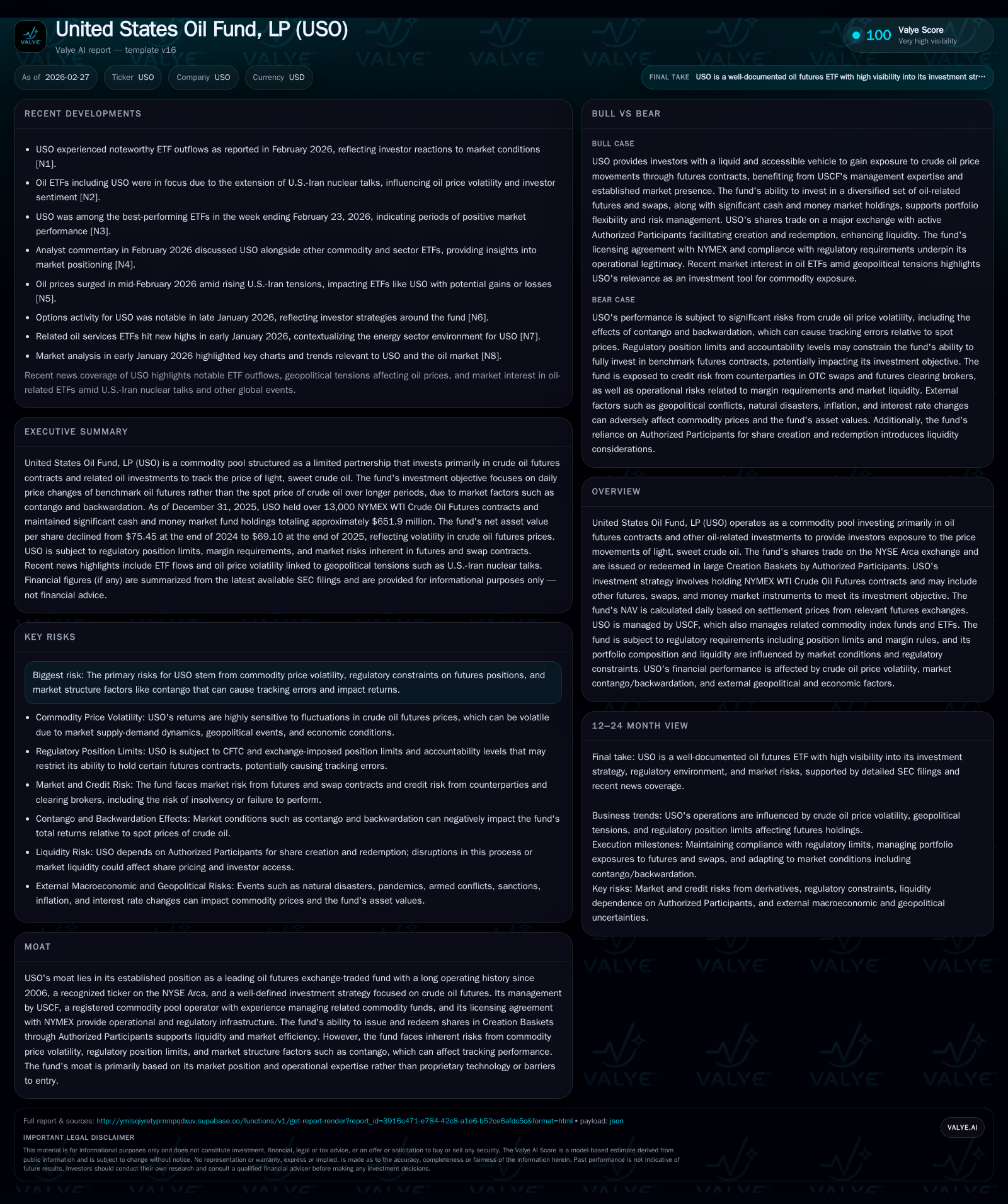
The United States Oil Fund, LP (USO) witnessed a dramatic shift from robust positive net income in FY2024 to a marked loss in FY2025, primarily due to oil price volatility and structural dynamics inherent in futures markets. Regulatory position limits and accountability levels imposed by NYMEX have intermittently constrained USO’s investment capacity, affecting tracking performance. Early 2026 ETF flows show investor sensitivity to geopolitical tensions impacting oil prices, while contango-induced roll costs continue to challenge total returns. Liquidity remains well-supported via cash holdings and creation/redemption mechanisms, but ongoing litigation and regulatory scrutiny add layers of uncertainty.
A Rollercoaster: Historical Financial Performance and Key Drivers
United States Oil Fund LP’s financial trends over recent years reveal stark volatility tied directly to fluctuations in the price of WTI crude oil futures contracts it holds. The fund's revenue experienced a catastrophic YoY drop of approximately -153.9%, shifting from positive $98.9 million in fiscal year (FY) 2024 down to a $53.3 million loss in FY2025 according to its latest annual filing [F1]. Net income followed a comparable trajectory, collapsing by -157.6% YoY to a loss of around $55.5 million for FY2025 relative to an income of nearly $96.3 million earned the prior year [F1]. This financial reversal underscores how USO's returns are heavily leveraged to futures pricing dynamics rather than direct commodity ownership.
Operating cash flow also plunged significantly by over 110%, shifting into negative territory at roughly -$21.8 million by FY2025 from a positive $175.7 million in FY2024 [F1]. This swing manifests the impact of marked changes in open futures contract valuations and realized gains/losses through rebalancing actions.
Historical performance (annual)
| FY | Rev ($mm) | Net ($mm) | CFO ($mm) | Rev YoY | Net YoY |
|---|---|---|---|---|---|
| 2025 | -53 | -55 | -22 | -153.9% | -157.6% |
| 2024 | 99 | 96 | 176 | +133.7% | +132.5% |
| 2023 | -294 | -297 | -13 | -282.5% | -288.4% |
| 2022 | 161 | 157 | 872 |
Source: SEC companyfacts cache [F1].
The erratic financial path is emblematic of USO’s design: it tracks WTI crude oil futures prices through direct contractual positions rather than physical barrels. Its returns remain vulnerable to shifts in futures curve shapes—particularly contango—and regulatory constraints limiting position sizes.
Navigating Position Limits and Regulatory Barriers
Regulatory oversight plays a pivotal role for USO’s operating model. The NYMEX imposes accountability levels—not fixed position limits—on crude oil futures contracts that govern how many contracts entities may hold before enhanced scrutiny or potential action occurs. Currently set at 10,000 contracts per single month and a cumulative cap of 20,000 net contracts across all months for light sweet crude oil futures [S1], these thresholds influence how fully USO can deploy capital into benchmark positions.
During FY2025 USO exceeded these accountability levels multiple times—reaching as high as approximately 16,767 contracts for a single month—but regulators did not require position reductions [S1]. Such regulatory tolerance allows temporary breaches but adds uncertainty since enforcement could mandate rapid adjustments.
Firm position limits are also applied on near-month contracts shortly before expiration where excess holdings require liquidation due to exchange risk controls [S1]. This necessitates frequent portfolio rebalancing that contributes to tracking deviations versus spot price changes.
ETF Flows and Market Sentiment in Early 2026
Investor sentiment expressed via exchange-traded fund flows has increasingly reflected geopolitical concerns impacting crude oil supply expectations. February 2026 saw meaningful outflows from USO amid extended U.S.-Iran nuclear negotiations and rising geopolitical tensions clouding near-term demand forecasts [N1][N2][N5].
These developments drive speculative repositioning among ETFs focused on energy commodities. Options activity around March expirations also highlights anticipation of pivotal events influencing price trajectories [N6].
Structural Challenges: Contango Effects and Tracking Error
A defining feature of futures-based commodity ETFs is the impact of roll yield stemming from contango—the condition where longer-dated futures trade at higher prices than near-term expirations [S1]. For USO specifically holding WTI crude oil contracts on NYMEX exclusively [S1], this creates roll costs when expiring contracts must be sold lower while new positions are purchased at higher forward prices.
This structure causes persistent negative tracking error relative to spot market prices despite directional daily correlations [S1]. Backwardation periods can temporarily alleviate roll costs but depend on favorable supply-demand dynamics that are inconsistent.
OTC swap agreements supplement futures holdings offering some flexibility but still subject USO to margin requirements and counterparty risks influencing timing and execution precision [S1].
Capital Management: Liquidity and Distributions
Despite recent losses, USO maintains substantial liquidity critical for supporting redemption demands inherent in its limited partnership ETF structure using creation/redemption baskets. As of December 31, 2025 USO held approximately $651.9 million in cash & equivalents—a robust reserve compared with prior years—primarily invested in money market funds and U.S Treasury instruments under custody agreements with BNY Mellon [F1][S6][S12].
Brokerage commissions average $7–8 per round-turn trade tied directly to futures/options activity required for share creations or redemptions by Authorized Participants facilitating ETF liquidity provisioning [S21].
There are no dividends or share repurchase programs noted since inception consistent with pass-through tax treatment typical for commodity pools that mark-to-market underlying contract valuations rather than distribute earnings [S19][S24][S29].
Risks from Litigation and Regulatory Enforcement
USO faces ongoing legal risks linked to market disruptions during the COVID-19 pandemic when demand collapsed sharply causing derivatives market dislocations. Several class action lawsuits including the "Lucas Class Action" and derivative suits allege fiduciary breaches related to disclosures about these volatilities but have been dismissed or stayed pending motions as recently as late 2025 [S4][S5].
Enforcement actions resulted in settlement orders imposing $2.5 million civil penalties across SEC and CFTC jurisdictions on manager USCF without admission of wrongdoing but highlighting regulatory scrutiny beyond normal operational risks [S5][S23].
These claims reflect challenges common among commodity funds navigating systemic shocks rather than fundamental governance or solvency failures.
USCF’s Role and Operational Infrastructure Supporting USO
United States Commodity Funds LLC (USCF) serves as general partner managing USO under Commodity Pool Operator registration regulated by the National Futures Association ensuring compliance with complex oversight requirements relevant for trading exchange-traded WTI futures parameters [S1].
USCF operates cybersecurity programs protecting internal infrastructure and third-party providers such as custodian BNY Mellon safeguarding sensitive data assets reducing operational risk exposures potentially caused by cyberattacks or system outages that could disrupt trade executions or shareholder transactions crucial for creation/redemption mechanics [S3][S1].
Licensing agreements with NYMEX underpin contractual rights allowing use of benchmark CL futures contracts integral for maintaining USO’s market identity and compliance alignment underpinning efficient issuance/redemption essential for ETF trading ecosystem participation.
This analysis is based solely on publicly available data from company filings and verified news sources up to February 27th, 2026 regarding United States Oil Fund LP (ticker: USO). It does not offer investment advice but aims to provide a comprehensive understanding of fundamental operational drivers affecting financial results and industry-specific risks inherent within ETNs/commodity pools exposed principally to crude oil futures markets.
Disclaimer: This is research-only, informational analysis and not investment advice. It may include AI-generated interpretation and general industry context. Always verify important details using primary sources.

Comments