
Voyager Acquisition’s Strategic Pivot: Synergies and Challenges Post-Veraxa Merger
Voyager Acquisition transformed from a SPAC to a biotech enterprise through its merger with Veraxa, recalibrating its operational and financial profile amidst oncology innovation ambitions.
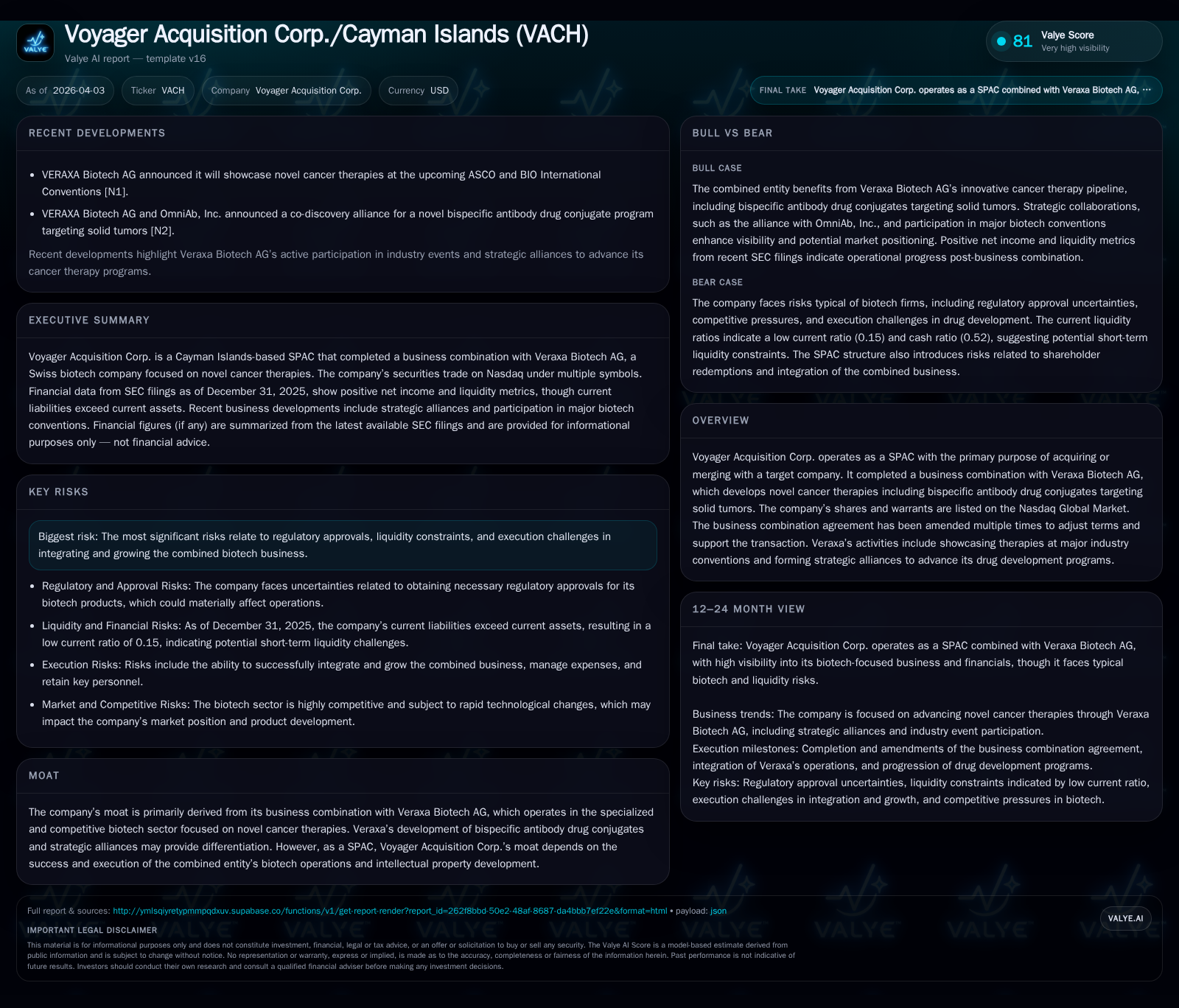
Voyager Acquisition Corp., originally a blank-check SPAC, redefined its corporate identity by completing a business combination with Veraxa Biotech AG, a company focused on novel bispecific antibody drug conjugates for cancer therapies. This transition marks a shift from a financial vehicle to an operating biotech firm, introducing complex dynamics in growth prospects, financial performance, and risk exposure. The combined entity faces steep challenges including regulatory approvals, liquidity pressures, and integration hurdles while relying on Veraxa’s innovative oncology platform as a potential value driver.
Genesis and Growth: Voyage from SPAC Beginnings to Biotech Merger
Voyager Acquisition Corp. was initially established as a Special Purpose Acquisition Company (SPAC), designed solely to raise capital through an IPO for the purpose of merging with or acquiring another business. The defining moment for Voyager came in 2025 when it undertook its initial business combination with Veraxa Biotech AG, a Swiss-based public limited company specializing in novel cancer therapeutics. This business combination agreement required multiple amendments over time to adjust merger terms — including increasing aggregate merger consideration from $1.3 billion to $1.35 billion [S25].
This merger fundamentally restructures Voyager’s role; no longer just a shell or capital pool, it has become an operating entity with direct exposure to the biotech sector's growth imperatives and risks. Post-merger governance changes were significant: shareholders approved eliminating the SPAC's blank-check status, authorized a single class of common shares replacing previous complex share structures, and empowered the board with enhanced control mechanisms [S6]. The strategic implication is clear—Voyager has pivoted into an active participant in oncology innovation rather than merely facilitating capital deployment.
Performance Snapshot: Financial Trends Through the Transition
The transition to biotech operations altered Voyager’s financial fabric markedly. Data from fiscal years ending 2024 and 2025 reveal sharp divergence between operating income and net income trends [F1]. Operating income deteriorated from -$702,959 in 2024 to -$1,785,259 in 2025 signaling intensifying expenses linked to research & development (R&D) outlays inherent to clinical-stage biotechnology initiatives. This equals a negative year-over-year swing of approximately 154%.
Contrastingly, net income moved into positive territory at $8.99 million in 2025 versus $4.14 million in 2024 — up roughly 117% year-over-year — reflecting factors such as possible one-time gains or non-operational accounting items tied to merger effects rather than core profitability.
Operating cash flow remained negative but improved slightly from -$703,468 in 2024 to -$486,182 in 2025 [F1], illustrating ongoing cash burn consistent with early-stage biotech companies investing heavily ahead of revenue generation.
Balance sheet scrutiny reveals acute liquidity tension: year-end current assets stood at $193,640 against current liabilities of $1,294,118 producing a current ratio of merely ~0.15—below conventional adequacy thresholds—implying significant short-term solvency risk [F1]. Meanwhile, equity became more negative (-$13.15 million from -$11.37 million), underscoring accumulated deficits post-business combination and investment ramp-up (approximate ROE is -68.4%) [F1].
These dynamics underscore that Voyager/Veraxa stands at an inflection point where sustainability depends heavily on successful capital raises or partnerships alongside effective operational execution.
Innovative Edge: Veraxa’s Therapeutic Focus as a Growth Driver
Veraxa Biotech’s core competency lies in its pioneering work on bispecific antibody drug conjugates (ADCs). These are sophisticated molecules engineered to simultaneously bind two distinct epitopes on solid tumor cells—offering enhanced targeting precision compared to traditional monoclonal antibodies.
The therapeutic rationale for this ADC platform integrates bispecificity to recruit immune effector functions while delivering cytotoxic payloads selectively to malignant tissues—addressing unmet needs in highly refractory solid tumors where monotherapies have limited efficacy.
Veraxa maintains visibility within industry circles by showcasing pipeline progress at major oncology conventions and has forged strategic alliances aimed at accelerating clinical development programs . Such collaborations may provide crucial validation pathways and extend market reach once products enter late-stage trials.
While explicit clinical data timelines remain confidential or pending disclosure, Veraxa’s mechanistic sophistication places it among niche innovators attempting to carve defensible positions amid intense competition from larger pharmaceutical incumbents advancing their own multispecific platforms.
Regulatory and Integration Hurdles: Risk Factors in Transformation
The path forward is fraught with regulatory uncertainties—a persistent challenge for all clinical-stage biotech firms and especially heightened for recently combined entities like Voyager Acquisition/Veraxa [S23]. Obtaining U.S. FDA approval or relevant international agency clearances requires extensive safety/efficacy data amid strict compliance protocols.
Capital constraints compound these difficulties. As per recent SEC filings detailing liquidity conditions and debt structures [S4][S5][S7], Voyager/Veraxa confronts pressure points due to liquidity shortfalls relative to near-term obligations. Management has acknowledged these risks without substantive indications of imminent alleviation via financing arrangements.
Moreover, integrating the two entities poses operational risks: harmonizing disparate corporate cultures—from SPAC sponsor frameworks to research-intensive biotech environments—alongside aligning strategic priorities remains ongoing challenges that could disrupt momentum if unmet.
Investor confidence hinges on mitigating these execution risks while progressing clinical milestones fluidly.
Capital Strategy and Shareholder Returns Post-Merger
In moving away from its SPAC roots, Voyager Acquisition has adopted governance reforms including authorization of a streamlined single ordinary share class alongside conditional share capital allowing flexibility for future financings up until end-2030 [S6]. This institutional shift supports agility but raises dilution considerations for shareholders given potential equity issuances needed to fuel R&D expenditures.
There is an absence of dividend declarations or share repurchase programs thus far—a predictable posture aligned with typical biotechs prioritizing reinvestment over distributions during early product development phases [S12][S14–S21]. The reallocation reflects emphasis on funding clinical trials rather than returning cash flow upstream.
Equity erosion evidenced by rising negative shareholder equity suggests net value creation relies heavily on intangible asset appreciation through proprietary technologies rather than immediate balance sheet strength [F1]. Consequently, investor returns are contingent on future breakthroughs rather than near-term capital returns.
Looking Ahead: Milestones and Market Expectations for the Combined Entity
Forward guidance remains cautious with no specific quantitative forecasts publicized beyond broad management commentary found in recent communications [S9][S10]. Key watch points include Veraxa’s clinical trial readouts which will critically inform viability of bispecific ADC candidates; regulatory filing progress indicative of timeline adherence; and liquidity position adjustments through new funding rounds or partnership deals.
Given industry patterns and disclosed risk profiles, success will require not only scientific validation but also efficient capital consumption management intertwined with robust shareholder engagement strategies—hallmarks essential for sustaining long-term market access.
Key Metrics Table: Historical Financial Performance Overview
Historical performance (annual)
| FY | Net ($mm) | CFO ($) | OpInc ($) | Net YoY |
|---|---|---|---|---|
| 2025 | 9 | -486182 | -1785259 | +117.1% |
| 2024 | 4 | -703468 | -702959 |
Source: SEC companyfacts cache [F1].
Capital returns and efficiency (annual)
| FY | ROE% |
|---|---|
| 2025 | -68.4 |
| 2024 | -36.4 |
Source: SEC companyfacts cache [F1].
Operating income deepened into losses despite net income improvement driven likely by merger-related accounting impacts; cash flows remain negative yet show slight improvement; liquidity strain evident through low current ratio.
Voyager Acquisition Corp.'s transformation highlights the volatile intersection between SPAC financial engineering and high-risk biotech innovation focused on next-generation oncology therapeutics. Success depends not only on advancing science but also on shrewd capital management amidst demanding regulatory frameworks. Though nascent financials reflect typical early developmental deficits compounded by merger complexity, future progress hinges critically on Veraxa’s ability to marshal clinical successes against formidable approval hurdles while maintaining sufficient liquidity throughout this pivot phase.
This analysis refrains from forecasts absent explicit company guidance but identifies pivotal catalysts investors should monitor closely as indications of trajectory clarity emerge.
Disclaimer: This report is for informational purposes only and does not constitute investment advice or recommendations regarding any securities discussed herein.
Disclaimer: This is research-only, informational analysis and not investment advice. It may include AI-generated interpretation and general industry context. Always verify important details using primary sources.

Comments