
Virco Faces Seasonal Sales Dip as Macroeconomic Pressures Persist
Virco’s 2026 Q1 filing reveals a 9.1% sales decline amid seasonal headwinds and macro uncertainty, underscoring its resilient domestic manufacturing and direct sales model.
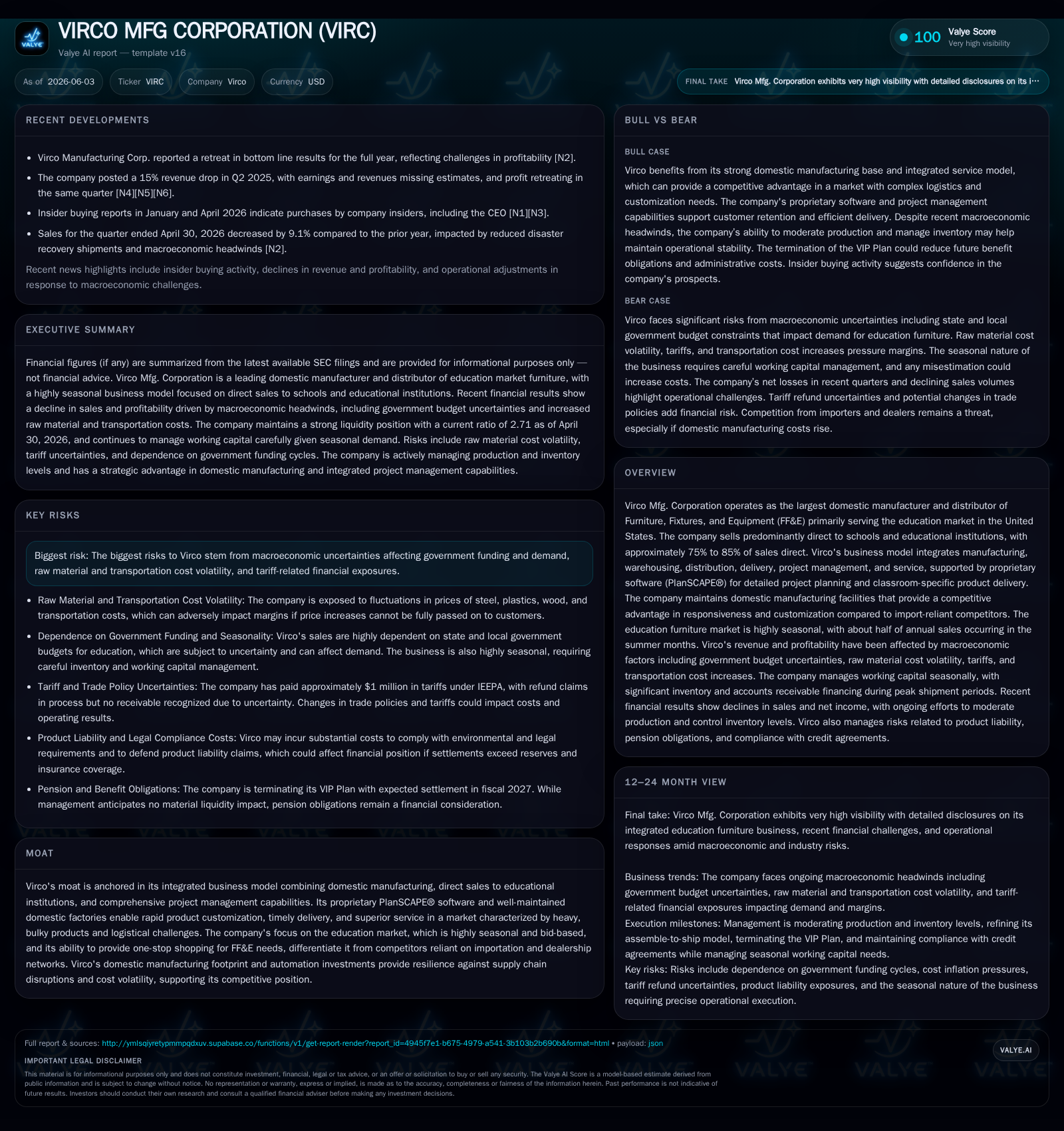
Virco Mfg. Corporation reported a 9.1% decrease in net sales for the first quarter ended April 30, 2026, impacted by typical seasonality compounded by weaker demand due to macroeconomic uncertainty affecting educational budgets. Despite the softness, order backlog remained stable year-over-year, signaling normalized demand post-disaster recovery shipments. Virco’s integrated domestic manufacturing footprint and direct-to-school sales approach provide strategic advantages in responsiveness, customization, and supply chain control in a bid-based and highly seasonal education furniture market. Raw material cost inflation and tariff volatility pose margin pressures, but the company maintains strong liquidity to navigate these challenges.
First Quarter Sales Decline Highlights Seasonality and Macroeconomic Impact
Virco Mfg. Corporation’s latest quarterly filing (10-Q as of June 3, 2026) disclosed a net sales decrease of 9.1% for the quarter ended April 30, 2026 compared to the prior year period [S2]. This near double-digit drop primarily reflects both pronounced seasonality intrinsic to the education furniture market and continuing macroeconomic headwinds dampening demand from public educational institutions.
Critically, the prior year comparable period included approximately $2.7 million in shipments related to disaster recovery projects—an atypical revenue boost largely absent this fiscal year where only about $190,000 of such shipments occurred [S2]. Excluding this distortion yields a more modest underlying sales decline of approximately 1.7%, indicating demand is stabilizing after elevated prior-year activity.
The company noted that current macroeconomic uncertainty affecting state and local government budgets—the primary funders of public education infrastructure—has reduced confidence among buyer institutions, contributing to softer orders [S2]. As of April 30, Virco’s shipments plus order backlog stood about 2% below last year’s level but management characterized the backlog as comparable year-over-year, reflecting normalization following an extraordinary COVID-related rebound phase [S2]. Production levels have been moderated accordingly to balance timely summer deliveries with efficient inventory management.
Integrated Domestic Manufacturing Model Anchors Competitive Edge
Virco stands out in an industry heavily shaped by import competition due to China’s WTO entry two decades ago [S1]. Unlike many rivals that closed domestic fabrication facilities in favor of imported components or finished goods, Virco retained and continues to operate fully depreciated yet well-maintained domestic manufacturing plants equipped with selective automation [S1]. This domestic footprint confers multiple advantages: rapid product customization, shorter lead times, better control over quality and supply chain reliability in a sector where bulky furniture complicates logistics.
The recent COVID-19 pandemic disruptions alongside tariff shifts and global freight instabilities have highlighted risks inherent in import reliance across the furniture industry; Virco's integrated manufacturing-distribution system domestically positions it favorably against peers who face elongated supply delays or pricing shocks [S1]. This vertically integrated model enables responsiveness essential for bid-based educational contracts that often require classroom-specific product mixes delivered on tight schedules.
Direct Sales & Proprietary Project Management Drive Customer Stickiness
Differentiating itself further is Virco’s predominant direct-to-customer sales model whereby roughly 75% to 85% of sales engage directly with schools and educational institutions rather than through dealership networks common elsewhere in furniture markets [S1]. Direct relationships empower closer collaboration during bidding phases—a critical competitive factor given that school districts procure mainly via bids specifying exact FF&E requirements.
Supporting this approach is Virco’s proprietary PlanSCAPE® software platform which integrates project management tools including product specification per classroom, pricing strategies, logistics planning and turnkey setup services [S1]. This comprehensive capability streamlines what would otherwise be fragmented purchases across multiple vendors into one-stop shopping benefiting schools’ operational continuity during disruptive construction cycles or renovations.
Moreover, approximately 80% of Virco’s sales are FOB destination—meaning responsibility for delivery logistics rests with Virco—reinforcing service differentiation against dealers relying mostly on pick-up or third-party distribution [S1]. The bundled offering confers switching costs by embedding planning expertise with execution execution reliability which helps sustain contract renewals despite aggressive price competition.
Tariffs, Input Costs, and Trade Dynamics Shape Margin Outlook
Raw material cost volatility remains a central risk factor. Throughout fiscal 2026 Q1, materials such as steel and petroleum-based plastics experienced inflationary pressure tied partially to geopolitical tensions including Middle East conflict impacting crude oil and natural gas prices [S2]. These fluctuations increase production input costs directly while also elevating transportation expenses integral given the weighty bulk of school furniture deliveries.
Additionally, U.S. trade policy under the International Emergency Economic Powers Act (IEEPA) had instituted broad tariffs on imports including those from China and neighboring countries—raising input costs for imported components [S2]. However, a February 2026 U.S. Supreme Court decision invalidated these IEEPA tariffs on constitutional grounds introducing complexity over tariff pass-through strategies [S2].
While Virco has incrementally raised product prices during fiscal year 2027 efforts to fully offset higher raw material and freight expenses are constrained by bid contract rigidity and timing mismatches between cost increases and price resets—a classical 'pricing lag' dynamic placing short-term pressure on gross margins [S2,S1]
Education Market's Bid-Based Purchasing Adds Demand Volatility
The business landscape Virco operates within is dominated by public education budgets which are inherently cyclical and highly seasonal—around half of annual FF&E revenue occurs during summer months coinciding with school vacations enabling installations [S1,S2]. Capital expenditures are predominantly bond-financed at state/local levels making them sensitive to political processes.
Procurement typically follows formal bid-based purchasing processes exposing Virco to sizable swings based on timing of new bond approvals or discretionary spending shifts post-budget seasons [S1,S2]. This induces lumpiness in order intake during late winter through spring ahead of summer delivery peaks necessitating careful labor force flexibility via seasonal hires and overtime.
Virco’s ability to integrate project management at scale addresses these challenges by allowing granular classroom-level delivery scheduling reducing potential installation delays or penalty exposures tied to failed timelines under contract terms.
Growth Outlook: Order Backlog Normalization and Pricing Challenges
Management commentary signals cautious optimism toward backlog stabilization signifying demand normalization after pandemic-induced turbulence [S2,S3]. The absence of large-scale disaster recovery orders going forward means typical seasonality patterns are resuming without anomalous lifts seen last fiscal year.
Persistent macro uncertainty regarding government funding outlooks tempers growth expectations; combined with raw material inflation pressures constraining margin expansion even as moderate price increases are attempted [S2,S3]
Capital expenditure plans continue focusing on manufacturing automation upgrades alongside investments in software enhancements to PlanSCAPE®, aiming for productivity gains while preserving service quality differentiators crucial for competitive advantage [S1].
Operational Risks: Supply Chain, Labor, and Funding Uncertainty
Key risks remain around sudden raw material cost spikes beyond pricing adjustment capacities plus labor availability constraints especially for seasonal temporary employees vital for peak summer production surges [S1,S2]. Additionally local government budget tightening amid macroeconomic cycles may reduce spending frequency thus impacting order volumes unpredictably.
Tariff policy oscillations introduce further cost structure uncertainty due to potential reinstatement or escalation depending on evolving trade negotiations or geopolitical developments [S2,S1]. The company must continue agile sourcing initiatives including exploring alternative suppliers or material substitutions to mitigate these risks.
Looking Ahead: Key Milestones for Order Flows and Cost Pass-through
Upcoming quarters will be critical for monitoring incremental order intake improvements following normalization of disaster recovery projects completed previously [S2,S3]. Management intends close scrutiny of achievement toward maintaining inventory alignment with just-in-time deliveries minimizing working capital drag while meeting customer deadlines.
Renewal windows on annual contracts will test ability to embed flexible pricing clauses reflecting volatile inputs—a pivotal factor influencing margin recovery prospects while sustaining contract volume retention.
Financial Position: Solid Liquidity Supports Strategic Flexibility
Virco entered this period with robust liquidity fundamentals supportive of tactical resilience amid margin pressures: cash & equivalents stood at $14.4 million as of January 31, 2026 versus total debt under $3.9 million yielding a net cash position near $10.5 million [F1], supported by a strong current ratio of approximately 2.71 as of April 30, 2026 [F1]. The company maintains access to bank lines structured for seasonal demands providing optionality should abrupt working capital needs arise around peak production cycles.
Capital expenditures remain disciplined focusing on long-term efficiency gains rather than expansion requiring heavy financing commitments.
This analysis synthesizes current operating realities underscored by Virco’s integrated business model combining domestic production agility with direct client engagement tailored to the idiosyncratic seasonality and bid-based dynamics unique to education FF&E markets. While short-term sales softness related partly to nonrecurring factors tempers near-term growth visibility amidst macroeconomic ambivalence and input cost inflation challenges persistently pressure margins—the company’s foundational strengths position it maintain competitive durability moving forward.
Investment insights should rely on continuous tracking of order backlog evolution post-summer selling season alongside actualized cost pass-through capabilities defined during contract renewals throughout fiscal year 2027. Robust liquidity fortifies strategic flexibility allowing measured reinvestment in operational platforms essential given supply chain complexity endemic to bulky educational furniture distribution.
Disclaimer: This report provides an analytical overview based strictly on disclosed filings without offering investment advice or forecasts.
Disclaimer: This is research-only, informational analysis and not investment advice. It may include AI-generated interpretation and general industry context. Always verify important details using primary sources.

Comments