
Vista Energy Advances Production and Leverages Debt for Expansion in 2026
Vista Energy reported strong operational progress and completed a significant debt issuance, reinforcing its growth plans amid evolving regulatory landscapes.
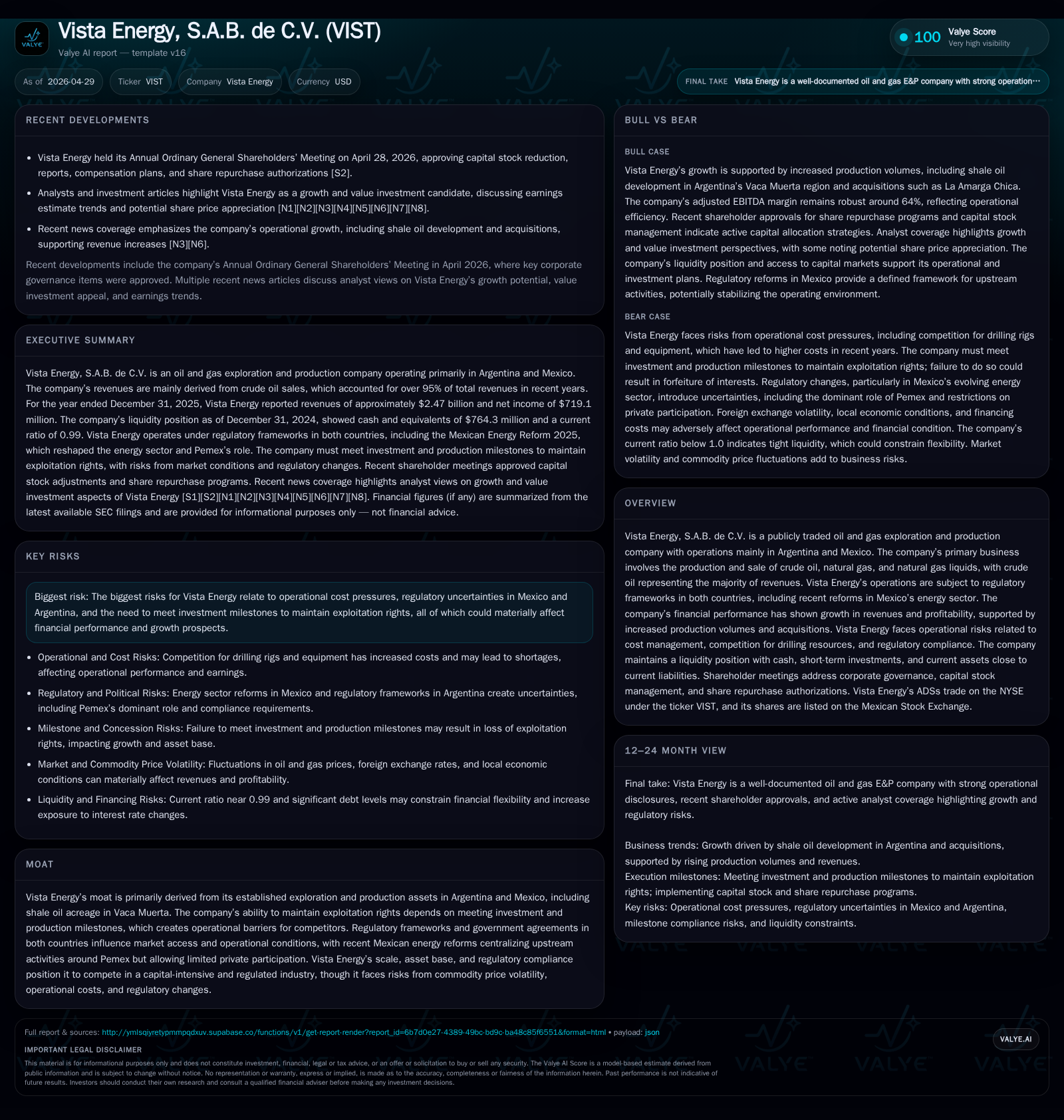
In its latest quarterly filing for early 2026, Vista Energy, S.A.B. de C.V. achieved shareholder approval of board compensation and finalized a $500 million senior notes issuance, anchored by its Argentine subsidiary. The company continues to capitalize on its core exploration and production assets in Argentina and Mexico with an emphasis on shale development in Vaca Muerta. While regulatory reforms in Mexico centralize state control, Vista maintains operational resilience through milestone-driven concessions. Growth will be driven by capital expenditure execution, acquisition opportunities, and production expansion, balanced against operational cost pressures and regulatory uncertainties.
Recent Operating Update
Vista Energy's latest quarterly disclosure dated April 28, 2026, centers around corporate governance resolutions and fresh capital raising activities that have meaningful implications for the company's growth trajectory [S2,S3]. At the Annual Ordinary General Meeting, the shareholders ratified compensation for Board members excluding executive leadership — consisting of $80,000 in cash fees paid quarterly plus rights to receive Series A shares or American Depositary Shares — aligning incentives with shareholder interests amidst operational scaling [S2]. Meanwhile, earlier in April, Vista Energy Argentina S.A.U., the company's principal Argentine subsidiary, priced a $500 million issuance of senior notes bearing a coupon of 7.875% due in 2038 under New York law. This offering was conducted under existing global debt programs authorized by multiple prior shareholder meetings, underscoring Vista’s capacity to access international capital markets effectively despite regional volatility [S3].
Business Model
Vista Energy operates as an independent oil and gas exploration and production entity focusing chiefly on upstream activities within Argentina and Mexico. Its revenue predominantly derives from the sale of crude oil (over 95% contribution), complemented marginally by natural gas and natural gas liquids sales [S14]. The company manages a portfolio of concession agreements requiring strict achievement of investment milestones—typically related to drilling volumes and production targets—to retain exploitation rights.
Revenue mechanics hinge on commodity volumes produced and sold into competitive markets with pricing exposed to global oil benchmarks but adjusted regionally for quality differentials and transportation logistics. The firm employs cash flow generated from operations supplemented by debt issuance (as evidenced by recent note offerings) to fund its capital-intensive drilling program. Margins benefit from scale efficiencies on rising production and disciplined cost control amid sector inflationary pressures.
Vista’s dedicated trading arm VEISA contributes revenues primarily through export transactions settled on Cost Insurance Freight (CIF) or Delivered At Place (DAP) terms, though internal accounting normalizes this for clarity on FOB equivalents to maintain consistent margin analyses [S9]. Notably, the company focuses significant capex in developing shale oil reserves within the prolific Vaca Muerta basin in Argentina — a globally recognized shale play offering substantial long-term reserve potential when successfully exploited.
Industry Structure and Competitive Position
Vista Energy occupies an intermediate position within Latin America's oil value chain: upstream E&P specializing in resource development rather than midstream transport or downstream refining. Its competitiveness is anchored in possessing sizeable acreage — including both conventional fields and unconventional shale assets — coupled with proven operational expertise spanning two key countries.
The regulatory environment forms a structural barrier shaping competitive dynamics. In Mexico, the Energy Reform enacted in March 2025 materially reshaped sector governance by consolidating upstream exploration and production under Pemex as a public state-owned enterprise while allowing restricted private participation under particular conditions [S1]. This creates challenges for private E&P firms like Vista in gaining access to new opportunities but also limits competition from additional entrants pending policy shifts.
In Argentina, regulatory guidelines govern reserve certification using SPE standards aligned with SEC definitions; foreign exchange controls impact service availability by restricting international providers' entry — directly affecting rig supply chains and drilling costs [S1]. Thus, operational cost inflation is partly driven by external demand cycles for rigs heightened by elevated commodity prices coupled with macroeconomic policy constraints.
Vista’s moat benefits from milestone commitment agreements securing exploitation rights that necessitate sustained investment within allotted timelines—discouraging casual competitors lacking capital depth or long-term strategy [S14]. Nevertheless, execution risks around meeting these milestones owing to market conditions or financing shortfalls represent critical vulnerabilities.
Growth Drivers
Growth at Vista Energy is expected to be propelled chiefly by:
- Production Volume Expansion: Continued development of Vaca Muerta shale acreage alongside conventional field optimizations intend to increase output volumes driving top-line growth.
- Capital Expenditures Execution: Aggressive capex programs toward drilling new wells, completing facilities investments (totaling approximately $1.33 billion in 2025), underpin future reserve additions exceeding depletion rates [S19,S21].
- Strategic Acquisitions: Opportunistic asset purchases are key to augmenting reserves quickly where market conditions permit.
- Operational Efficiency Gains: Managing increasing input costs through supplier negotiations, enhanced drilling technologies, and integration of logistics aims at preserving gross margins near current levels (~64%) despite external pressures.
- Export Market Penetration: Through VEISA's export capabilities, Vista seeks to diversify sales channels beyond domestic consumption while capturing favorable international pricing spreads.
Risks / Watchpoints / Growth Constraints
Key risks potentially constraining Vista’s growth include:
- Regulatory Uncertainty: Increased centralization via Mexico’s Energy Reform may limit private sector upstream roles or impose onerous compliance burdens. Similarly, adjustments in Argentine foreign exchange controls could disrupt equipment sourcing externally dependent on international suppliers [S1,S14].
- Operational Cost Inflation: Tight rig markets coupled with inflationary supply costs risk squeezing operating margins unless offset by productivity gains or price recoveries.
- Milestone Compliance: Failure to meet drilling/investment thresholds stipulated contractually may jeopardize concession retention — essential for sustaining production base.
- Commodity Price Volatility: Fluctuating crude oil prices directly affect revenues; adverse price trends can delay or reduce capital deployment initiatives.
- Liquidity Availability: Recent successful debt issuances support capex funding needs, and the company maintains near-neutral working capital with a current ratio of approximately 0.99 as of December 31, 2024, reflecting tight working capital management typical in the sector [F1].
What To Watch Next
Stakeholders should monitor several forthcoming indicators:
- Progress on executing drilling schedules especially within Vaca Muerta acreage;
- Quarterly updates on production volumes and average realized prices reflecting market conditions;
- Regulatory developments emanating from Mexican energy sector authorities impacting private participation rules;
- Additional bond or credit facility issuances indicating financial strategy adjustments;
- Operational cost trends including rig availability metrics across Argentine basins;
- Shareholder communications concerning capital allocation decisions such as potential further share repurchases or dividend policies given recent approvals up through 2025 [S10,S23].
Brief Financial Profile Context
As of December 31, 2024—the most recent fiscal year-end supported by companyfacts—Vista reported annual revenue of approximately $1.65 billion with net income totaling $477.5 million [F1]. These figures have grown substantially relative to prior years reflecting both organic production gains and acquisitions detailed through year-end 2025 filings reporting revenues surpassing $2.47 billion along with adjusted EBITDA reaching $1.6 billion maintaining margins over 60% consistently across periods [S1,S6,S22].
Balance sheet liquidity at December 2024 featured cash equivalents near $764 million against current liabilities slightly above $1 billion yielding a near-neutral current ratio (~0.99), indicative of tight working capital management given industry cyclicality characteristics [F1]. Recent large-scale financing transactions—including the April 2026 bond issuance—augment long-term funding capacity necessary for executing aggressive development plans without immediate refinancing pressures [S3]. Interest expenses have increased commensurately due to higher principal borrowings yet remain manageable relative to operating cash flows generated per quarter [S12,S13]. Overall profitability metrics such as ROACE demonstrate robust returns averaging around high twenties (%) bolstered by capital efficiency improvements since prior fiscal points reviewed.
Disclaimer: This analysis is based solely on publicly filed documents as referenced herein up to April 28, 2026. It does not constitute investment advice or recommendations but aims to provide a grounded business perspective on Vista Energy’s operating status and outlook.
Disclaimer: This is research-only, informational analysis and not investment advice. It may include AI-generated interpretation and general industry context. Always verify important details using primary sources.

Comments