
Loma Negra’s 2025 Revenue Decline Highlights Pricing Pressure Despite Volume Gains
Loma Negra’s latest filings reveal softer cement pricing offsetting volume growth, amid evolving Argentine market and regulatory dynamics.
In its latest quarterly disclosure and 2025 annual report, Loma Negra reported a 7.8% revenue decline driven principally by weaker pricing in its core cement segment, offset only partially by volume increases. The company benefits from an integrated supply chain that includes owned quarries and a railway concession facilitating logistics. While construction material demand shows mixed recovery patterns—with stronger bulk cement and concrete activity and lagging retail bagged cement—pricing remains under pressure in a competitive and politically uncertain environment. Growth drivers include infrastructure projects and an expanding renewable energy mandate, but risks linger from raw material sourcing, currency exposure, and regulatory challenges. Financially, the company maintains liquidity coverage through operational cash flow and bond issuances in USD, with no restrictive covenants on dividend payments.
Recent Operating Update
Loma Negra’s latest quarterly reports filed in April 2026 confirm ongoing challenges into the first quarter of the year following a tough 2025. The company’s Form 6-K filings ([S2], [S3]) emphasize that while the core production lines remain operationally stable, revenue softness reflects significant price erosion across major segments, primarily cement. This update confirms underlying trends from the full-year Form 20-F filing ([S1]), anchoring analysis on operating performance deterioration amidst macroeconomic uncertainties.
Business Model
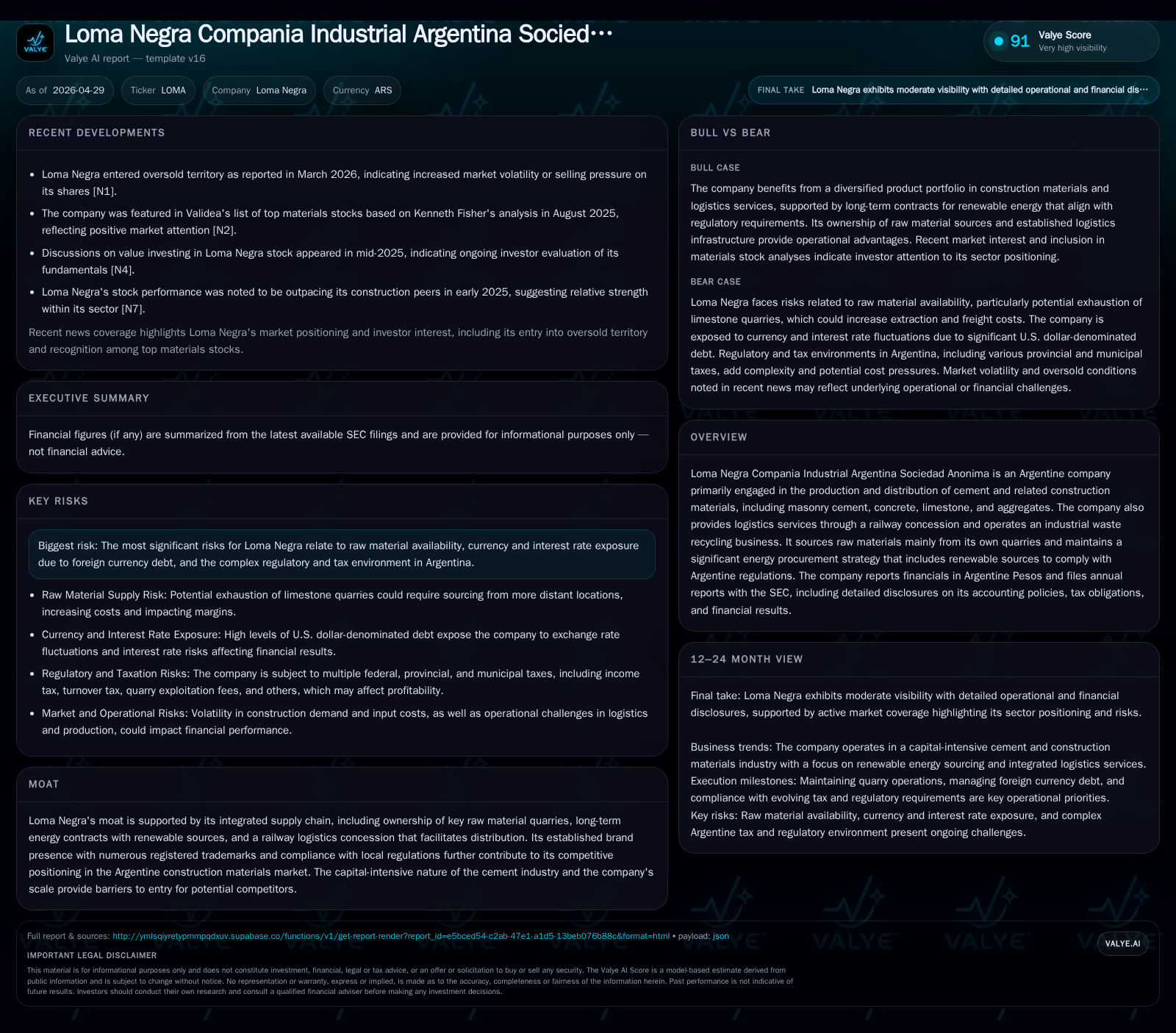
Loma Negra operates as Argentina's leading producer of cement and related construction materials including masonry cement, concrete, limestone, and aggregates. Its operations span extraction from company-owned quarries to final delivery logistics via an owned railway concession (Ferrosur Roca), granting control over critical inputs and distribution channels. Revenues stem largely from selling bulk and bagged cement products to industrial, infrastructure contractors, and retail markets.
The company also diversifies income with complementary businesses such as industrial waste recycling (Recycomb) and railroad logistics services which augment the core manufacturing portfolio.
Pricing is highly sensitive to Argentine economic conditions including inflation rates, exchange rates given the dollarization of debt burdens, and fluctuating demand tied to public infrastructure spending cycles.
Industry Structure and Competitive Position
The capital-intensive nature of cement production constrains new entrants given the requirement for extensive quarry assets and energy supply agreements. Loma Negra maintains a strong moat composed of:
- Ownership of essential raw material sources minimizing supply risk.
- Strategic long-term renewable energy contracts designed to comply with evolving Argentine environmental laws (Law No. 27,191).
- Control over rail logistics crucial for heavy bulk transport across Argentina's challenging geography.
- A portfolio of over 120 registered trademarks bolstering brand presence.
Competitively, Loma Negra contends with regional companies but enjoys scale advantages enabling operational efficiencies.
Growth Drivers
- Infrastructure Projects: Boosts in large-scale public works support bulk cement demand which grew moderately despite price pressures.
- Concrete Segment Expansion: Concrete volumes rose sharply (42.7%) fueled by industrial projects favoring ready-mix concrete use.
- Railroad Volume Increases: Growing shipments (8.2%) driven by aggregates expansion enhance subsidiary revenues.
- Renewable Energy Compliance: Contracts exceeding regulatory requirements not only reduce costs but improve ESG positioning.
- Selective Maintenance Capex: With capacity expansions largely completed by 2021, ongoing investments focus on sustaining productivity at existing assets.
These drivers align with KPIs such as sales volume metrics, contract renewals for energy supply, backlog in public infrastructure tenders, and rail freight tonnage growth.
Risks / Watchpoints / Growth Constraints
What to Watch Next
Stakeholders should monitor:
- Quarterly volume trends particularly in bulk versus bagged cement segments for signs of recovery or further softness ([S2], [S3]).
- Outcomes around extension or renegotiation of the Ferrosur Roca railway concession post-September 2026 ([S23]).
- Macroeconomic indicators influencing construction activity amid Argentine election cycles that sway demand patterns.
- Currency exchange fluctuations impacting net financial costs tied to high USD-denominated borrowings ([S9]).
- Regulatory adjustments easing or tightening foreign exchange access affecting dividend policies (10E Taxation section).
- Progress on capital expenditure plans focused on maintenance versus new capacity additions ([S6]).
Financial Profile Summary
Overall, Loma Negra demonstrates resilience through broad diversification across materials segments bolstered by an integrated value chain though challenged by prevailing macro-financial headwinds weighing on profitability margins.
This analysis is based exclusively on official SEC disclosures up to April 28, 2026 ([S1]-[S29]) and available company facts data ([F1]). It does not constitute investment advice.
Disclaimer: This is research-only, informational analysis and not investment advice. It may include AI-generated interpretation and general industry context. Always verify important details using primary sources.

Comments