
Beasley Broadcast Group Faces Nasdaq Listing Challenge While Pursuing Digital Growth
Beasley Broadcast Group confronts a Nasdaq compliance warning amid efforts to diversify beyond traditional radio broadcasting.
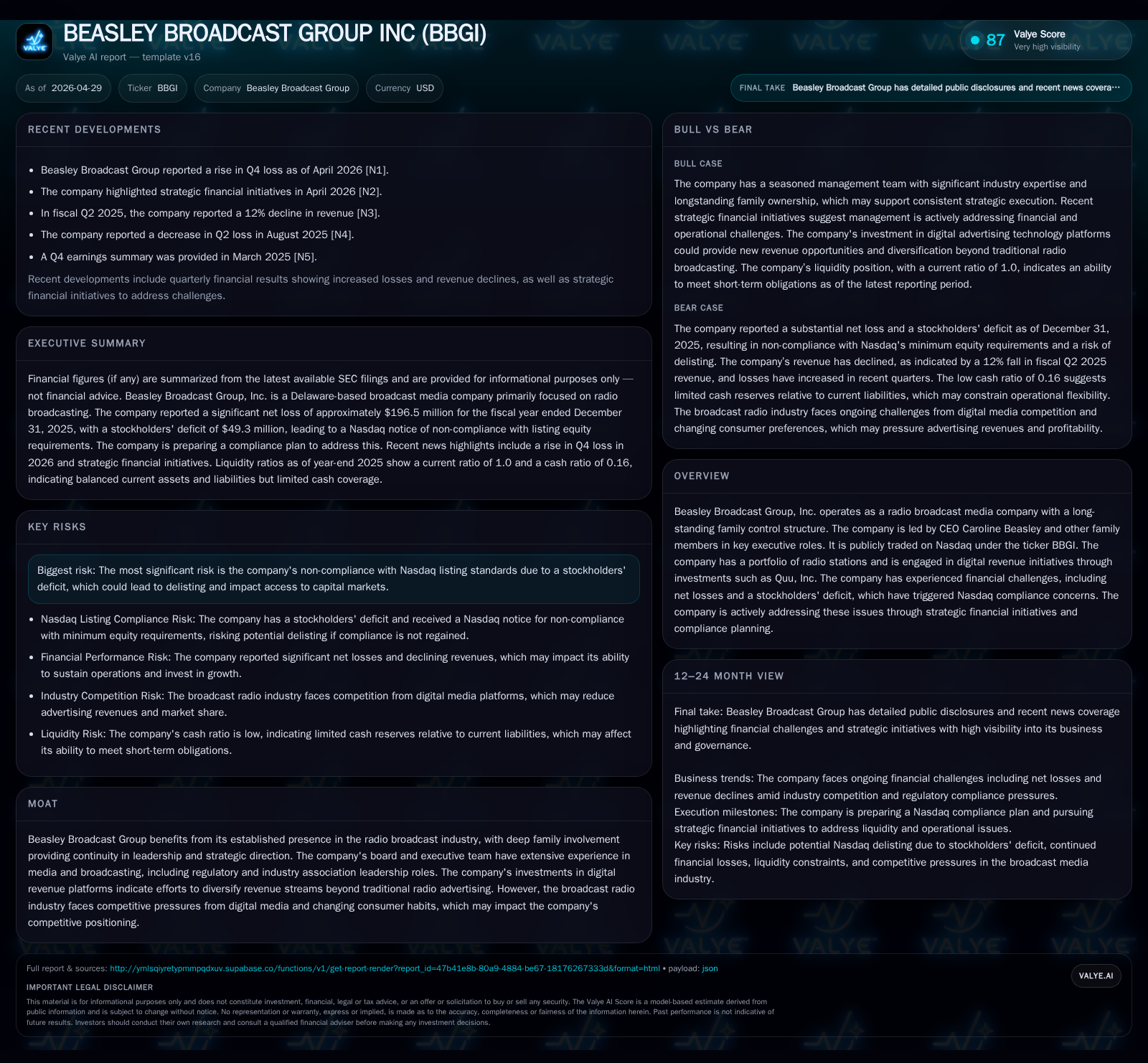
In April 2026, Beasley Broadcast Group received a Nasdaq notice for failing to meet the minimum stockholders' equity requirement, reflecting ongoing financial distress. While maintaining its portfolio of traditional radio stations, the company is actively pursuing digital media ventures and strategic initiatives to stabilize and grow revenue streams. The company's leadership remains deeply entrenched in the broadcast industry, leveraging experience to navigate regulatory and market challenges. The key immediate focus is submitting an effective Nasdaq compliance plan while advancing digital monetization opportunities.
Quarterly Operating Update Highlights Listing Compliance Risk
On April 13, 2026, Beasley Broadcast Group (BBGI) was formally notified by Nasdaq that it is not in compliance with the minimum stockholders’ equity rule requiring at least $2.5 million to maintain listing on The Nasdaq Capital Market [S3]. As reported in its 2025 annual filing, Beasley recorded a stockholders’ deficit of roughly $49.3 million at year-end [S24], confirming this compliance gap. The non-compliance status poses an existential threat; however, Nasdaq allows BBGI until May 28, 2026 to submit a detailed plan to regain compliance with continued listing rules. If accepted, Nasdaq may grant up to an additional 180 days, extending through October 10, 2026, for Beasley to demonstrate restored equity levels [S24].
This development crystallizes the urgency behind Beasley’s ongoing strategic financial initiatives, including debt restructuring talks initiated earlier in the year [N1]. These direct regulatory pressures expose vulnerabilities tied to legacy financial burdens and underline the precarious position of traditional radio broadcasting companies amid shifting media consumption patterns.
Business Model: Traditional Radio Anchored with Emerging Digital Ventures
Beasley’s business model primarily derives revenue from operating radio broadcast stations within local and regional U.S. markets. Revenue streams hinge largely on selling advertising airtime across its portfolio of branded stations that target geographically defined audiences [S1]. This classic model benefits from relatively stable contract-based advertiser relationships but lacks significant barriers preventing advertisers from migrating to digital alternatives as competition intensifies.
To combat secular erosion in radio ad dollars driven by digital media proliferation, Beasley is expanding its footprint into digital media products. Notably, the company holds investments in firms such as Quu Inc., a digital content revenue platform aimed at supplementing traditional ad sales with programmatic and online monetization strategies [S1]. This pivot evidences management’s recognition that long-term growth requires diversification beyond linear broadcasting into scalable digital service offerings.
Family leadership continuity—CEO Caroline Beasley alongside brothers Brian E. Beasley (COO) and other family members—provides institutional memory combined with strategic oversight informed by decades in the broadcast industry [S1]. Additionally, executive roles carry expertise from influential media policy backgrounds (e.g., General Counsel Chris Ornelas’ NAB tenure), buttressing governance quality against complex legal and regulatory regimes.
Competitive Landscape and Industry Dynamics in Radio Broadcasting
Pricing power for traditional ad inventory is pressured by audience fragmentation and consolidation trends among national advertisers seeking cross-platform exposure [S1]. Regulatory oversight by the FCC around licensing caps limits rapid geographic expansion through acquisitions or frequency increases, constraining capacity growth options [S1].
Furthermore, evolving advertiser preferences demand more measurable ROI than static radio spots can reliably deliver alone. Beasley’s participation in industry bodies like the Radio Advertising Bureau aids insight generation into competitive dynamics but highlights pressure points where broadcast must innovate.
Growth Drivers: Digital Monetization and Market Penetration Opportunities
Management is prioritizing dual avenues for revenue growth: enhancing digital ad monetization capabilities via investments such as Quu Inc., and deepening engagement within existing radio markets through local content differentiation [S1,N1]. Digital initiatives offer scalability benefits paired with lower marginal distribution costs compared to terrestrial transmission.
Key growth metrics likely to signal progress include increases in digital revenue proportion of total sales, expansion of registered users or advertisers on new media platforms, higher retention rates across both traditional listener bases and emerging digital audiences, and successful cross-selling integration between legacy and new channels [N1].
Near-term milestones hinge on execution of announced strategic plans linked to compliance-driven financial restructuring. The company’s public commentary stresses intent to stabilize operating income trends while investing prudently in technology adoption [N1].
Risks and Constraints: Nasdaq Delisting Threat and Industry Disruption
The most immediate risk arises from BBGI’s failure to meet Nasdaq’s minimum equity threshold due primarily to accumulated net losses and stockholders’ deficit exceeding $49 million at end-2025 [S24,F1].
Externally, macroeconomic pressures dampen corporate advertising budgets which directly impact BBGI’s top-line results [S6,N2]. Concurrently, abrupt shifts in consumer listening habits towards digital challenge Beasley's ability to justify price premiums on traditional ad slots.
Operationally, cash flow constraints induced by servicing approximately $310 million of outstanding debt (as of last known data 2021) against modest cash reserves near $9.9 million exacerbate balance sheet stress [F1].
Advances along these fronts will indicate whether BBGI can manage immediate financial headwinds while fostering sustainable transformation aligned with evolving industry norms.
Financial Snapshot: Liquidity and Leverage Position
Latest financial snapshot
| Metric | Value | Period |
|---|---|---|
| Cash & equivalents | $10mm | |
| 2025-12-31 | ||
| Current assets | $60mm | |
| 2025-12-31 | ||
| Current liabilities | $60mm | |
| 2025-12-31 | ||
| Current ratio | 1x | |
| 2025-12-31 |
Source: SEC companyfacts cache [F1].
These financial conditions necessitate urgent remedial measures epitomized by its ongoing dialogue with noteholders over possible restructurings documented earlier this year [S11]. Absent successful deleveraging or improvement in profitability margins driven partly by expanded digital revenues, maintaining listing standards will remain challenged.
Note: This analysis focuses entirely on publicly disclosed information contained within regulatory filings and verified secondary sources as of April 29, 2026. It does not constitute investment advice or recommendations regarding securities trading.
Disclaimer: This is research-only, informational analysis and not investment advice. It may include AI-generated interpretation and general industry context. Always verify important details using primary sources.

Comments