
Elme Communities Executes Liquidity Plan While Managing Portfolio Transition
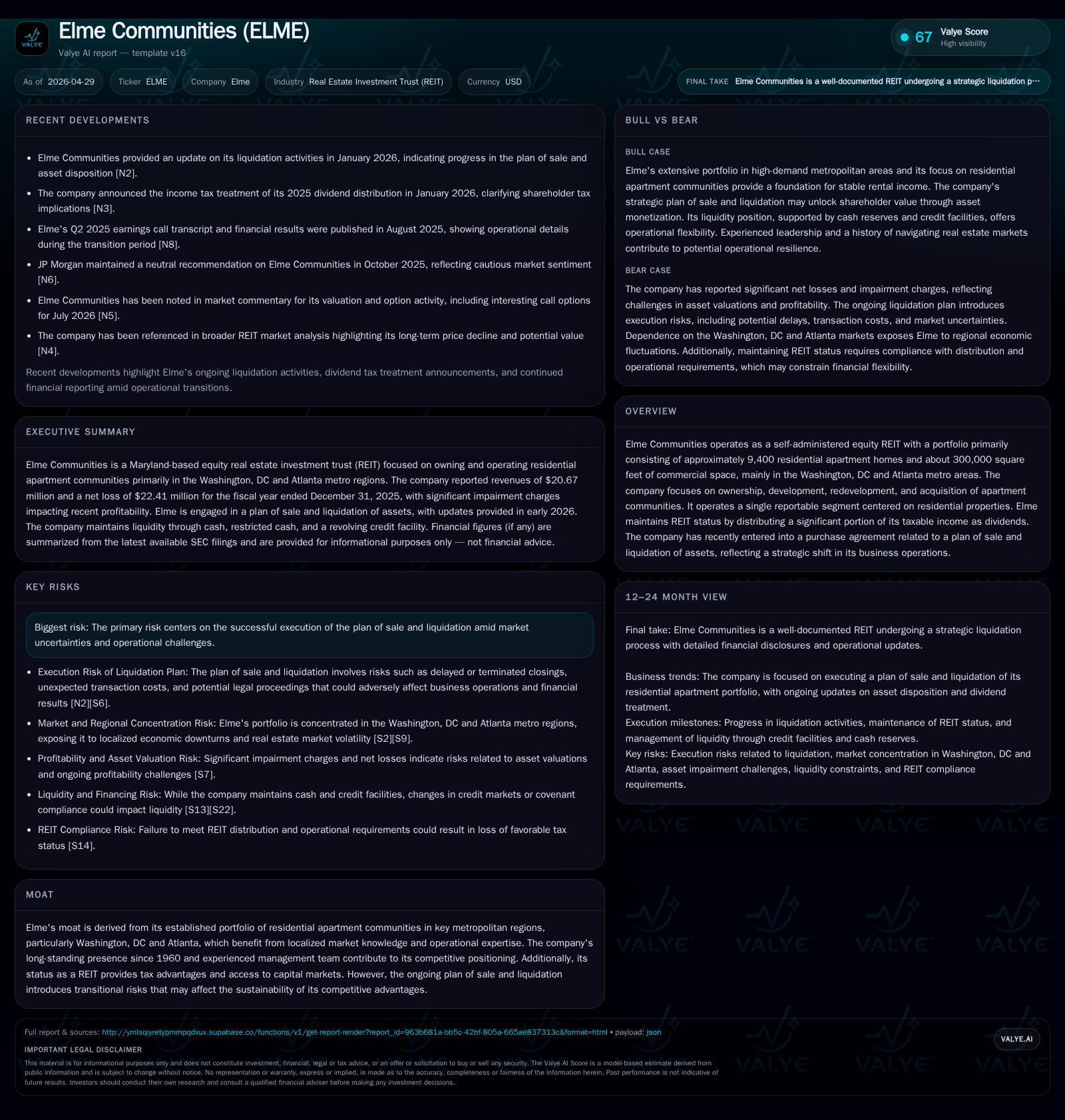
Elme Communities has entered a structured plan of sale and liquidation, marking a strategic shift impacting operational metrics and financials in 2025.
In its latest Q3 2025 filing, Elme Communities disclosed a significant real estate impairment and declining net operating income tied to an executed purchase agreement and a formal plan of sale and liquidation. Operating primarily as a residential equity REIT with concentration in Washington, DC and Atlanta, Elme is now focused on orderly asset disposition under liquidity-driven management. This pivot constrains long-term growth prospects while emphasizing execution risk. Key operational KPIs such as occupancy have softened amidst the transition, and the company leverages its REIT status to maintain cash flow and dividend continuity despite earnings volatility.
Recent Operating Developments: The Plan of Sale and Liquidation
Elme Communities’ latest quarterly disclosures [S2] reveal a marked turning point driven by the August 1, 2025 Purchase Agreement effectuating a comprehensive Plan of Sale and Liquidation. This strategic pivot reflects a decisive move away from traditional growth toward capital return through asset divestiture. The Q3 2025 results show an impactful $111.7 million real estate impairment charge alongside increased general and administrative expenses ($7.7 million) and a net operating income (NOI) decline of $0.8 million compared to the prior year period.
The impairment largely stems from portfolio revaluation aligning with anticipated sale prices under the new plan. Residential same-store average occupancy dipped modestly to 94.4% in Q3 2025 from 95.2% in Q3 2024, indicating transitional softness among core assets [S2]. Management emphasizes operational execution focused on smooth asset disposition while maintaining property operations through this phase.
Business Model Overview: Residential Focus with REIT Structure
Founded in 1960, Elme Communities functions as a self-administered equity Real Estate Investment Trust (REIT) with its revenues derived predominantly from rental income on approximately 9,400 residential apartment homes concentrated in the Washington, DC and Atlanta metropolitan areas [S1][F1]. In addition to residential holdings, the company owns roughly 300,000 square feet of commercial space mainly in Washington D.C., which forms a smaller portion of its portfolio.
The single-reportable segment focuses exclusively on residential properties operated for rental income generation. Revenue mechanics hinge on occupancy levels, effective rent pricing, lease renewals, and contractual structures typical for multifamily housing operators [S1]. Maintaining REIT status obliges Elme to distribute the majority of taxable income as dividends — a source of strong shareholder cash returns historically maintained despite recent earnings volatility [F1].
Operational leverage has traditionally been driven by maintaining high occupancy rates (~95% pre-liquidation), efficient property management yielding stable NOI margins, and prudent redevelopment activities that support long-term value accretion within its existing footprint [S2][S1].
Competitive Positioning in Metropolitan Apartment Markets
Elme’s moat is principally geographic and experiential: entrenched presence in two high-barrier metro areas characterized by supply-demand imbalances favoring landlords supports relatively stable occupancy and pricing power [S1][F1]. Its portfolio scale—while modest relative to large institutional REITs—affords economies of scale through centralized administration and localized market knowledge.
However, this concentrated exposure amplifies regional economic sensitivities including regulatory shifts affecting rent control policies or property taxes. Additionally, competitive pressures from larger apartment REITs or new developments pose ongoing challenges but are tempered by tenant switching costs that are moderate but non-trivial given location desirability.
In terms of product quality and operational relevance, Elme’s strategy includes selective redevelopment projects aimed at upgrading aging assets to retain competitive positioning even as the overall portfolio faces liquidation constraints [S2].
Growth Drivers: Opportunities and Limitations Amid Liquidation
The major driver historically has been organic rental income growth backed by occupancy stability and selective property enhancements. Current redevelopment initiatives remain underway but function more as value preservation tactics rather than catalysts for expansion given the liquidation trajectory detailed in recent filings [S2].
Potential upside exists if occupancy stabilizes or improves post-announcement due to renewed market confidence or favorable leasing conditions; however, new leasing velocity may be tempered amid tenant uncertainty about asset ownership changes. Transaction milestones such as closing individual property sales per the Purchase Agreement serve as proxies for progress in unlocking shareholder value.
Elme’s access to capital markets is also transitioning with acquisition activity effectively paused while leveraging proceeds from asset divestitures to reduce debt [S8][S12]. Thus growth drivers persist chiefly in managing orderly wind-down efficiency rather than traditional expansion.
Risk Factors: Execution Risks and Market Uncertainties
Execution risk dominates as Elme navigates complex transactional logistics under its Plan of Sale and Liquidation [S4][S11]. Delays or failures to close sales at expected prices expose the company to liquidity shortages or extended holding costs.
Legal risks surface as litigation threats related to portfolio sales have emerged alongside sensitive employee retention issues prompted by organizational changes [S6]. Maintaining REIT status throughout transfer processes imposes additional compliance burdens requiring carefully managed distributions and corporate governance adherence.
Market uncertainties include fluctuations in regional demand for multifamily housing influenced by macroeconomic factors such as interest rates influencing mortgage affordability, potential rent control legislation affecting pricing power, and broad financial market volatility impacting buyer appetite for commercial real estate assets [S21].
Third-party contractual provisions triggered by asset sales may complicate timelines or increase transactional costs further [S11]. Finally, any unanticipated capital expenditures necessary during liquidation could impose unexpected financing needs [S6].
Outlook & What to Watch Next
Investors should monitor forthcoming updates on key transaction closings stipulated under the Purchase Agreement. Progress on sales closings will critically inform timing for liquidating distributions announced previously — initial distribution was paid early January 2026 with additional payments contingent on successful wind-down milestones [S10][S25].
Watch for updates regarding debt repayment status against the Goldman Sachs–provided secured loan facility ($520 million principal) collateralized by remaining assets post-portfolio sale [S12]. Further signals will include disclosure around tenancy occupancy trends amid transition-related disruptions or improvements.
Management retention plans disclosed through retention agreements underscore efforts to maintain leadership stability during this phase; tracking related cost implications offers insight into operating expenditure adjustments [S3][S6]. Regulatory or tax developments impacting ongoing REIT qualification remain an area warranting investor attention.
Financial Summary: Annual Trends Reflecting Transition
Historical performance (annual)
Capital returns and efficiency (annual)
The fiscal year ended December 31, 2025 bears out the tactical shift toward liquidation with revenues plunging over two-thirds year-over-year due primarily to asset dispositions reducing rental base size. Severe impairments contributed to an operating loss exceeding $120 million driven largely by write-downs related to updated portfolio valuations reflecting expected sale prices.
Despite this earnings pressure, positive operating cash flows near $62 million highlight continued core rental operations generating substantial cash inflow—supporting dividend payments consistently near $64 million annually despite net losses [F1]. Capital expenditures contracted sharply aligned with reduced development activity typically associated with growth phases.
Balance sheet discussions note total debt levels circa $91.9 million per historical data; more recent borrowings include a secured loan facility used as financing backbone supporting transition initiatives while preserving liquidity reported at approximately $6.6 million cash equivalents as of late October 2025 [F1][S2][S7][S8].
This analysis is based solely on publicly filed documents including SEC reports valid as of April 2026 without offering investment advice or recommendations.
Disclaimer: This is research-only, informational analysis and not investment advice. It may include AI-generated interpretation and general industry context. Always verify important details using primary sources.

Comments