
Village Super Market’s Growth Moderated by Geographic Focus and Capital Investment Timing
Village Super Market sustains competitive positioning through Wakefern membership while navigating capital deployment and competitive pressures in the Northeast.
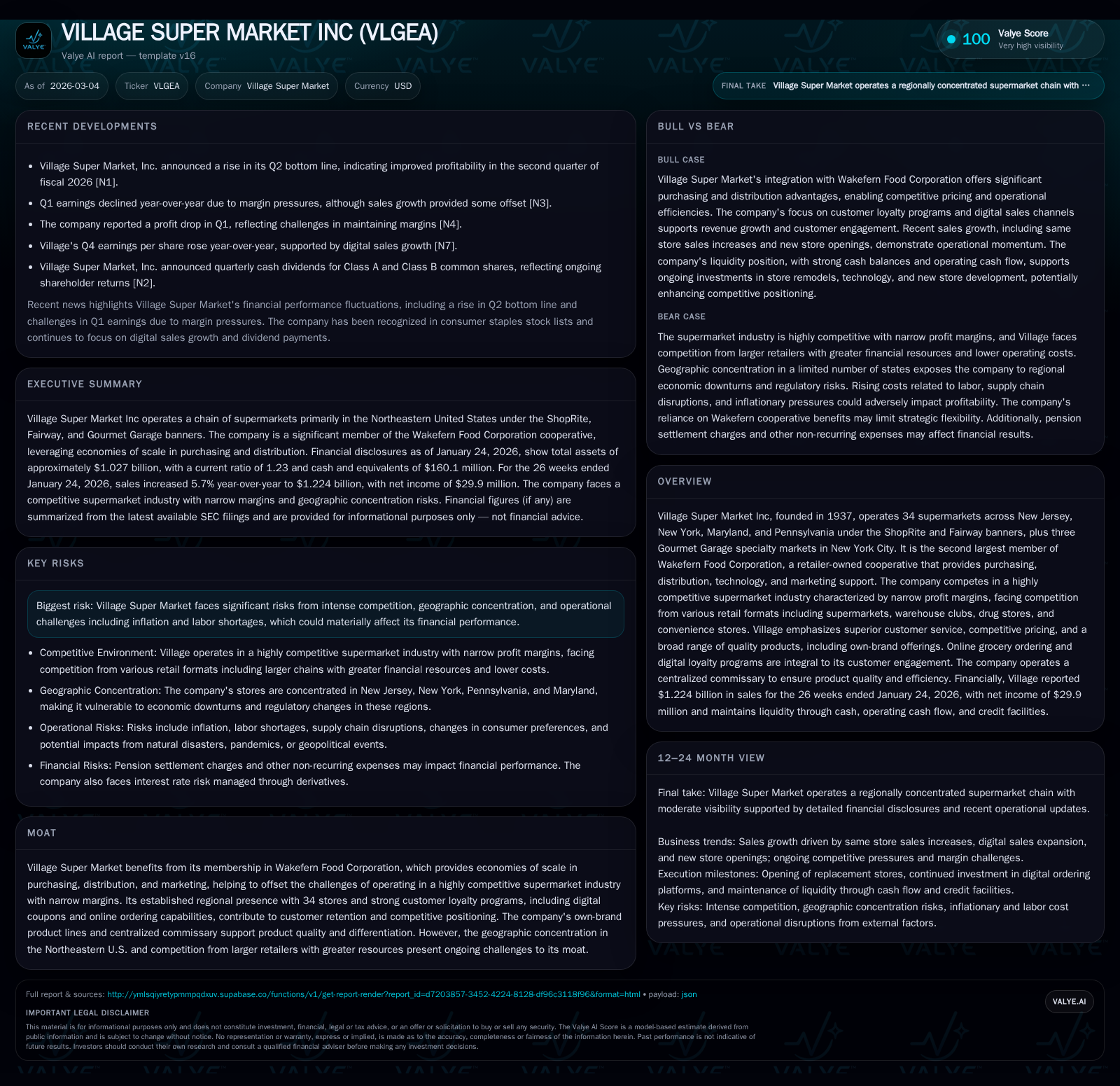
Village Super Market Inc operates 34 supermarkets primarily in the Northeastern U.S. under ShopRite and Fairway banners, leveraging its cooperative relationship with Wakefern Food Corporation to maintain scale advantages amid a fragmented and low-margin supermarket industry. The company’s recent financial performance reflects steady operating income growth, supported by disciplined cost management and investment in store replacements and remodels, though capital expenditure timing has delayed some projects. Liquidity remains robust with ample credit availability, enabling ongoing investments despite inflationary and labor challenges. Looking forward, same-store sales growth is projected to be modest, with future expansion dependent on resolving trademark disputes with Wakefern and successful store repositionings.
Company Overview and Industry Context
Village Super Market Inc traces its roots back to 1937 and presently runs 34 supermarkets predominantly under the ShopRite and Fairway brand names across New Jersey, New York, Pennsylvania, and Maryland, along with three Gourmet Garage specialty outlets in NYC. As the second-largest member of Wakefern Food Corp., a retailer-owned cooperative, Village secures supply chain efficiencies, centralized distribution support, marketing services, and technology platforms that are critical levers amid supermarket chains' inherently thin margins. This cooperative model differentiates Village within a fragmented U.S. grocery industry contending with grocers, warehouse clubs (e.g., Costco), supercenters (e.g., Walmart), drug stores, convenience formats, and online entrants.
The company emphasizes superior customer service alongside aggressive pricing strategies and a curated own-brand portfolio to foster shopper loyalty. Digital initiatives including online grocery ordering and tailored loyalty programs augment engagement in an increasingly technology-driven marketplace.
Historical Financial Performance
Village's operating results over the last four fiscal years reflect positive momentum despite ongoing competitive headwinds:
Historical performance (annual)
| FY | Net ($mm) | CFO ($mm) | OpInc ($mm) | Capex ($mm) | Net YoY |
|---|---|---|---|---|---|
| 2025 | 56 | 93 | 72 | 59 | +11.7% |
| 2024 | 50 | 81 | 62 | 63 | +1.5% |
| 2023 | 50 | 105 | 66 | 46 | +85.3% |
| 2022 | 27 | 80 | 39 | 43 |
Source: SEC companyfacts cache [F1].
Capital returns and efficiency (annual)
| FY | Div ($mm) | Buybacks ($mm) | FCF ($mm) |
|---|---|---|---|
| 2025 | 13 | 0 | 34 |
| 2024 | 13 | 2 | 18 |
| 2023 | 13 | 4 | 58 |
| 2022 | 13 | 1 | 36 |
Source: SEC companyfacts cache [F1].
Note: Revenue figures were not explicitly reported for recent years but historically approximate $1.6 billion [F1]
Key financial trends include a marked rebound in operating income starting FY2023 following sector-wide inflationary pressures impacting earlier periods. Net income similarly gained traction with double-digit growth year-on-year for FY2025.
Operating cash flows have remained robust throughout this period supporting capital expenditures that escalated notably post asset acquisitions such as portions of Fairway's footprint in fiscal 2020 [S7][S9]. Dividend payments have been consistent just above $13 million annually indicating disciplined shareholder returns despite elevated reinvestment.
Capital Allocation & Liquidity Position
The company’s investment strategy focuses on replacing aging stores while upgrading technology infrastructure to enhance shopper experience and operational efficiency.
For fiscal year ending July 2026 (ongoing), Village revised its capital expenditure budget downward from initial plans of approximately $75 million to nearly $65 million reflecting delays in certain store openings and remodel schedules notably for new sites in East Orange and Galloway New Jersey [S12][S17]. These replacement stores embody modern grocery retail principles emphasizing fresh produce and streamlined checkouts.
Liquidity remains sound with cash and equivalents totaling around $160 million as of January 24th 2026 supplemented by about $66 million of unused capacity on its unsecured revolving credit facility expiring April 2030 [F1][S11]. Total long-term debt approximates $59 million comprising secured term loans with fixed effective interest rates between approximately 2% to over 5%, managed via interest rate swaps mitigating SOFR variability risk [S10][S16][S22].
Additionally leveraged funding through a New Markets Tax Credit program supports the East Orange store construction while providing tax incentives linked to community development goals typical for urban revitalization projects [S11][S18].
During the first half of fiscal year ending July 2026 (26 weeks ended January), capital expenditures totaled approximately $17.7 million focused on replacement stores and remodels while dividend payments remained steady at about $6.65 million for the period [S17]. No share repurchases occurred reflecting prioritization of cash toward reinvestment rather than buybacks [F1].
Operational Highlights & Strategic Drivers
Village leverages Wakefern's purchasing scale to mitigate supplier cost pressures prevalent among regional grocery chains lacking national reach. Its centralized commissary supports product quality consistency especially for private-label offerings.
Digital engagement campaigns informed by data analytics drive targeted promotions amidst competition from brick-and-mortar giants like Wegmans or Stop & Shop as well as e-commerce platforms such as Instacart-enabled delivery.
However geographic concentration constitutes a vulnerability; economic headwinds or demographic shifts in the Northeast states where all stores cluster can disproportionately affect performance versus more dispersed national peers [S23][S25].
An unresolved trademark dispute between Village and Wakefern concerning marketing agreements caused delays in new store approvals but has not materially impacted current operations [S14]. This legal uncertainty warrants monitoring as escalation could affect expansion capabilities or impose costs.
Future Outlook & Considerations
Management expects same-store sales growth between +1% to +3% for fiscal year ending July 2026 reflecting prudent outlook amid inflation normalization post-pandemic alongside intensifying retail competition [S12].
Capital spending will remain focused on flagship replacements alongside smaller remodeling projects aimed at maintaining contemporary store standards necessary for customer retention.
Liquidity sources combining operating cash generation plus revolving credit access are expected sufficient to fund working capital needs plus property development commitments throughout the fiscal year [S12][S17].
Investors should watch progress on resolving legal disputes with Wakefern as well as the pace and reception of newly constructed outlets which will be pivotal milestones influencing revenue upside potential over subsequent periods.
Conclusion
Village Super Market holds a defensible niche within the densely contested supermarket arena by harnessing cooperative advantages conferred by Wakefern membership coupled with strong regional brand presence centered in the Northeast corridor. Its financial results demonstrate growing profitability supported by effective cash flow management despite sizeable reinvestment demands driving capital expenditure shifts.
Geographic concentration introduces cyclicality risks amplified by fierce competition from larger national chains and alternative retail formats encroaching on grocery market share especially online.
The company’s deliberate capital allocation away from buybacks toward sustaining store network modernization alongside continued shareholder dividends highlights a balanced approach amid evolving retail market conditions.
Monitoring execution of project timelines alongside resolution of unsettled contractual issues with cooperative partners will be essential to assessing Village's capacity for incremental growth beyond steady operational improvements currently forecasted.
This analysis is based on publicly available information including SEC filings through March 2026 [F1] and recent market reports [N1]. It does not constitute investment advice but aims at providing an informed overview grounded in documented company disclosures.
Disclaimer: This is research-only, informational analysis and not investment advice. It may include AI-generated interpretation and general industry context. Always verify important details using primary sources.

Comments