
Village Super Market Inches Forward on Operating Efficiency Amid Grocery Margin Pressure
VLGEA’s latest quarterly report shows margin compression yet stable liquidity underpinned by its cooperative model and multi-banner strategy.
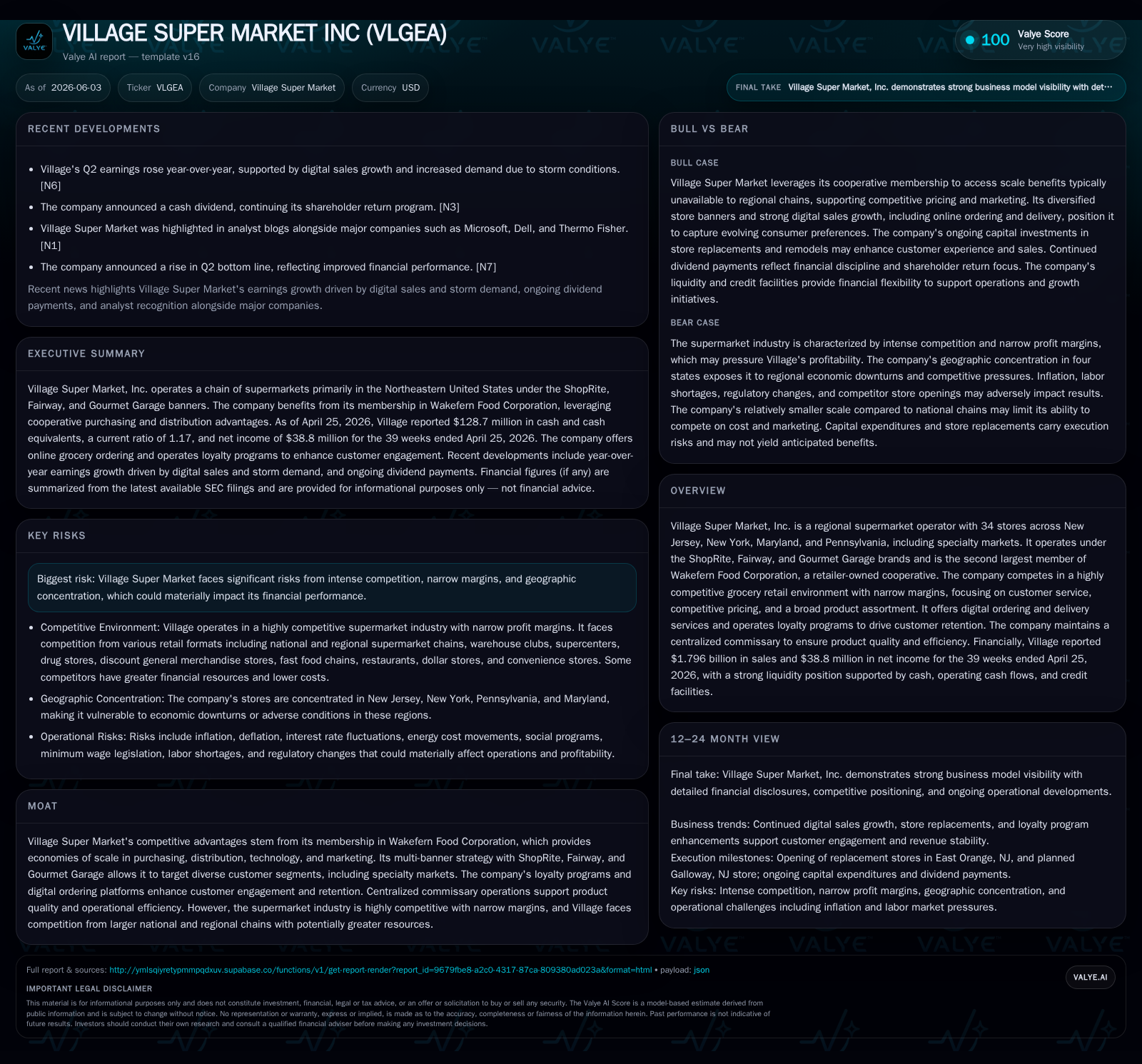
Village Super Market’s Q3 fiscal 2026 results reveal typical margin pressure in a highly competitive grocery market, with gross profit margin declining from 28.77% to 28.08% and operating margin retreating to about 1.5%. Despite this, operating income remained positive, supported by tight control of operating expenses and steady interest costs. The company leverages its Wakefern cooperative membership for purchasing scale and operates multiple store banners targeting diverse customer segments. Growth drivers include loyalty program expansion and digital ordering, but risks persist from intense competition, narrow margins, and ongoing legal disputes with Wakefern. Liquidity is solid with $128.7 million cash on hand and robust operating cash flow, ensuring capacity for capital investments and debt servicing.
Q3 Operating Update: Margins Under Pressure, Operating Income Holds
Village Super Market’s fiscal Q3 ended April 25, 2026, exhibits typical margin compression challenges faced by regional grocers competing during inflationary input costs and aggressive competitor pricing. Gross profit margin slid to 28.08% of sales from last year’s 28.77%, driven by modest increases in cost of sales (now 71.92%) relative to last year’s 71.23% [S2]. Operating income fell sharply in percentage terms to roughly 1.47% of sales versus 2.43% in prior year quarters, though it remains positive, signaling the company’s ability to manage expense growth prudently.
Administrative expenses edged up slightly to 25.11% of sales from prior-year levels but did not escalate out of control despite wage pressures linked to the high unionization rate (~91%) [S2]. Depreciation remained stable around 1.5%. Interest expense held steady at approximately 0.15%, partially offset by interest income on notes receivable from Wakefern [S2]. These data points corroborate that while Village faces squeezing operating margins, it continues generating meaningful operating cash flows by balancing cost control with service investments.
Business Model Snapshot: Multi-Brand Supermarket Strategy within Wakefern Co-op
Village operates a portfolio of 34 supermarkets under multiple banners—ShopRite stores serve broad supermarket customers while Fairway and Gourmet Garage cater to premium or specialty segments [S1]. This multi-banner approach supports geographic and demographic diversification within the Northeast corridor (NJ, NY, MD, PA). Village benefits materially from being the second largest member of Wakefern Food Corporation—a retailer-owned cooperative that aggregates purchasing power to reduce merchandise acquisition costs and supports centralized distribution logistics complemented by a shared commissary system enhancing product consistency [S1].
Digital tools such as online ordering and delivery services augment the convenience proposition alongside loyalty programs engineered to boost repeat purchases and increase basket sizes [N1]. These operational features reinforce Village’s positioning despite the intensely competitive landscape characterized by narrow industry margins.
Competitive Dynamics: Regional Scale vs National Players and Cooperative Benefits
In a grocery environment where national incumbents like Kroger or Amazon Fresh boast scale advantages unmatched by regionals like Village alone, the Wakefern cooperative affiliation is critical. It affords Village cost benefits via collective buying agreements, technology platforms for inventory management and eCommerce fulfillment efficiencies unavailable to standalone chains [S1],[S2]. However, the company still faces hurdles including aggressive discount retailers and supercenters exerting price pressure.
Moreover, operating primarily in four adjacent states restricts geographic scale but allows nuanced local merchandising reflective of community preferences—particularly benefiting specialty banners like Fairway that appeal to niche food shoppers. Pricing power remains modest overall given the plethora of competing formats ranging from drug stores to dollar stores offering partial grocery assortments.
Growth Opportunities: Customer Loyalty and Diversified Banner Footprint
Village diligently works on growing its loyalty program penetration aiming for improved customer retention metrics; these programs tend to stabilize demand elasticity even when overall price competition intensifies [S1],[N1]. The push into digital ordering aligns with evolving consumer preferences for omni-channel retail convenience—a factor increasingly vital in grocery where eCommerce fulfillment costs challenge profitability but yield incremental volume.
Specialty brand stores like Gourmet Garage capitalize on consumer trends favoring organic or gourmet products with better margins than traditional groceries—which can incrementally lift overall portfolio profitability if managed carefully [S1]. Planned store replacement investments demonstrate commitment towards modernizing physical locations enhancing shopping experience while controlling maintenance capex through phased remodels [S2].
Risks and Constraints: Narrow Margins, Litigation, and Geographic Concentration
Village discloses ongoing litigation against Wakefern related to trademark usage and other cooperative agreements which has delayed approval timelines for new store openings planned historically under cooperative auspices [S3]. While operations have not been significantly disrupted yet, these legal uncertainties pose potential risks around future business development flexibility.
The structure of the grocery industry—with razor-thin average net margins—means any unfavorable shifts such as wage inflation (exacerbated by labor union agreements covering most employees), higher supply costs or more aggressive promotional activity could erode profits quickly [S3],[S2]. Geographic concentration limits risk diversification; downturns or competitive escalations in these Northeastern states could disproportionately impact results.
What to Watch Next: Earnings Guidance, Same-Store Sales Momentum, Cooperative Developments
The company forecasts same-store sales growth between 1.5% and 2.5% for fiscal year 2026 supported by stable traffic combined with modest price increases [S2,S10]. Market watchers should monitor same-store sales trends quarterly as an indicator of resilience against discount grocer encroachment.
Progress on opening the replacement store in Galloway scheduled for fiscal year 2027 will be a key execution milestone alongside rollout success of digital engagement initiatives planned across banners [S2]. Total long-term debt was approximately $47.1 million after deducting the current portion from total debt near $56.5 million reported in the latest filing [S2].
Operating cash flow for the trailing nine months reached $78.5 million supporting capital expenditures primarily targeting store replacements and upgrades totaling an expected $65 million in fiscal year 2026 [S2,S10]. Liquidity availability under the unsecured revolving credit line was nearly $66 million maintaining financial flexibility despite elevated competition-induced margin pressure.
Disclaimer: This analysis is based exclusively on publicly filed SEC documents supplemented by known industry context without any proprietary non-public information access or forward-looking investment research view.
Financial position in context
As of 2026-04-25, companyfacts shows $129mm in cash and equivalents [F1]. Current assets of $212mm and current liabilities of $182mm imply a current ratio near 1.17x for 2026-04-25 [F1].
Disclaimer: This is research-only, informational analysis and not investment advice. It may include AI-generated interpretation and general industry context. Always verify important details using primary sources.

Comments