
Assessing VANJIA CORP’s Early Path in the Software-as-a-Service Landscape
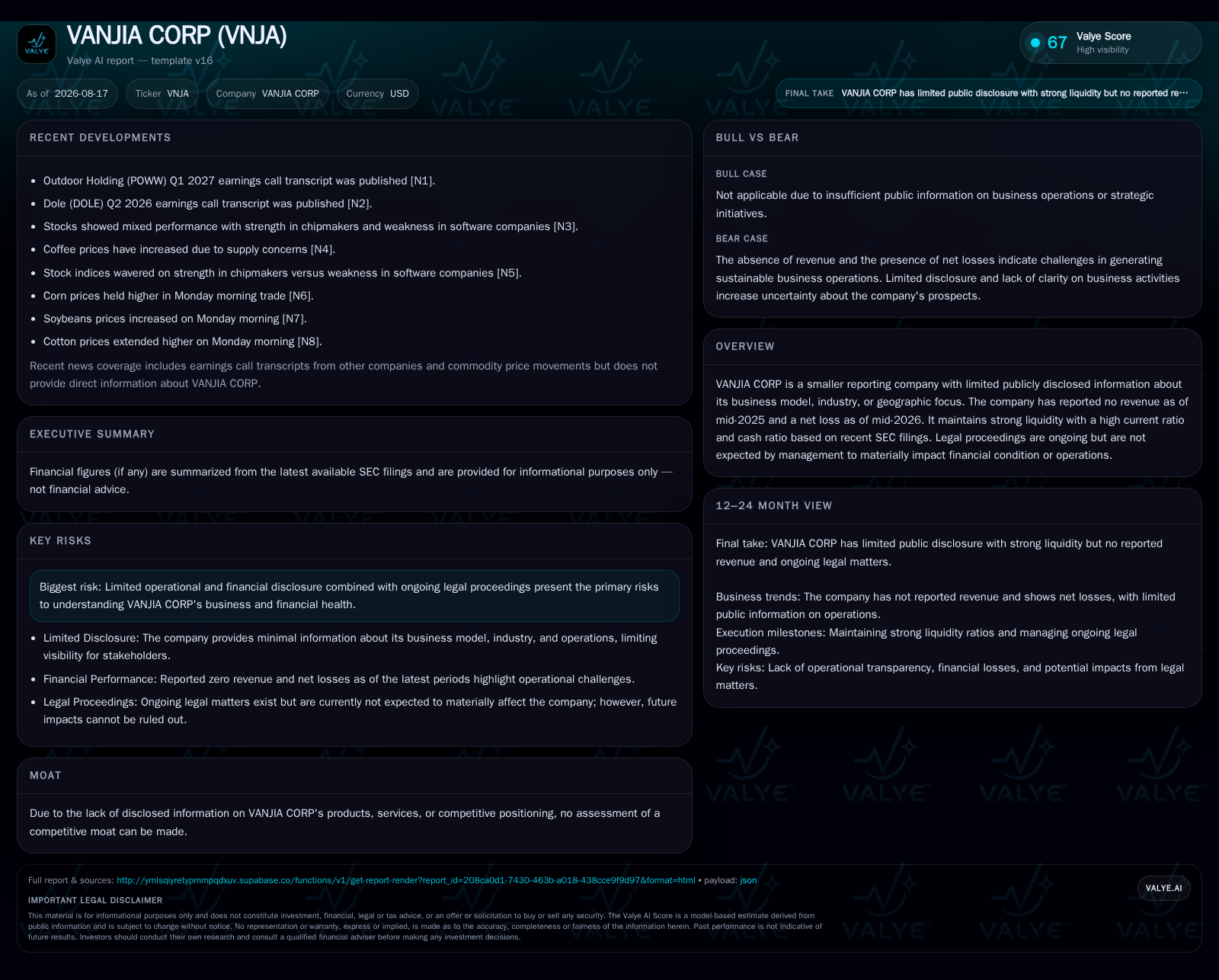
VANJIA CORP’s latest quarterly filing highlights sustained net losses amid no revenue generation, underscoring key uncertainties on its SaaS business viability despite robust liquidity.
VANJIA CORP reported no meaningful revenue in its Q2 2026 filing while maintaining a strong cash position and high current ratio, reflecting solid liquidity but limited operational traction. The company’s business model appears aligned with typical SaaS subscription frameworks, but scant disclosures hinder visibility into customer acquisition, retention, or product-market fit. Legal proceedings remain ongoing yet are deemed non-material by management, though such uncertainties compound execution risk as VANJIA seeks growth. Future progress will hinge on milestones like subscription revenue ramp and customer metrics typical for early-stage SaaS firms.
Latest Quarterly Report Reveals Liquidity Strength but Absent Revenue Clarity
The twin facts of zero identifiable sales and a persistent net loss highlight a critical early-stage status. Without evidence of recognized recurring revenues or disclosed sales contracts, VANJIA remains reliant on its cash reserves to fund operations, raising questions about its timeline to sustainable revenue generation. For SaaS companies—where subscription growth velocity and churn stability underpin valuation—the inability to demonstrate basic KPIs such as MRR growth or customer stickiness limits the visibility into business health.
Decoding VANJIA’s Business Model: SaaS Assumptions with Limited Disclosures
Absent explicit statements about product offerings or pricing structures in SEC disclosures, it is reasonable to infer based on meta-industry context that VANJIA aims to operate under the conventional SaaS archetype. Such companies generate revenue predominantly through subscription licensing for cloud-hosted software applications delivered on multi-tenant architectures enabling scalability and continuous updates. Key financial drivers typically include customer acquisition cost (CAC), churn rate reflecting customer retention dynamics, and customer lifetime value (LTV) which balances acquisition investment against expected subscription tenure.
These dynamics require robust onboarding procedures and integration APIs facilitating rapid deployment within client environments. Given the lack of publicized contracts or user metrics from VANJIA’s reports [S1],[S2], there is no concrete measure yet of how well it manages these critical SaaS success factors. Moreover, without disclosed data on price tiering or freemium conversion models—common levers for scaling usage and ARPU—assessing VANJIA’s path to scalable recurring revenue remains speculative.
This opacity intensifies execution risk since early churn or ineffective CAC often fatally impair ARR build-out before scale economies emerge. The company must transparently report future progress on these frontiers to substantiate its emerging SaaS profile.
Competitive Dynamics: Positioning Without Market Visibility in Intense SaaS Environment
The broader SaaS sector is fiercely competitive with incumbents like Salesforce setting benchmarks for subscription revenue growth and enterprise-scale adoption. Vertical SaaS specialists often capture niches by combining domain-specific functionality with tailored integrations—yet require demonstrable user engagement gains and clear differentiation to justify customer investment amid pricing pressures.
Without any declared customer wins or product specifics from VANJIA's filings [S1], evaluating its competitive moat is infeasible. The risks common among emerging SaaS providers—rapid innovation demands, intense sales cycles, regulatory compliance costs especially around data privacy—are likely present but unquantifiable here.
Moreover, dependency on cloud infrastructure providers poses operational risks including outages and cost fluctuations that may impact margins once commercial sales commence. Therefore, until VANJIA reveals tangible market penetration indicators or project delivery successes, its competitive stance will remain unclear relative to more established pure-play providers.
Potential Growth Drivers Aligned With Industry Trends and Market Uptake Risks
The macro environment for SaaS firms is broadly supportive due to accelerating digital transformation initiatives across industries coupled with shifts away from on-premises software toward cloud subscriptions. If VANJIA can leverage these trends by expanding into new geographic markets or augmenting solutions with complementary modules providing workflow automation or enhanced user experience, it may unlock accelerated uptake.
Such growth depends heavily on achieving low churn through stickiness-inducing features and efficient CAC relative to LTV—a balance many early-stage SaaS firms struggle to strike. Scalability achievable through multi-tenant cloud hosting architectures will be critical to manage marginal cost leverage as users increase.
Nonetheless, without disclosed operating metrics confirming commercial traction or product-market fit velocity,[S2], potential growth remains aspirational rather than evidenced for this company.
Risks Rooted in Legal Proceedings and Uncertain Operational Execution
Management acknowledges ongoing legal proceedings described as arising from ordinary business activities but assesses no material adverse effect expected on financial condition or operations [S1],[S8]. Such legal matters nonetheless introduce unpredictability around legal costs allocation and possible distractions impacting execution bandwidth.
Coupled with the standard SaaS risks—including volatile churn rates affecting ARR stability; susceptibility to competitive pricing pressure; delays in product updates; complexity integrating into diverse IT environments—these factors collectively amplify operational risk given the company’s embryonic status without visible revenues.
Underwriting assumptions about safe runway thus must integrate these legal uncertainties alongside structural sector hazards inherent in scaling a software subscription business.
"Looking Ahead": Key Metrics and Milestones To Monitor Next Quarter and Beyond
Analysts tracking VANJIA should focus keenly on forthcoming disclosures highlighting initial signs of subscriber acquisition reflected in MRR/ARR figures. Equally important will be qualitative commentary regarding CAC efficiency improvements alongside early churn rate data which together illuminate unit economics sustainability.
Additional milestones include announcements related to strategic partnerships enabling broader channel access or steps toward enhancing integration capabilities through APIs enhancing onboarding velocity. Any updated guidance around timelines for commercial deployments would improve transparency over path-to-scale prospects.
Financial Profile Discussion: Balancing Cash Reserves Against Sustained Losses
However, the company continues to post net losses consistent with an early-stage growth profile reliant heavily on capital deployment into research & development plus sales/marketing without offsetting revenue streams. The burning of cash reserves without immediate prospects for positive free cash flow amplifies financing risk over medium term absent evident commercialization acceleration.
Prudent stewardship entails vigilant management of burn rates alongside expeditious progress toward measurable subscription revenues—the key inflection point signaling transition from speculative investment toward scalable business model validation within the software-as-a-service industry framework.
This analysis synthesizes publicly filed information on VANJIA CORP through August 17, 2026 filings combined with general industry understanding applicable under limited disclosure conditions. It does not constitute investment advice but aims to contextualize operating status relative to typical SaaS sector dynamics.
Disclaimer: This is research-only, informational analysis and not investment advice. It may include AI-generated interpretation and general industry context. Always verify important details using primary sources.

Comments