
Vantage Corp Strengthens Tanker Shipbroking Presence through Acquisitions and IPO Capital Expansion
Fiscal 2026 brought transformative acquisitions and a public listing for Vantage Corp, offsetting weaker shipping markets.
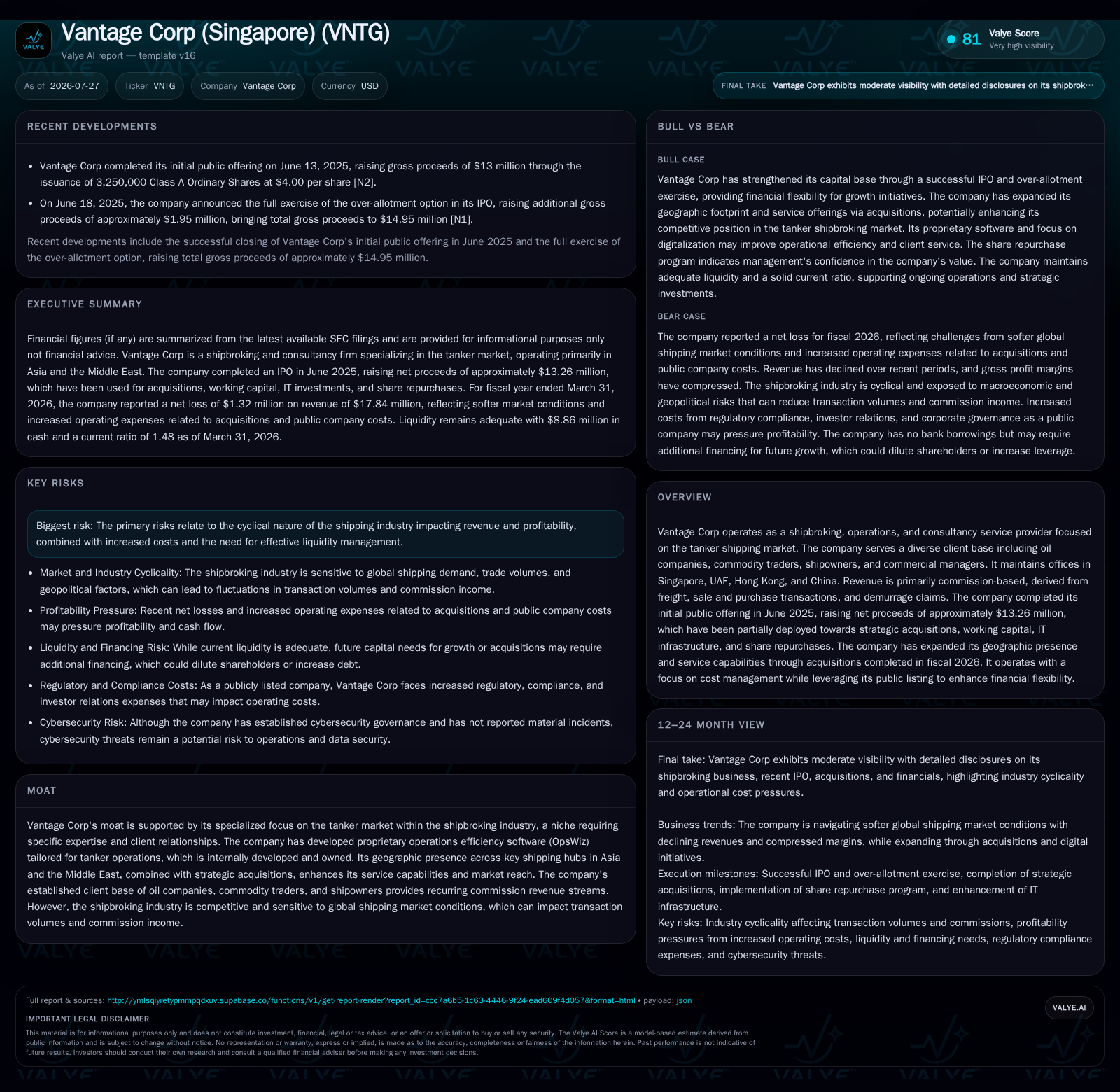
Vantage Corp, a specialized shipbroking and consultancy provider focusing on the tanker segment, reported a 4.4% revenue decline to $17.8 million in fiscal year 2026 amidst softer global shipping conditions and transaction volumes. The year was marked by strategic acquisitions expanding geographic reach and service capabilities, notably PJ Marine entities in Singapore and China. The company’s June 2025 IPO raised $13.26 million net, significantly bolstering liquidity and enabling investments in growth and share repurchases. Despite increased expenses tied to public company compliance and acquisition-related costs leading to a net loss of $1.3 million, Vantage maintains a niche competitive moat with its focused tanker expertise and proprietary operations software. Key risks remain cyclical shipping demand and geopolitical tensions.
Recent Operating Update
Vantage Corp’s fiscal year ended March 31, 2026 was pivotal, with key developments shaping its near-term trajectory. Revenue declined by 4.4% to $17.8 million compared to fiscal 2025, primarily reflecting continued softness across global tanker freight markets and reduced transactional volumes due to geopolitical uncertainty and broader economic headwinds affecting international trade [S1][S11]. This contraction underscores the high cyclicality embedded in shipbroking revenues that directly correlate with freight rate levels and market activity.
Offsetting some of these pressures was the company's deliberate growth strategy through acquisitions—completing deals for PJ Marine Singapore Pte. Ltd., Peijun Marine Consultant Co., Limited, and PJ Marine Shanghai Co., Ltd.—which broadened its geographic footprint into key Asia-Pacific hubs while enhancing consultancy capabilities [S1][S25]. The acquisitions contributed intangible assets such as goodwill that increased non-current assets from just $0.25 million in March 2025 to over $7 million as of March 2026 [S5].
Business Model Analysis
Vantage operates primarily in the niche tanker shipping brokerage sector, generating most revenue through commissions paid by shipowners negotiated on freight payments by charterers—either spot or period charters—sale-and-purchase vessel transactions, and demurrage settlements when charterers delay offloading cargo beyond agreed schedules [S1]. Commission rates are generally percentages of freight or transaction values; hence total income is directly sensitive to freight rate fluctuations, number of charter contracts brokered (volume), contract types (spot versus longer-term period charters), and demurrage claim recoveries.
The firm's clientele encompasses oil companies requiring crude tanker charters, commodity traders arranging transportation to meet delivery schedules, shipowners seeking commercial management support or asset sales/purchases, thus positioning Vantage at a critical nexus between shipowners seeking utilization optimization and cargo owners balancing supply chain requirements across volatile markets. Revenues are realized via broker fees structured largely as variable commissions tied closely to freight market dynamics but occasionally supplemented by lump-sum consulting engagements.
Vantage’s proprietary internally developed operational efficiency software (OpsWiz) is designed specifically for tanker operations management—a value-add differentiator uncommon among pure brokerage peers who mainly provide transactional intermediation without integrated digital tooling. This software supports vessel scheduling optimization, demurrage mitigation assistance, risk compliance monitoring particularly amid shifting global maritime regulations related to environmental standards (IMO 2020 sulfur cap et al.), potentially increasing sticky client relationships given switching costs associated with integrated operational tools.
Geographically, Vantage has established offices in Singapore (headquarters), UAE (Middle East hub), Hong Kong, and mainland China—covering critical tanker shipping corridors for crude oil flows from the Middle East across Asia-Pacific destinations that represent significant share of global tanker demand. This regional spread strengthens client access but also exposes the firm to geopolitical risks influencing maritime trade lanes such as tensions around Strait of Hormuz or South China Sea.
Financially, the company's commission-driven revenue mechanics entail upfront payroll compensation expenses for experienced brokers plus variable commissions paid downstream reflecting deal closures—hence cost structure involves substantial personnel expense variability linked with transaction cycle pacing plus fixed overheads magnified post-IPO via public company compliance costs.
Industry Structure and Competitive Position
Shipbroking is fragmented globally yet highly specialized vertically by vessel type: dry bulk vs container vs tankers—with each niche requiring dedicated market intelligence about specific cargo types, freight indices (e.g., Baltic Dirty Tanker Index for tankers), regulations, routing constraints, fuel cost impacts, and chartering practices including spot vs time charters.
Vantage’s focus on tankers situates it in a narrower sub-segment where expertise commands customer loyalty given complexity around crude oil flows’ sensitivity to crude prices impacting freight demand/supply imbalances frequently influenced by macroeconomic cycles and geopolitical conflicts such as those ongoing in the Middle East or Eastern Europe [S1]. Peers like Clarksons Platou (broader shipbroking service provider), Braemar ACM Shipbroking (noted tanker broker), or Howe Robinson Partners (shipping consultancy) likewise compete on the basis of breadth of geographic coverage combined with deep customer relationships.
However, scale limitations may pressure commission rate negotiations during trough cycles due to relative bargaining power constraints versus clients or larger competitors.
Growth Drivers
Several structural drivers underpin Vantage’s growth prospects:
- Strategic Acquisitions: The recent acquisition spree expanding into Singaporean and Chinese maritime hubs enhances direct access to emerging Asian demand centers while enlarging service portfolios which can accelerate wallet share per client through bundled operational consulting alongside brokerage services.
- Market Cyclicality Favoring Tankers: Periods of rising crude oil prices historically boost tanker spot rates due to surging demand constrained capacity causing freight rate spikes that directly lift brokerage commissions.
- Recurring Revenue from Period Charters: Increasing volume of longer-term period charters stabilizes cash flow streams reducing revenue volatility inherent in spot charter-dependent models; Vantage consciously expanded this segment recently boosting commission income by $1.25 million despite overall volume decline last year [S22].
- Technological Innovation: Continued investment in digital operational platforms like OpsWiz can deepen client engagement creating switching barriers while improving internal efficiency reducing cost ratios long term.
- Regulatory Complexity: Heightened environmental regulations elevate demand for consultancy services helping clients navigate compliance mitigating potential disruption risks thereby diversifying revenues.
- Geographic Expansion: Broadening presence across Asia-Pacific ports positions Vantage favorably amidst ongoing globalization despite occasional disruptions from geopolitical tensions.
Risks / Watchpoints / Constraints
Key challenges temper growth visibility:
- Industry Cyclicality: Freight rates fluctuate sharply with global trade volumes sensitive to macroeconomic downturns or trade disputes impacting transaction counts lowering commission earnings substantially during troughs.
- Geopolitical Risks: Conflicts such as the Iran-Israel war or Russia-Ukraine crisis introduce routing uncertainties deterring cargo movement or increasing insurance premiums impacting charters’ economics negatively affecting brokerage activity [S1].
- Rising Public Company Costs: Compliance burdens increase fixed costs compressing margins requiring disciplined cost control especially if market softness persists [S17].
- Acquisition Integration Risks: Assimilating acquired entities operationally or culturally entails execution risk which could dilute focus or strain resources if not managed prudently.
- Competition Pressure: Consolidation among larger players or new entrants leveraging technology could challenge commission pricing power particularly if freight markets weaken further.
- Client Concentration & Credit Risk: Dependency on limited major oil companies or traders exposes receivables collections risk; credit management policies therefore are critical.
- Foreign Exchange Exposure Minimal But Present: While USD functional currency dominates revenues limiting FX risks currently, expansion into diverse markets may necessitate hedging strategies going forward.
What To Watch Next
Investors should monitor several operational milestones:
- Quarterly transaction volumes particularly shifts between spot versus period charters as indicators of revenue stability;
- Freight rate movements correlating with commodity price trends that underpin commission calculations;
- Progress integrating acquired businesses evidenced through cross-selling operational services;
- Cost structure evolution post IPO-related expense ramp-up including amortization trajectories;
- Client retention metrics signaling competitive strength especially among shipowners using the OpsWiz platform;
- Announcements regarding new geographic offices or service offerings enhancing full-service capabilities;
- Impact from regulatory changes fostering greater demand for consultancy services supporting margins;
- Liquidity indicators showing continued healthy current ratio maintaining above industry norms amid working capital demands;
- Share repurchase activity intensity signaling capital allocation discipline without compromising cash reserves.
Financial Profile Discussion
Overall liquidity appears robust, supporting ongoing strategic investments alongside disciplined spending controls, although sustained profitability recovery will be critical going forward given operating leverage pressures inherent post-listing.
This analysis is based exclusively on publicly available SEC filings dated through July 27, 2026 without incorporating non-public information or forecasts beyond stated disclosures; it does not constitute investment advice but aims to provide informed understanding grounded in operational evidence within the shipbroking sector specializing in tankers.
Disclaimer: This is research-only, informational analysis and not investment advice. It may include AI-generated interpretation and general industry context. Always verify important details using primary sources.

Comments