
Vodafone Group Expands Scale and Digital Services While Managing Competitive Pressures and Integration
Vodafone reported solid service revenue growth in Q4 FY26 driven by African markets and UK consolidation, offset by European ARPU pressure amid intense competition.
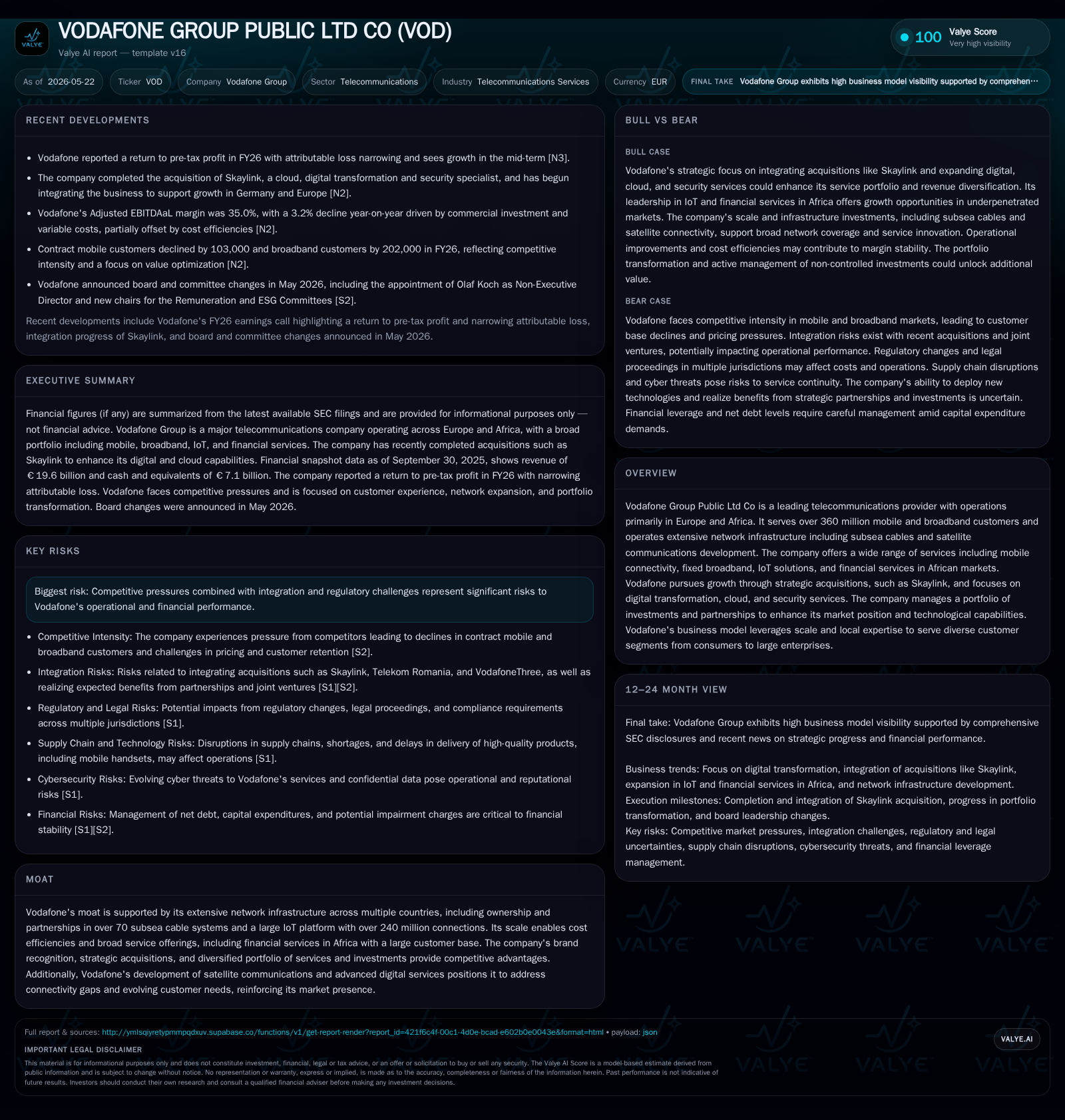
In its latest quarterly update, Vodafone Group highlighted growth across Africa, Türkiye, and the UK following its full ownership of VodafoneThree, alongside continued challenges in pricing power within European markets such as Germany and Portugal. The Group benefits from a broad network footprint, extensive subsea cable capacity, and one of the world's largest IoT platforms with over 240 million connections. Strategic acquisitions like Skaylink and increasing stake in Safaricom underpin digital transformation ambitions. However, competitive intensity, regulatory complexities, and integration risks remain material constraints as Vodafone navigates evolving telecom demand dynamics. Financially, net debt increased due to consolidation effects and share buybacks, while adjusted financing costs decreased reflecting bond redemptions.
Recent Operating Update
Vodafone's latest quarterly disclosures provide a clear narrative of strategic consolidation and robust market performance primarily driven by its African operations and UK merger integration. As of Q4 FY26 ending March 31, 2026, total revenue rose 7.4% year-over-year to €8.4 billion bolstered by service revenue growth of 7.8%, with organic service revenue growth even stronger at 12.9% [S2][S3]. Vodacom’s markets in South Africa, Egypt, Tanzania, DR Congo, Mozambique, and others led this momentum through contract customer expansion and pronounced financial services adoption.
In Europe, however, the story is more nuanced. Germany experienced a slight organic decline in service revenues of 0.2% for FY26 but saw improving trends through the year culminating in a modest 1.3% growth in Q4 as competitive pressures eased slightly [S3]. Portugal faced more acute challenges following the market entry of a fourth operator that compressed mobile ARPU despite mitigating growth in fixed line revenues; pricing actions announced early in 2026 aim to support ARPU stabilisation going forward [S3].
Meanwhile Vodafone incrementally strengthened its business portfolio via strategic acquisitions such as Skaylink - which enhances its cloud and security capability - alongside completing full ownership of VodafoneThree (UK), consolidating scale.
Business Model
Vodafone generates revenue primarily from mobile connectivity subscriptions (both prepaid and contract), fixed broadband services including fibre to the home/businesses (FTTH), Internet of Things (IoT) connectivity platforms, as well as financial services particularly targeted at African markets where mobile money adoption is substantial. Customers range across consumer retail segments to business enterprises requiring complex digital infrastructure solutions.
Revenue drivers include pricing per subscriber (ARPU), subscriber base expansion or contraction, service mix shifts toward higher-value offerings (e.g., data-heavy plans or managed ICT services), network usage intensity (volume), plus value-added services such as insurance products bundled with connectivity.
Margins depend heavily on operational efficiency linked to the scale of network infrastructure deployment (including subsea cables which reduce transit costs), spectrum licensing costs, and successful integration of acquired assets.
Vodafone’s large IoT platform—with over 240 million connections—creates recurring revenue streams with high switching costs due to integrated hardware-software ecosystems deployed across industrial assets promoting customer stickiness [S2]. Additionally, financial services products like Vodafone Cash or similar insurance offerings enhance wallet share in emerging markets where banking penetration lags.
Industry Structure and Competitive Position
The telecommunications sector remains highly competitive especially within mature European markets where multiple operators contend for market share often leading to price wars that squeeze ARPUs. Vodafone’s competitors include national incumbents (e.g., Deutsche Telekom in Germany) as well as challengers like Three UK post-merger consolidation.
Africa presents a more fragmented landscape but also harbors significant growth opportunities driven by underpenetrated mobile internet markets and growing fintech adoption. Here Vodafone leverages its local brands such as Vodacom with differentiated products tailored to regional needs.
Vodafone’s multi-region geographical diversification acts as a hedge against cyclical downturns localized within specific countries or regions.
The company’s ownership or partnership stakes spanning more than seventy subsea cable systems along with ongoing investments in satellite communications infrastructure underpin a durable technological moat that places it ahead of peers who rely more heavily on third-party transit arrangements [S2]. This infrastructure supports high-volume data traffic at more favorable unit economics.
Strategically acquired digital assets like Skaylink augment traditional telecom offerings enabling Vodafone to compete effectively against cloud-native ICT providers by offering hybrid managed services combining network connectivity plus cybersecurity.
Growth Drivers
Emerging Market Mobile & Financial Services Penetration: Rapid expansion of mobile users combined with growing use of digital wallets/financial products forms a structural long-term tailwind particularly visible in Vodacom’s African footprint (South Africa, Egypt, Tanzania etc.) [S7][S8].
Enterprise Digital Transformation: Increasing demand for cloud services, cybersecurity solutions, IoT deployments—especially among large corporate clients—boosts business segment revenues aided by acquisitions like Skaylink [S1][S3].
Network Capacity & Technology Upgrades: Continued investment in high-capacity networks including fiber optics upgrades (FTTH/FTTC) plus next-gen satellite communications expands addressable market even into previously unreachable geographies [S2]
Mergers & Acquisitions: Full consolidation of VodafoneThree strengthens UK market position while further acquiring shares in Safaricom increases presence in Kenya—the continent’s prominent telecom-fintech hub [S1][S3][S22].
Pricing Recovery Measures: Recent pricing initiatives across consumer/business portfolios addressing ARPU compression caused by intensified competition aim for improved margin sustainability over time [S3]
Risks / Watchpoints / Growth Constraints
- Competitive Pressures: Saturated European telecom markets experience cutthroat pricing battles impacting mobile ARPU notably visible in Germany and Portugal sectors [S3].
- Integration Challenges: Assimilating VodafoneThree fully alongside recent acquisitions entails execution risk potentially causing short-term cost inefficiencies or customer disruption [S1][S10].
- Regulatory Environment: Changes in licensing regimes (e.g., spectrum auction terms) or antitrust scrutiny pose ongoing compliance burdens that can slow rollout plans or require additional capital outlay [S1][S19].
- Foreign Exchange Volatility: Significant exposure to multiple currencies means fluctuations impact reported euro revenues/margins particularly inflationary pressures affecting emerging markets [S3].
- Technology Deployment Risks: Emerging satellite communications service development depends on successful rollout amidst technical complexity; failure could impair differentiated offering potential [S2][N2][N6].
- Customer Acquisition/Retention Dynamics: Subscriber churn due to competition or macroeconomic factors may delay timelines for organic growth targets especially in price-sensitive segments [S19].
What to Watch Next
Key milestones include:
- Continued integration updates on VodafoneThree UK including operational synergies realization timeline.
- Safaricom share acquisition progress potentially impacting consolidated earnings exposure.
- Progress reports on direct-to-mobile satellite communications commercial launch dates.
- Pricing strategy effectiveness measured via mobile ARPU trends across competitive European markets.
- Further advances on IoT platform scaling indicated by connection volume growth metrics beyond current >240 million nodes.
- Regulatory developments regarding spectrum licenses influencing capital expenditure decisions.
- Financial guidance updates especially for adjusted EBITDAaL and free cash flow reflecting organic growth sustainability.
Financial Profile Summary
As at May 12, 2026 quarter end, net debt increased to €25.4 billion from €22.4 billion the prior March primarily reflecting consolidation of VodafoneThree debt post-acquisition alongside €2 billion share buyback activity [S3]. Despite this leverage uptick, Vodafone maintains a target leverage ratio range between 2.25x – 2.75x net debt to adjusted EBITDAaL aimed at sustaining investment grade credit ratings enabling continued investment capacity [S3]. Adjusted financing costs declined materially by €496 million benefiting from early redemption gains on bonds totaling €771 million versus prior year figures indicating improved interest expense management [S3]. Cash equivalents stood at approximately €7.1 billion per last available data point ending September 2025 on company facts [F1], providing liquidity buffer against near-term obligations.
Free cash flow generation remains a strategic focus underlying dividend policies and funding for both organic capex expansion (~€7.3 billion invested annually) plus targeted acquisitions [S8][F1]. The disciplined capital deployment balance remains critical given competitive dynamics necessitating sustained technology upgrade spending while preserving financial flexibility.
This analysis is based strictly on recent SEC filings and credible news sources without speculative judgment beyond provided evidence. It aims to highlight operational developments shaping Vodafone's evolving business landscape within the telecommunications sector.
Disclaimer: This is research-only, informational analysis and not investment advice. It may include AI-generated interpretation and general industry context. Always verify important details using primary sources.

Comments