
Victoria's Secret & Co. Quarterly Momentum: Brand Strength and Omnichannel Growth
Q1 2026 results highlight steady operational performance amid evolving tariff policies and sustained brand engagement.
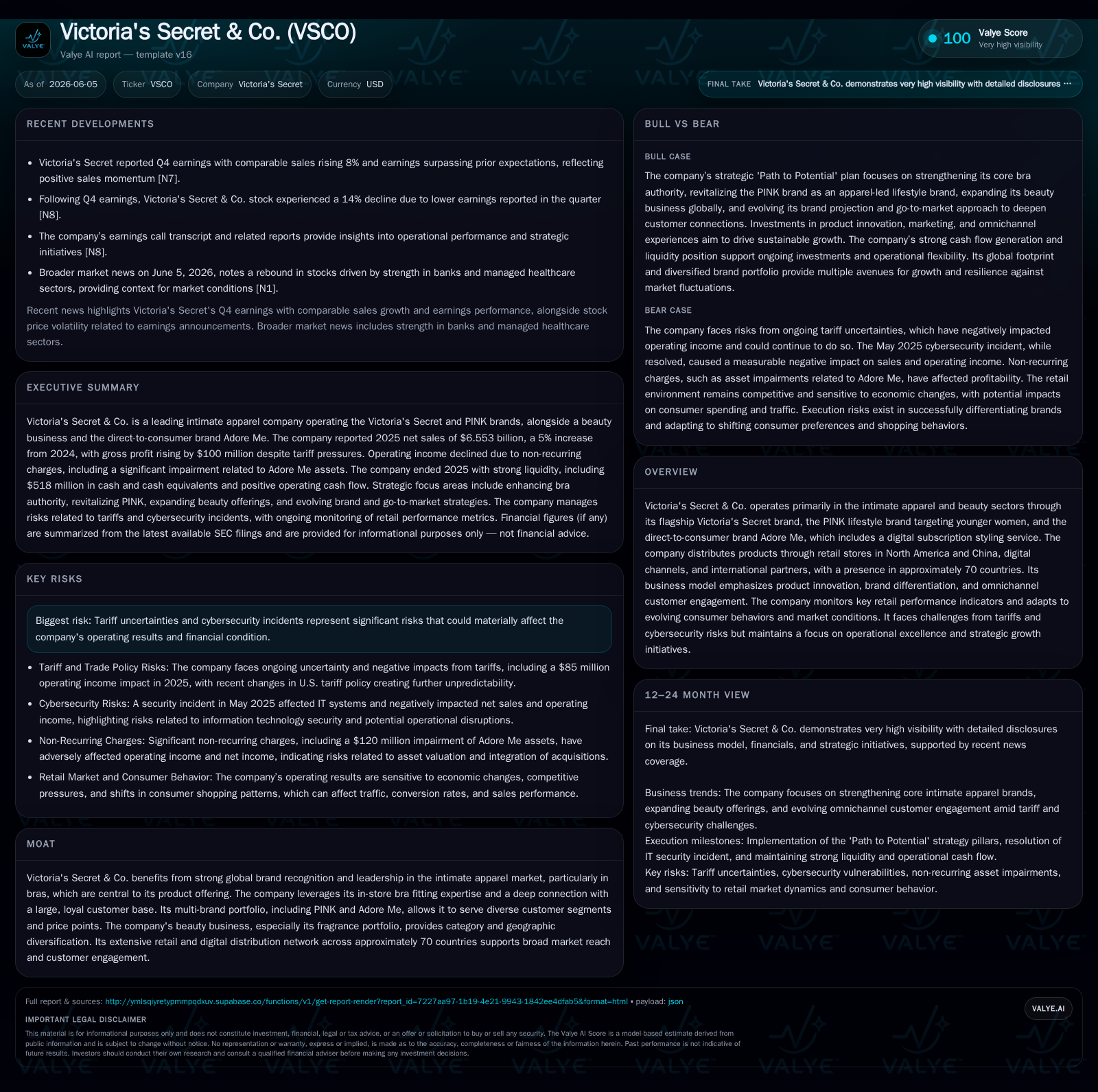
Victoria's Secret & Co. reported solid Q1 2026 operating income of $271 million and net income of $161 million, demonstrating resilience despite ongoing tariff-related cost pressures. Its multi-brand strategy—with flagship Victoria’s Secret, PINK, and direct-to-consumer Adore Me—combined with a robust omnichannel distribution across approximately 70 countries, underpins diversified revenue streams and customer loyalty. The company continues to navigate macro risks including tariffs and cybersecurity vulnerabilities while focusing on digital expansion and subscription service growth to drive long-term value. Financially, it maintains healthy liquidity with $207 million in cash against $990 million in debt, supporting strategic investments and operational execution.
Q1 2026 Operating Update: Strength Amid Tariff Headwinds
Victoria's Secret & Co.’s latest quarterly filing for the period ending January 31, 2026 delineated continued operational strength amid a challenging macro backdrop dominated by shifting tariff regimes. The company recorded an operating income of $271 million and net income of $161 million during the quarter [F1][S2], underscoring resilient core profitability which outpaced lingering cost pressures. Notably, management reiterated ongoing tariff-related risks stemming from the altered U.S. trade policy landscape; while certain IEEPA-imposed tariffs were invalidated by the Supreme Court in early 2026, a newly implemented 10% global tariff under Section 122 of the Trade Act sustains uncertainty regarding overall input costs and refund prospects for prior payments [S1].
Despite these headwinds estimated to have reduced operating income by roughly $85 million in full year 2025 even after mitigation efforts [S1], Victoria’s Secret is adapting through targeted sourcing strategies and efficient supply chain recalibrations. The recent event filing on June 2 affirmed these themes alongside stable guidance updates signaling confidence in controlling margin pressures through strategic execution [S3]. Cybersecurity risks remain on the radar following a May 2025 incident that was promptly resolved without substantive business impact [S1][S2].
Business Model and Product Portfolio: Multi-Brand Market Coverage and Innovation
The company’s revenue model capitalizes on a tiered brand architecture serving distinct but complementary consumer segments. The flagship Victoria's Secret brand dominates intimate apparel globally with fashion-forward collections emphasizing bras—a category where it enjoys leadership bolstered by proprietary fitting expertise cultivated in physical stores [S1]. PINK targets younger women with lifestyle intimates embodying playful design language and broader apparel assortments. Meanwhile, Adore Me enhances the portfolio through a direct-to-consumer (DTC) channel featuring lingerie at varied price points coupled with a subscription styling service via its DailyLook acquisition—adding recurring revenue potential and digital-first customer engagement capabilities [S1].
Revenue accrual combines sales from company-operated retail footprints primarily in North America and China alongside digitally driven commerce avenues and international license or partnership-operated channels spanning roughly 70 countries worldwide—ensuring geographic diversification and broad market reach [S1]. This omnichannel distribution supports superior customer access whether through personalized fitting experiences or digital touchpoints facilitating convenience-driven purchasing decisions.
Industry Position: Competitive Moat and Channel Diversification
Victoria’s Secret maintains a defensible competitive position based on its entrenched brand equity within intimate apparel—particularly bras—as well as its differentiated in-store customer service offerings such as expert bra fittings that cultivate high switching costs absent among many specialty apparel peers lacking integrated physical presence or fitting proficiency [S1]. The multi-brand structure further segments risk by addressing different demographics while expanding wallet share opportunities.
Growth Drivers: Digital Expansion, Subscription Services, and Global Reach
Near-term catalysts center on scaling digital penetration supported by enhanced eCommerce platforms alongside broadening Adore Me’s subscription base which drives higher customer lifetime values via tailored product offerings fitting diverse budgets and life stages. The integration of DailyLook stylists enriches customer experience beyond traditional transactional interactions.
Product innovation remains integral to sustaining pricing power—periodic refreshes aligned with fashion trends attract repeat buyers while regular-priced sales gains reported imply solid acceptance of new assortments over promotional dependency [S1]. International growth leverages partnerships enabling localized reach without full brick-and-mortar exposure risks.
Retail KPIs such as comparable store sales trajectories, conversion rates reflecting effective marketing and merchandising efforts, units per transaction indicating increasing basket sizes, and average transaction value combine as actionable metrics guiding both operational refinements and investment allocation across channels [S1]
Risks and Constraints: Tariffs, Cybersecurity, and Macro Uncertainty
The tariff environment remains a principal risk vector for Victoria’s Secret & Co., with evolving regulations generating unpredictable cost impacts despite proactive mitigation attempts. The persistence of a new 10% global tariff under recently enacted statutes complicates cost planning especially for imported inventory components critical to the intimate apparel supply chain which is often complex due to multiple sourcing geographies [S1]. Additionally, uncertainties around retroactive refunds for prior IEEPA tariffs paid impair working capital forecasting.
Cybersecurity breached systems incidentally in May 2025 required responsive investments but did not disrupt operations materially; however, this area demands vigilance as reliance on digital channels grows steadily [S2]. Broader economic factors including discretionary consumer spending variability tied to inflationary pressures or competitive discounting also form background constraints.
Outlook and What to Watch Next
Victoria's Secret’s management commentary accompanying the June 2 event filing reflects modest optimism supported by stable guidance for Q2/2026 performance adjusted for tariff impacts slightly clarified post-Supreme Court ruling. Investors should monitor same-store sales progression particularly in mature markets versus growing online channel conversion shifts which hint at evolving consumer preferences impacting unit economics.
Execution on expanding Adore Me subscriptions represents an important barometer for assessing direct-to-consumer momentum as it correlates directly with recurring revenue quality improvements. Margin trends related to trade policy developments alongside inventory turns during peak seasonal periods will also be key indicators of supply chain adaptability.
Financial Position Snapshot
As of quarter end May 2, 2026, Victoria's Secret & Co.'s balance sheet exhibits cash and equivalents totaling approximately $207 million set against total debt near $990 million resulting in net debt around $783 million [F1]. The current ratio is 1.26 based on current assets of $1.626 billion and current liabilities of $1.286 billion [F1].
This analysis is based strictly on publicly available SEC filings supplemented by sector-native insights aimed at clarity on Victoria's Secret & Co.'s operating environment without constituting investment advice.
Disclaimer: This is research-only, informational analysis and not investment advice. It may include AI-generated interpretation and general industry context. Always verify important details using primary sources.

Comments