
VanEck Solana ETF Navigates SOL Volatility Amid Regulatory Ambiguity
The VanEck Solana ETF (VSOL) faces ongoing challenges from extreme fluctuations in Solana token prices and an unsettled regulatory environment impacting its operation and investor appeal.
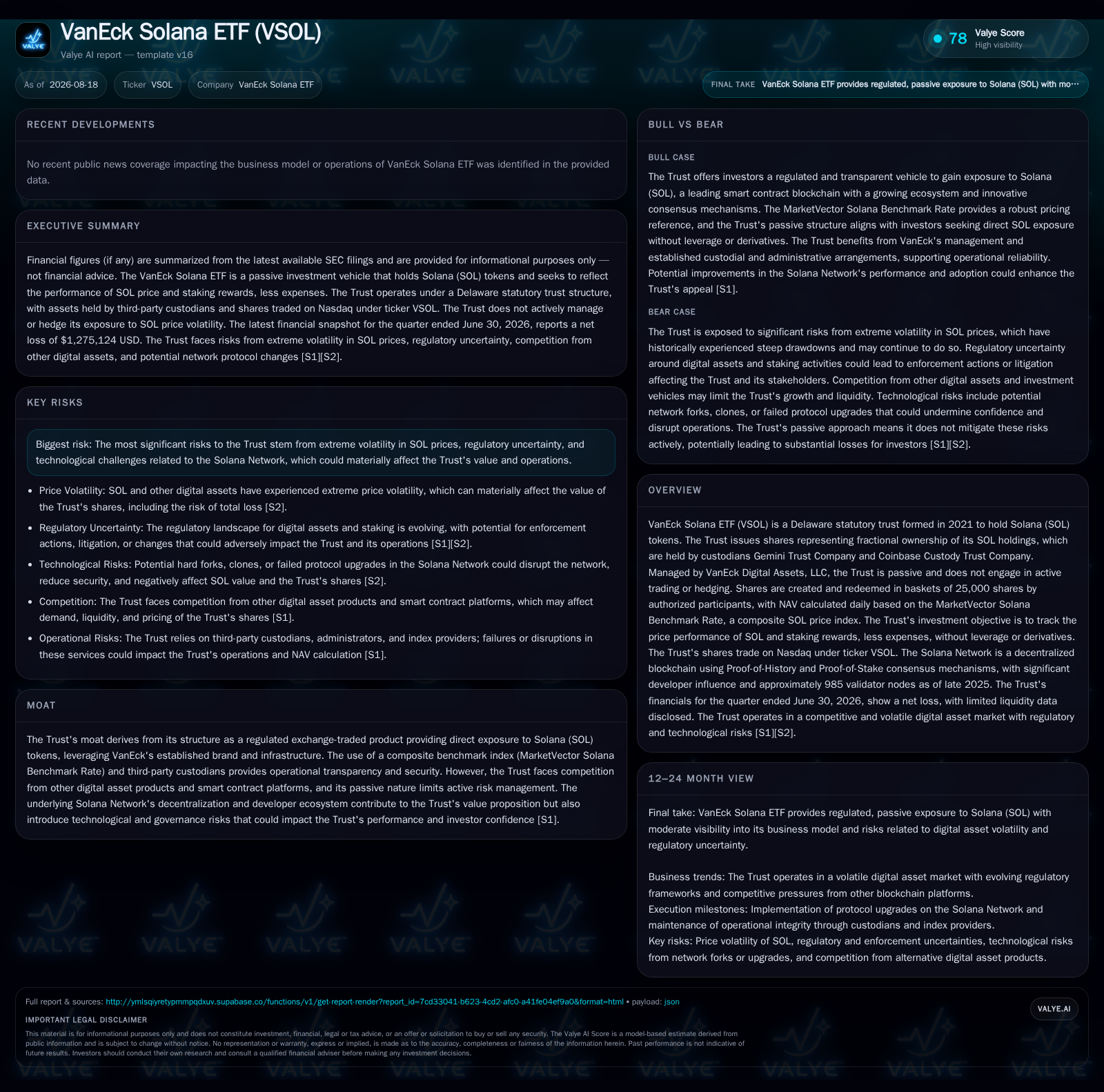
VanEck’s latest August 2026 quarterly filing underscores persistent extreme volatility in Solana’s (SOL) market price, directly influencing VSOL’s net asset value due to its passive exposure. The Trust’s reliance on a composite benchmark index for NAV calculation and established custodians supports operational integrity, but regulatory uncertainty around digital asset classification and staking activities adds execution risk. Key metrics such as creation/redemption volumes, premium/discount spreads, and staking reward developments remain critical indicators of VSOL’s performance and liquidity dynamics.
Recent Quarter Highlights Sustained SOL Price Volatility
The August 2026 quarterly filing reveals that Solana’s native token continues to experience pronounced price swings that directly impact VSOL’s net asset value (NAV) given its passive holding structure [S2]. This volatility reflects ongoing market turbulence following the 2022–2023 collapse of major crypto entities such as FTX, Celsius Network, Voyager Digital, and Three Arrows Capital. These events severely disrupted investor confidence and liquidity across digital assets including SOL, which declined over 90% in 2022 alone with continued erratic movements into mid-2026. The ETF’s lack of active risk management means investors are fully exposed to this price volatility—both upside and downside—amplifying investment risk [S2].
Business Model Anchored on Passive Exposure and Composite Indexing
VSOL operates as a Delaware statutory trust created to provide regulated exchange-traded access to SOL tokens through passive ownership rather than active portfolio management [S1]. It calculates daily NAV using the MarketVector™ Solana Benchmark Rate developed by BITA GmbH. This composite index aggregates order book data from multiple reputable exchanges to produce a representative U.S. dollar valuation for SOL, enhancing pricing accuracy compared to single-exchange indices prone to manipulation or stale quotes [S1]. Custody services are provided by Gemini Trust Company LLC and Coinbase Custody Trust Company LLC—established custodians known for employing multi-signature wallets and rigorous cybersecurity protocols—mitigating risks inherent in digital asset security [S1]. The Trust explicitly avoids leverage, derivatives, or hedging strategies, exposing shareholders solely to the spot price movements plus any staking rewards earned on held tokens [S1].
Creation/Redemption Mechanism Maintains Liquidity Alignment
Liquidity management hinges on Authorized Participants (APs), typically registered broker-dealers or qualified financial institutions authorized to create or redeem shares in blocks of 25,000 (“baskets”) through delivery or receipt of equivalent amounts of SOL or cash [S1]. This mechanism enables arbitrage opportunities when market prices diverge from NAV by incentivizing APs to transact shares accordingly—thereby helping maintain tight tracking between share prices and underlying asset values. However, significant market stress or regulatory disruptions can widen premium/discount spreads if APs encounter execution challenges or counterparty risks during redemption cycles. Additionally, liquidity providers contracted by VanEck facilitate bulk transactions necessary for creations/redemptions; operational interruptions here could impede fund flow efficiency [S25].
Industry Positioning Relative to Peer Digital Asset ETFs
Within the specialized category of ETFs offering direct cryptocurrency exposure, VSOL competes against established products like Grayscale Bitcoin Trust (GBTC) which faces its own structural discounts due to limited redeemability. Other competitors include diversified crypto ETFs such as Bitwise Crypto Industry Innovators ETF targeting broader blockchain exposure. VSOL's partnership with leading custodians Coinbase Custody and Gemini enhances its operational credibility relative to peers using less prominent custodians. The use of a composite benchmark index further strengthens transparent NAV calculations compared to funds relying on single-source pricing vulnerable to distortions. Nonetheless, passive product design limits fee-setting power primarily to low management fees tied to assets under management rather than alpha generation.
Growth Drivers: Staking Rewards and Ecosystem Expansion
Returns for VSOL investors stem not only from spot price appreciation but also from staking rewards earned through participation in Solana’s Proof-of-Stake consensus mechanism [S1]. These rewards can augment total yield beyond pure price exposure but introduce complexity because staking services are delivered via third-party providers whose agreements may be scrutinized under securities laws—a source of regulatory ambiguity [S9,S17]. Institutional interest in blockchain integration within traditional portfolios offers potential demand growth for products like VSOL. Additionally, an expanding developer ecosystem on Solana boosts token utility via decentralized applications—a fundamental factor supporting longer-term token value stability. Progress toward regulatory clarity could further unlock institutional capital inflows currently constrained by legal uncertainties.
Key Risks: Price Volatility, Regulatory Uncertainty & Operational Vulnerabilities
VSOL faces several material risks shaping investor outcomes. Extreme price volatility remains a core challenge given direct exposure without active hedging—sharp NAV declines can rapidly erode shareholder value especially amid systemic shocks such as exchange failures observed historically [S3,S7,S22]. Regulatory uncertainty is pronounced; while recent SEC interpretive releases classify SOL tentatively as a "digital commodity" rather than a security—shielding the Trust from onerous securities regulations—this position could change subject to future legal rulings or policy shifts that might force liquidation or restructuring [S3,S4,S12,S16,S21,S23]. Staking arrangements add compliance complexity since service contracts could be interpreted as investment contracts requiring registration—potentially exposing involved parties including Sponsor and custodians to enforcement risk [S9,S17]. Operationally, custody risks remain paramount given the irreversible nature of private key loss or theft inherent in bearer digital assets. Benchmark index limitations may also cause tracking deviations impacting performance fidelity. Market liquidity constraints during periods of stress could impair creation/redemption processes amplifying market pricing inefficiencies.
Monitoring Metrics: Premium/Discount Dynamics, AP Activity & Regulatory Developments
Investors should closely observe share price premiums or discounts relative to NAV as indicators of liquidity stress or market sentiment shifts impacting fund valuation integrity [S27]. Volume trends in basket creations/redemptions reveal inflows/outflows reflecting investor appetite or redemptions mediated through Authorized Participants’ engagement levels. Regulatory developments remain critical—any changes affecting crypto asset classification or enforcement priorities could materially alter operational viability or require strategic adjustments within the Trust framework. Updates regarding staking reward policies stemming from SEC guidance or judicial decisions will inform the sustainability of yield components influencing total returns. Furthermore, governance changes within Solana's protocol affecting validator participation costs or decentralization metrics may indirectly affect token confidence with downstream impacts on fund valuations
This analysis synthesizes disclosures primarily from VanEck Solana ETF's latest quarterly (August 2026) and annual filings (March 2026), highlighting how persistent digital asset price volatility combined with unsettled regulatory treatment define the strategic landscape confronting this passive digital asset ETF.
Disclaimer: This report provides an analytical overview based exclusively on publicly available filings without offering investment advice or forecasts.
Disclaimer: This is research-only, informational analysis and not investment advice. It may include AI-generated interpretation and general industry context. Always verify important details using primary sources.

Comments