
Viatris Inc's Strategic Reset Amid Portfolio Streamlining and Innovation
Viatris realigns its global pharmaceutical footprint through targeted divestitures and pipeline advancements while confronting margin pressures in a challenging market.
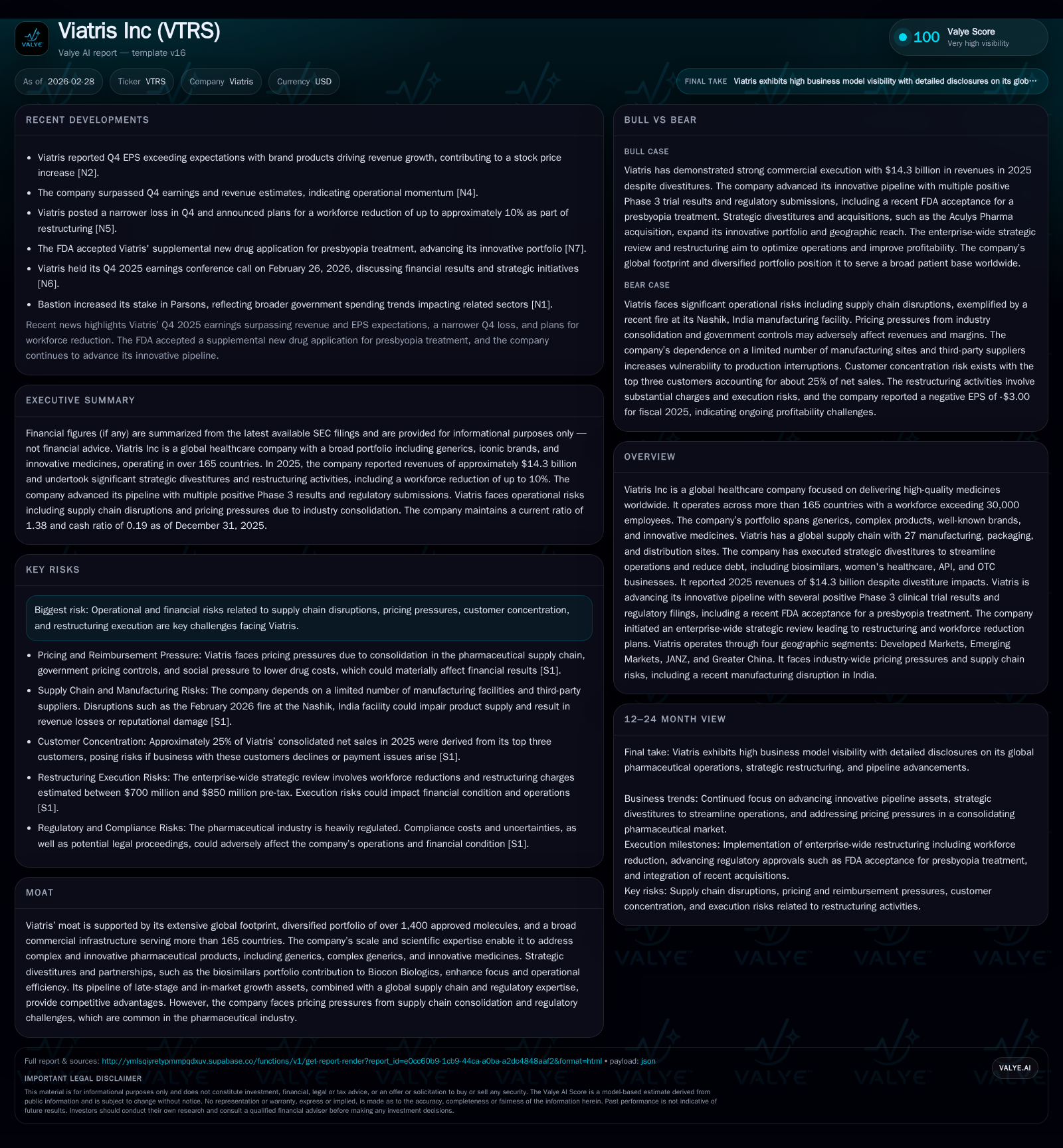
Viatris Inc, a global healthcare player serving over 165 countries, reported a revenue decline of roughly 3% in fiscal 2025 to $14.3 billion, alongside a stark swing to a $2.66 billion operating loss driven primarily by portfolio divestitures and restructuring costs. The company is executing a strategic reset by shedding non-core businesses including biosimilars, women's healthcare, API, and OTC segments to streamline operations and prioritize debt reduction. Concurrently, Viatris advances its R&D pipeline with regulatory progress such as FDA acceptance for a presbyopia treatment, positioning for future growth. Despite resilient operating cash flow exceeding $2.3 billion and increased share buybacks, Viatris faces significant pricing pressure and regulatory risks typical of large pharma with complex manufacturing footprints.
From Scale to Streamlined: A Look Back at Viatris’ Recent Historical Performance
Viatris operates at an extensive scale within the global pharmaceutical sector, delivering medicines to nearly a billion patients annually through a diverse portfolio encompassing generics, complex products, iconic brands, and innovative therapies [S1]. Over the past four fiscal years, reported revenues have steadily declined from $16.26 billion in FY2022 to $14.30 billion in FY2025, marking an approximate cumulative drop of 12% as the company has systematically divested various business units [F1]. The revenue contraction from FY2024 ($14.74B) to FY2025 ($14.30B) alone registers roughly a 3% decline.
This topline erosion coincided with a dramatic swing in operating income results. From strong operational profitability of $1.61 billion in FY2022 down to just $10 million in FY2024, Viatris posted an operating loss of approximately $2.66 billion in FY2025 [F1]. This negative pivot largely reflects restructuring charges and costs associated with strategic portfolio realignment initiatives rather than solely core operating deterioration.
Despite this profit volatility, Viatris maintained robust operating cash flow (CFO), sustaining levels around $2.3 billion in FY2025—just marginally below prior years (e.g., $2.95B in FY2022)—underscoring effective cash generation even during operational resets. Capital expenditures scaled moderately from $326 million in FY2024 to nearly $379 million in FY2025 [F1], potentially linked to supply chain modernization or innovative product investment efforts.
Historical performance (annual)
| FY | Rev ($bn) | CFO ($bn) | OpInc ($bn) | Capex ($mm) | Rev YoY |
|---|---|---|---|---|---|
| 2025 | 14.3 | 2.3 | -2.7 | 379 | -3.0% |
| 2024 | 14.7 | 2.3 | 0.0 | 326 | -4.5% |
| 2023 | 15.4 | 2.8 | 0.8 | 377 | -5.1% |
| 2022 | 16.3 | 3.0 | 1.6 | 406 |
Source: SEC companyfacts cache [F1].
Capital returns and efficiency (annual)
| FY | Buybacks ($mm) | FCF ($bn) |
|---|---|---|
| 2025 | 501 | 1.9 |
| 2024 | 250 | 2.0 |
| 2023 | 250 | 2.4 |
| 2022 | 2.5 |
Source: SEC companyfacts cache [F1].
Note: Free Cash Flow calculated as Operating Cash Flow minus Capex; buybacks represent share repurchases.
As the data reveals, Viatris faced considerable operational leverage effects linked with cost rationalization measures that have yet to fully restore earnings profitability.
Divestitures Driving Focus: Impact of Portfolio Simplification on Growth Trajectory
Aligned with its enterprise-wide strategic review initiated recently [N9], Viatris pursued deliberate asset pruning over the last two years aimed at refocusing on core pharmaceutical assets while accelerating debt reduction efforts [S1][S3]. Major moves included:
- Biosimilars Portfolio Contribution: In November 2022, Viatris transferred its biosimilars assets into Biocon Biologics via a combination of cash payments and issuance of Compulsorily Convertible Preference Shares equalizing roughly a ~12.9% stake [S1]. This move created a vertically integrated global biosimilars leader but removed this segment from Viatris’ standalone portfolio.
- Women’s Healthcare Divestiture: Completed March 2024 [S1], this deal transferred oral and injectable contraceptive businesses along with Indian manufacturing sites to Insud Pharma S.L., indicating exit from select specialized therapeutic categories.
- API Business Sale: Finalized June 2024 sales of active pharmaceutical ingredient manufacturing facilities—including three locations in Hyderabad and Vizag plus an R&D lab—to Matrix Pharma Private Limited further distanced Viatris from upstream raw material production [S1].
- OTC Business Divestiture: July 2024 transaction transferring over-the-counter drug units to Cooper Consumer Health marked another step toward concentrating on prescription pharmaceuticals [S1].
These transactions exemplify classic portfolio rationalization where less synergistic or capital-intensive businesses are shed enabling strategic asset reallocation toward high-growth or core operations while simultaneously generating proceeds for deleveraging [N10]. However, this simplification carries tradeoffs — specifically immediate revenue contraction reflected in top-line declines — balanced against long-term operational efficiency gains.
Unlocking Innovation: Pipeline Developments and Regulatory Milestones to Watch
Never relinquishing its innovation aspirations despite restructuring challenges, Viatris has steadily advanced several high-potential late-stage clinical candidates targeting unmet medical needs [N10][S1]. One highlight is the recent FDA acceptance of a supplemental New Drug Application for an investigational treatment addressing presbyopia—a progressive vision impairment common globally—with promising Phase III trial outcomes supporting potential commercial launch [N10].
Innovation productivity can be challenging for companies blending generic strongholds with newer proprietary assets; Viatris is positioning itself as an innovator-generic hybrid where pipeline projects serve as crucial medium-term growth engines that could partially offset generics pricing compression [S1]. Regulatory gating factors including timely approvals will materially influence commercialization timelines and overall contribution.
Complementary R&D initiatives continue alongside expanded capabilities in complex generics—products requiring specialized formulation or delivery technologies—leveraging global regulatory expertise derived from operating across more than 165 markets [S1]. Keeping abreast of clinical milestones remains important for tracking future revenue inflection points.
Financial Health Review: Operating Income, Cash Flow, and Capital Allocation Trends
Amid top-line pressures and large restructuring hits reflected in operating losses (-$2.66 billion in FY2025 vs +$10 million in FY2024) [F1], Viatris supported solid liquidity fundamentals via stable operating cash flow generation (~$2.3 billion annually). This robust CFO underpinned incremental capital deployment actions including significant increases in share repurchase programs—doubling from $250 million in FY2024 to over $500 million repurchased via buybacks in FY2025—signifying management confidence in generating shareholder value despite earnings headwinds [F1][S28].
Free cash flow conversion has held relatively firm given controlled capex spend (around $380 million or roughly ~2.7% of revenue), reflecting discipline around reinvestment balanced with capital returns.
Moreover, these financial flows partially enabled continued deleveraging efforts alongside divestiture realizations that injected liquidity while reducing complexity within the balance sheet structure [S12][S27]. Viatris maintains about $1.32 billion cash reserves at year-end FY2025 amidst total current liabilities near $7 billion indicating adequate cushion plus investment capacity for ongoing transformation investments [F1].
Balancing Act: Managing Operational Risks Amidst Industry Pricing Pressures
Price erosion remains endemic within generic pharmaceuticals due largely to customer consolidation across wholesalers, pharmacy chains, Pharmacy Benefit Managers (PBMs), insurers, and governmental programs driving stronger negotiating positions exerting downward pressure on reimbursement rates [S4][S22]. These forces exacerbate margin headwinds for companies like Viatris that operate expansive generic portfolios globally.
Additionally, the firm's supply chain risks are nontrivial given dependence on a limited number of tightly regulated manufacturing facilities subject to risks such as labor issues, regulatory inspections or geopolitical interruptions which could disrupt product availability or quality assurance leading to reputational risk or financial penalties [S21][S23].
Regulatory compliance challenges also loom large—with frequent changes across jurisdictions requiring investment into serialization/tracking systems per mandates like the U.S. Federal Drug Supply Chain Security Act or EU’s Falsified Medicines Directive—raising cost burdens particularly when paired with inflationary pressures affecting raw materials and logistics costs that cannot easily be passed through price-sensitive channels [S4][S7][S24].
Executions risk tied to ongoing workforce reductions planned near ~10% introduces additional layers of uncertainty impacting operational agility during transitional phases [N9]. The aggregate effect requires vigilant risk-adjusted management balancing cost control with continued market responsiveness.
Shareholder Returns: Dividends, Buybacks, and Debt Reduction Strategies
Despite turbulent earnings performance skewing return ratios such as ROE negatively due to large operating losses recorded for FY2025 ([F1]), Viatris demonstrates commitment toward shareholder distributions supported by substantial free cash flow generation.
The dividend yield recently transcended the notable threshold above 3%, underscoring reliability amid volatility while signaling management willingness to sustain income returns even amid earnings recovery challenges [N14]. Buyback activity accelerated markedly doubling calendar-year repurchases to exceed half a billion dollars in FY2025 versus prior years signaling opportunistic capital deployment leveraging balance sheet flexibility enhanced by strategic divestitures providing incremental cash inflows [F1][S16].
Debt repayment has been prioritized as well through proceeds recycling generated by portfolio pruning moves including biosimilars exits; these deleveraging efforts aim at long-term credit quality improvements integral for lowering funding costs though exact impact quantifications remain pending further disclosures beyond current filings [S12][S27][N10].
Outlook and Key Metrics: What To Monitor in Viatris’ 2026 Performance
Key performance aspects poised for attention throughout calendar year 2026 encapsulate:
- Execution progress on restructuring initiatives aiming at workforce reductions up to approximately ten percent which could affect operational cost base dynamics significantly if realized prudently without disruption [N9].
- Regulatory developments including anticipated approvals related to presbyopia treatment NDA supplement filed with FDA representing a pivotal product launch driver potentially altering midcycle revenue mix and competitive positioning in ophthalmic care markets [N10].
- Margin recovery trajectories influenced by evolving pricing landscapes marked by intensifying payer scrutiny coupled with internal efficiency gains achievable via streamlined operations after recent portfolio simplifications.
- Competitive market environment monitoring especially for generics tender wins/losses linked closely with established customer relationships impacted by intensified PBM negotiations noted sector-wide analysis suggests ongoing consolidation trends will keep pricing volatile long term.
- Debt structure evolution utilizing divestiture proceeds alongside free cash flow application providing insight into credit rating trends or financing terms sustainability given substantial outstanding notes maturity profiles reported previously yet unsummarized here explicitly [S12][S14].
These variables collectively frame an environment where forecasting remains subject to elevated uncertainty resting on both external policy/regulatory shifts plus internal execution capabilities—a classic illustration of complexity faced by diversified pharmaceutical enterprises maneuvering industry cycles rich with disruptions yet offering pockets of innovation-driven growth possibility.
Disclaimer: This report is intended solely for informational purposes based on publicly available documentation including SEC filings ([F1],[S#]) and verified news sources ([N#]). It does not constitute investment advice or recommendations regarding securities transactions.
Disclaimer: This is research-only, informational analysis and not investment advice. It may include AI-generated interpretation and general industry context. Always verify important details using primary sources.

Comments