
Warner Bros. Discovery’s Turnaround: Recalibrating Growth and Capital Amid Shifting Media Dynamics
Warner Bros. Discovery achieved a positive earnings rebound in 2025 after multi-year losses, driven by restructuring and strategic content investments while managing significant pension and litigation risks.
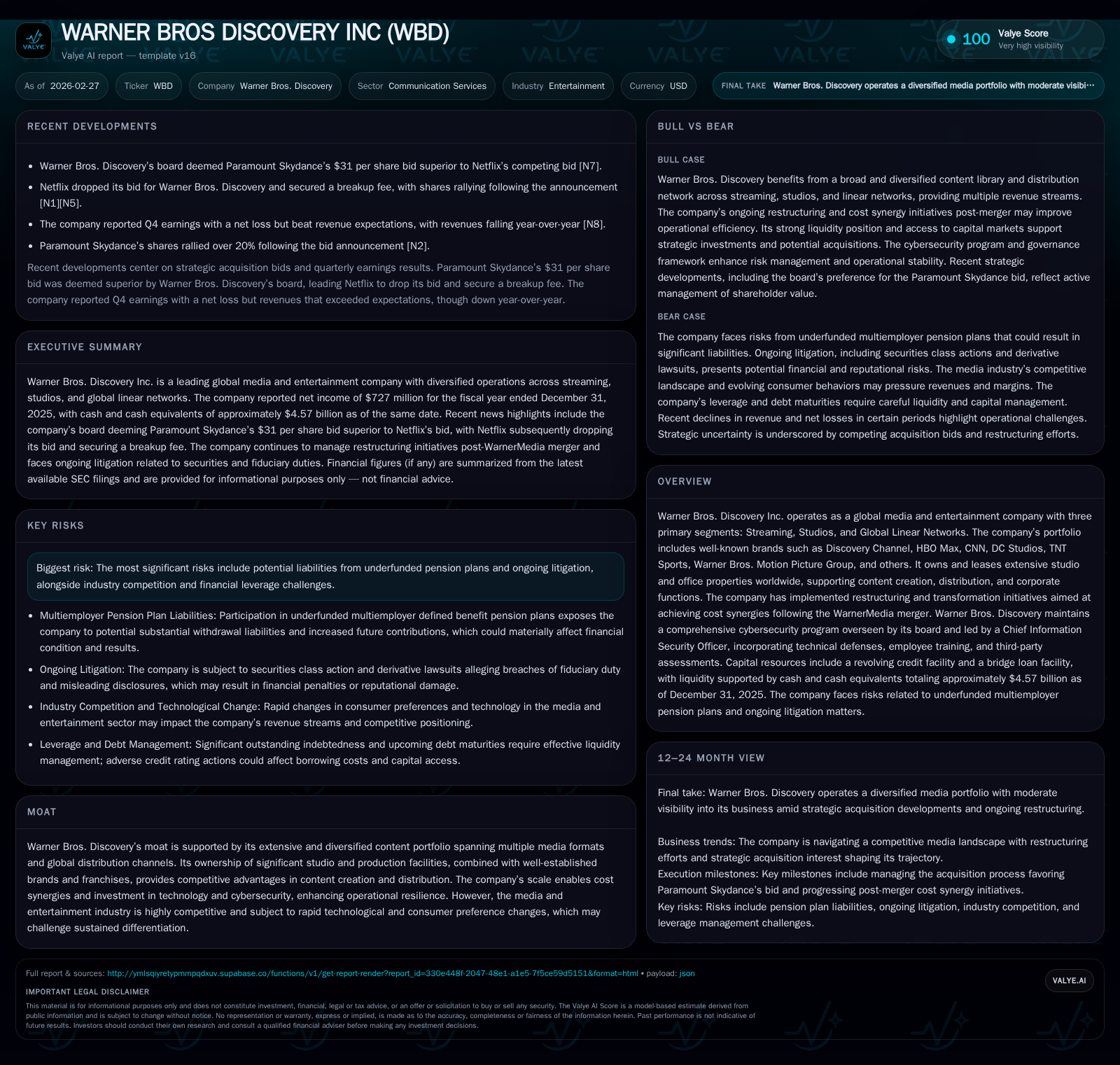
In 2025 Warner Bros. Discovery transformed deep operating losses into positive operating income and net profit through cost synergies following the WarnerMedia merger and disciplined operational management [F1][S1]. The company's diversified portfolio across Streaming, Studios, and Global Linear Networks sustained growth despite intense competition in streaming and shifting consumer preferences [S8][N3]. Strong liquidity and debt refinancing efforts have improved capital flexibility, though substantial pension liabilities and ongoing litigation pose material risks [S1][S10][S20]. Key forthcoming developments include monitoring Paramount Skydance’s acquisition bid outcome and evolving streaming subscriber dynamics [N13][N14].
Financial Resurgence After Multi-Year Losses
Warner Bros. Discovery (WBD) marked a pronounced financial turnaround for the fiscal year ended 2025. After enduring steep operating losses of approximately -$10 billion in 2024 and previous years suffering similarly heavy net losses (-$11.3 billion net loss in 2024), the company reported positive operating income of $738 million coupled with net income of $727 million in 2025 — translating into over a 100% year-over-year improvement from negative territory [F1]. This reversal signals successful execution of extensive operational restructuring initiated post the WarnerMedia merger.
Key drivers included aggressive cost synergy realization from combining legacy WarnerMedia with Discovery’s business units, rationalization of overlapping operations, and tighter expense management as outlined in their annual filings [S1]. Notably, the effective transition from a -$15 billion loss in 2023 to profitability underscores the depth of transformation underway.
Despite revenue data beyond 2018 limited in detail here ([F1] shows $10.55B revenue as of end-2018), the emphasis has clearly been on margin recovery via operating efficiency more than topline expansion recently.
Historical performance (annual)
| FY | Net ($bn) | CFO ($bn) | OpInc ($bn) | Capex ($mm) | Net YoY |
|---|---|---|---|---|---|
| 2025 | 0.7 | 4.3 | 0.7 | 1231 | +106.4% |
| 2024 | -11.3 | 5.4 | -10.0 | 948 | -261.8% |
| 2023 | -3.1 | 7.5 | -1.5 | 1316 | +57.6% |
| 2022 | -7.4 | 4.3 | -7.4 | 987 |
Source: SEC companyfacts cache [F1].
Capital returns and efficiency (annual)
| FY | FCF ($bn) | ROE% |
|---|---|---|
| 2025 | 3.1 | 2.0 |
| 2024 | 4.4 | -33.2 |
| 2023 | 6.2 | -6.9 |
| 2022 | 3.3 | -15.7 |
Source: SEC companyfacts cache [F1].
Table: Warner Bros. Discovery historical financial performance showing dramatic improvements in profitability metrics juxtaposed against fluctuating capex and cash flows [F1]
Content Strategy and Segment Performance Driving Growth
WBD operates three main segments: Streaming, Studios, and Global Linear Networks — each anchored by several marquee brands such as HBO Max for OTT streaming; Warner Bros. Motion Picture Group covering theatrical content; CNN for news; plus niche networks like Discovery Channel catering to global linear audiences [S8][N3].
The company’s competitive moat stems from this diversified content ecosystem spanning premium scripted series to documentaries to live sports programming through TNT Sports and DC Studios franchises — reflecting multi-format content monetization typical to integrated media conglomerates.
Synergy realization has involved consolidating distribution rights management functions to optimize licensing fees across platforms while cross-utilizing intellectual property franchises boosts long-term value capture. Multi-channel revenue streams insulate the firm somewhat against streaming churn volatility common among direct-to-consumer platforms.
Executives highlighted ongoing investment into original content aimed at supporting HBO Max's subscriber base growth as well as stable revenues from global networks during recent earnings communications [N3], reinforcing the balance between scale advantages and brand prioritization.
Streaming Market Position and Evolving Consumer Preferences
In streaming, WBD seeks to maintain relevance versus dominant peers like Netflix amid rapidly shifting consumer preferences favoring personalized on-demand entertainment over traditional viewing habits [N5][N7]. Competition intensified as Paramount Skydance emerged with a $31 per share acquisition bid regarded superior by WBD’s board compared to Netflix’s dropped offer—adding strategic complexity given Skydance’s ambitions within this space [N13][N14].
Subscriber counts remain critical forward indicators; although explicit subscriber figures aren't provided here, market commentary signals pressure on margin expansion owing to competitive pricing and content investment costs inherent to scaling platforms. This dynamic aligns with industry-wide challenges balancing growth investments against profitability.
Notably, Netflix’s withdrawal from bidding alleviated one layer of uncertainty for WBD but raised questions about concentration risk if new entrants materially alter sector power balances.
Capital Structure, Liquidity, and Strategic Allocation
Liquidity was robust as of December 31, 2025 with approximately $4.57 billion cash & equivalents complemented by undrawn capacity under a $4 billion revolving credit facility plus a commercial paper program increased earlier that year to $2 billion capacity—all part of an active capital structure management effort [F1][S4–S6]. The company also maintains a substantial bridge loan facility ($15 billion) used primarily for refinancing purposes with no defaults or covenant breaches reported.
Despite healthy cash flow generation—operating cash flow totaled nearly $4.32 billion in 2025—capex increased by close to 30%, reflecting planned investments into technology infrastructure and content production capabilities key for sustaining competitive position [F1].
Shareholder returns through buybacks have been dormant since before the WarnerMedia merger era with no repurchases recorded since at least FY2018, aligning with conservative allocation preferences during deleveraging phases [F1][S21]. Return on equity remains subdued around 2%, indicative of an early-stage recovery cycle where reinvestment trumps capital distribution.
| Fiscal Year | Net Income (USD Mil) | Operating Income (USD Mil) | CFO (USD Mil) | Capex (USD Mil) | Equity (USD Mil) |
|---|---|---|---|---|---|
| 2025 | 727 | 738 | 4319 | 1231 | 35919 |
| 2024 | -11311 | -10032 | 5375 | 948 | 34037 |
| 2023 | -3126 | -1548 | 7477 | 1316 | 45226 |
| 2022 | -7371 | -737 | 4304 | 987 | 47095 |
Table: Key financial aggregates illustrating significant profit recovery alongside capital expenditures ramped for transformation needs [F1]
Pension Liabilities, Litigation, and Financial Risks
A notable risk facing WBD derives from participation in multiple underfunded multiemployer defined benefit pension plans linked to unionized workforce segments which expose the company to potentially sizeable withdrawal liabilities if it reduces or ceases participation [S1][S10–S13]. These contingent obligations are inherently uncertain but remain monitored closely at board level given regulatory complexities.
Ongoing securities class actions and shareholder derivative lawsuits allege breaches related to disclosure practices during contract negotiations notably around NBA broadcasting rights renewal uncertainties; while dismissals are being sought by management, resolution timelines remain open-ended without forecasted material near-term impact [S10][S12][S13].
This legal milieu compounds leverage constraints amid sector cyclicality though current debt facilities remain covenant-compliant as disclosed.
Near-Term Catalysts and Market Developments to Watch
Market attention centers on several impending events: final adjudication of Paramount Skydance’s acquisition bid surpassing Netflix's offer widens strategic options or could spur governance shifts if consummated; quarterly earnings discussions will reveal clarity on streaming subscriber trends especially churn rates impacting growth outlooks; ongoing restructuring cost savings progressions will help discern consistency behind margin recoveries; additional integration milestones post-merger are critical for synergy confidence [N3][N4][N13][N14].
These variables represent crucial data points to gauge sustainability of the recent turnaround reflecting how well WBD adapts amidst fast-evolving industry conditions.
Valuation Considerations Amid Sector Disruption
From an analytical perspective absent explicit guidance or forward multiples disclosures here, valuation needs framing through lens of historically volatile earnings patterns wrought by cyclical media demand shifts combined with aggressive technology-driven disruption transforming traditional consumption paradigms.
Investors weighing WBD should factor its proven capacity for restructuring-led profitability rebounds balanced against substantial leverage loadings and latent pension plus litigation exposures. Persistent competition in direct-to-consumer markets constrains margin expansion potential necessitating careful monitoring of execution against stated synergy targets—a vital determinant shaping future investor sentiment.
This analysis is based solely on publicly available information including SEC filings (as of February 27, 2026), recent company disclosures, earnings call transcripts, official news reports through Nasdaq.com covering WBD developments along with validated company factual data snapshots.[F1] No speculative forecasts or investment recommendations are made herein.
Disclaimer: This is research-only, informational analysis and not investment advice. It may include AI-generated interpretation and general industry context. Always verify important details using primary sources.

Comments