
Webster Financial's 2025 Profit Expansion Supported by Diversified Segments and Strong Deposit Base
The bank’s robust profit growth in 2025 reflects diversified business lines and prudent capital management ahead of its pending acquisition by Banco Santander.
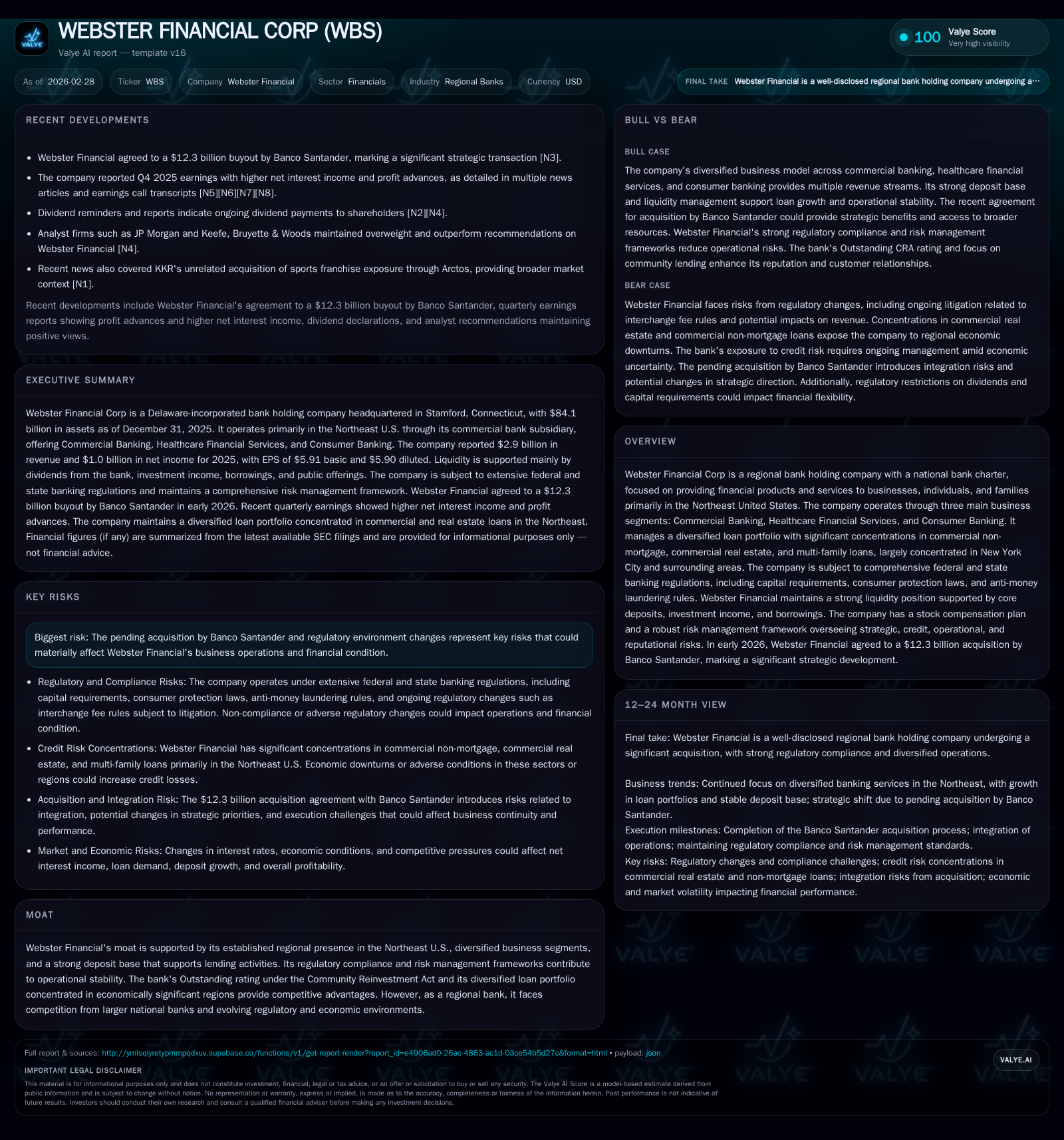
Webster Financial Corp delivered strong financial results in 2025, marked by nearly 12% revenue growth, an 18.7% rise in operating income, and a net income jump exceeding 30%, fueled largely by expanded non-interest income and disciplined expense control. The company’s three-pronged segment strategy—Commercial Banking, Healthcare Financial Services, and Consumer Banking—and concentrated Northeast footprint underpin operational resilience amid regional banking challenges. With its $12.3 billion acquisition by Banco Santander announced in early 2026, Webster’s capital deployment, including dividend stability and sizable share repurchases, signals balanced shareholder returns even as integration risks loom. Liquidity remains solid, supported by core deposits and rigorous risk governance structures focused on credit quality and regulatory compliance. Key milestones ahead include regulatory filings and integration execution that will define the company’s transition post-acquisition.
Robust Growth and Earnings Drivers in 2025
Historical performance (annual)
| FY | Rev ($bn) | Net ($mm) | CFO ($mm) | OpInc ($mm) | Rev YoY | Net YoY |
|---|---|---|---|---|---|---|
| 2025 | 2.9 | 1003 | 1058 | 1470 | +11.9% | +30.5% |
| 2024 | 2.6 | 769 | 1404 | 1239 | -11.4% | |
| 2023 | 868 | 979 | 1235 | +34.7% | ||
| 2022 | 644 | 1336 | 1079 |
Source: SEC companyfacts cache [F1].
Capital returns and efficiency (annual)
| FY | Div ($mm) | Buybacks ($mm) | FCF ($mm) |
|---|---|---|---|
| 2025 | 267 | 594 | 1009 |
| 2024 | 275 | 65 | 1368 |
| 2023 | 278 | 108 | 938 |
| 2022 | 248 | 322 | 1307 |
Source: SEC companyfacts cache [F1].
Webster Financial Corp demonstrated substantial financial advancement throughout fiscal year 2025 characterized by solid top-line expansion alongside significant profitability improvements. Total revenue reached approximately $2.9 billion, marking an increase of around 11.9% from $2.59 billion recorded in the prior year [F1]. This uplift was propelled not only by rising net interest income but also marked strengthening in non-interest income notably boosted by gains on sale of investment securities and enhanced proceeds from bank-owned life insurance (BOLI).
Non-interest income surged $149.6 million or about 59.4%, reflecting a strategic reduction of realized losses on securities sales which swung from a net loss of $136.2 million in 2024 to a modest gain of $0.2 million in 2025 [S1]. Additionally, the cash surrender value of life insurance policies grew roughly 20%, benefiting from favorable insurance events compared to the prior year’s baseline. Other income contributed with a $18.9 million increase driven partly by legal settlements, derivative valuation improvements, and hedging activity gains (investment banking clients’ derivative exposure), while traditional fee-based sources such as loan servicing were modestly down due to portfolio sales activities.
Operating income surpassed $1.47 billion—a near 19% gain over the previous year—underscoring operational leverage amid moderate expense increases mainly from higher compensation outlays tied to performance incentives and investments in risk management technology infrastructure [F1][S1]. The net income escalation was even more pronounced at approximately $1 billion for FY2025 representing a robust jump of more than 30%, signaling effective bottom-line scalability despite marginally higher credit provisions related to asset-based lending segments [F1][S16].
Throughout the period, Webster employed sector-specific levers like loan servicing rights amortization adjustments alongside targeted mortgage servicing rights sales that aided fee income stabilization while managing amortization costs effectively—a nuanced balance recognized among regional banks focusing on commercial real estate and residential mortgage services.
Diversification and Regional Presence Fueling Stability
As a regionally focused bank holding company with operations deeply embedded across the Northeast United States—particularly New York City metro areas—Webster’s diversified business approach mitigates market cyclicality risks common among specialty lenders or narrowly focused institutions.
The three principal business segments—Commercial Banking, Healthcare Financial Services (including HSA Bank operations), and Consumer Banking—offer differentiated revenue streams enhancing overall earnings stability [S1][S9]. Notably, commercial real estate loans along with multi-family property financing constitute almost 40% of total loans while commercial non-mortgage loans comprise approximately another third of the portfolio; concentration risks are actively managed with sophisticated underwriting standards applying dual grading systems for Probability of Default (PD) and Loss Given Default (LGD) measures tailored to geographic realities centered predominantly around NYC but extending into surrounding states including Connecticut, New Jersey, Rhode Island, Massachusetts, complemented by secondary markets [S9][S16].
Healthcare Finance represents a steady niche given demographic trends combined with specialized treasury products including health savings accounts offering resilient deposit inflows contributing to stable funding lines aligned with consumer banking franchise activities.[S10]
Overall deposit growth was consistent at approximately +6%, driven largely by interest-bearing checking accounts and money markets while non-interest-bearing demand declined slightly; this core deposit base supports conservative loan-to-deposit ratios near historical levels (~82%) ensuring balanced liquidity without overreliance on wholesale funding markets [F1][S4].
Acquisition by Banco Santander: Implications for Future Trajectory
On February 3, 2026, Banco Santander publicly disclosed its intention to acquire Webster Financial through a cash-and-stock transaction valued at roughly $12.3 billion—presenting not only a significant valuation premium but also marking Webster’s transition from an independent regional player into part of a global banking conglomerate [N1][N10][S3].
This acquisition could afford Webster access to broader capital markets capacity allowing for more flexible capital reallocations and potential cross-selling opportunities leveraging Santander's global footprint.
However, such large-scale mergers inherently entail regulatory complexity including mandatory approval processes under federal banking authorities scrutinizing capital adequacy impacts, anti-trust considerations particularly given overlapping geographic footprints, as well as integration risks related to IT systems convergence and cultural alignment.[N10]
Moreover, under FDIC guidelines applicable to sizable institutions post-merger, Webster will be subject to resolution planning (“living wills”) that impose additional governance standards; it recently received guidance on submission requirements with initial filings due April 2026 emphasizing readiness for orderly wind-down scenarios if required—factors warranting continued close monitoring.[S1]
Capital Deployment: Dividends, Buybacks, and ROE Trends
Webster's capital allocation discipline manifests clearly through consistent dividend payments coupled with amplified share repurchase activity during FY2025.
Dividend distributions totaled approximately $266.8 million maintaining prior-year payout levels despite elevated net income—reflective of regulatory constraints governing dividend capacity tied to bank earnings retention rules [F1][S18].
Meanwhile buybacks accelerated markedly surging from roughly $65 million repurchased in FY2024 to approximately $594 million shares retired during FY2025 under open market programs approved by the Board prior to acquisition announcements; this reflects management's commitment to enhance shareholder value through accretive capital return mechanisms ahead of impending ownership transitions.[F1][S22]
Equity stood just below $9.5 billion at year-end supporting an approximate annualized Return on Equity (ROE) near 10.6%, aligning comfortably within regional bank peer norms consolidating efficient use of capital while navigating the complex operating environment [F1].
Free cash flow (operating cash flow minus capex) approximated over $1 billion despite a year-over-year decline in operating cash flow owing primarily to working capital changes; however capital expenditures witnessed increases partly attributable to upgrades across digital platforms essential for future scalability—typical among banks investing strategically in infrastructure modernization.[F1]
Liquidity, Risk Governance, and Regulatory Compliance
Webster maintains robust liquidity supported chiefly by sticky core deposits encompassing demand deposits plus health savings accounts augmented with money market instruments ensuring funding flexibility critical under current asset-sensitive balance sheets.[S4][S5]
Management proactively monitors liquidity metrics alongside comprehensive contingency plans designed for stress scenarios evaluating funding options including secured borrowings evidenced via FHLB advances as well as Federal Reserve balances held above minimum reserve requirements.[S4]
Institutional risk governance is reinforced through dedicated committees: Information Risk Committee addresses cyber-security threats with routine Board-level reporting; Enterprise Risk Management Committee oversees broader operational risks while Credit Risk Management Committee governs portfolio concentrations ensuring adherence to underwriting standards limiting excessive exposures especially within geographically concentrated CRE segments.[S12]
Regulatory compliance encompasses stringent capital adequacy protocols mandated by OCC among others; Webster has absorbed phased impacts from recent accounting standard changes while maintaining capital buffers surpassing regulatory minima thereby ensuring resilience amidst evolving supervisory expectations.[S18][S19]
What Investors Should Watch Moving Forward
Looking ahead, attention centers on key catalysts shaping Webster's financial path. Ever-present is successful completion of the Banco Santander takeover process requiring shareholder approvals and final regulatory clearances anticipated within calendar year 2026—a process with potential timing shifts warranting close observation.[N1][N10]
Additionally, upcoming deadline for the institution’s first resolution plan filing under new FDIC mandates is April 2026; how this document addresses integration complexities will be instrumental for assessing operational risk posture post-merger.[S1]
Investors might also track quarterly updates on interest margin compression risks influenced by regional lending mix comprising adjustable-rate commercial loans offset partially by stable low-cost core deposits —a delicate balance common across mid-sized U.S banks undergoing industry-wide margin pressure. Capital policies may evolve following integration reflecting broader Santander group strategy potentially adjusting dividend pay-outs or share repurchase plans relative to emerging priorities.
In summary, Webster enters a transformative phase combining recent exemplary financial performance shaped by diversification and disciplined management with anticipated strategic evolution under new ownership structure. Continued vigilance on execution milestones alongside regulatory developments will be essential for understanding ultimate value creation dynamics.
Disclaimer: This analysis is for informational purposes only based on publicly available data as of February 28, 2026. It does not constitute investment advice or recommendations.
Disclaimer: This is research-only, informational analysis and not investment advice. It may include AI-generated interpretation and general industry context. Always verify important details using primary sources.

Comments