
Workday Strengthens Subscription Backlog and Expands AI Platform Amid Competitive Cloud Software Market
Workday's strong Q1 fiscal 2027 results underline durable demand for its AI-powered enterprise SaaS platform despite intense competition and operational costs.
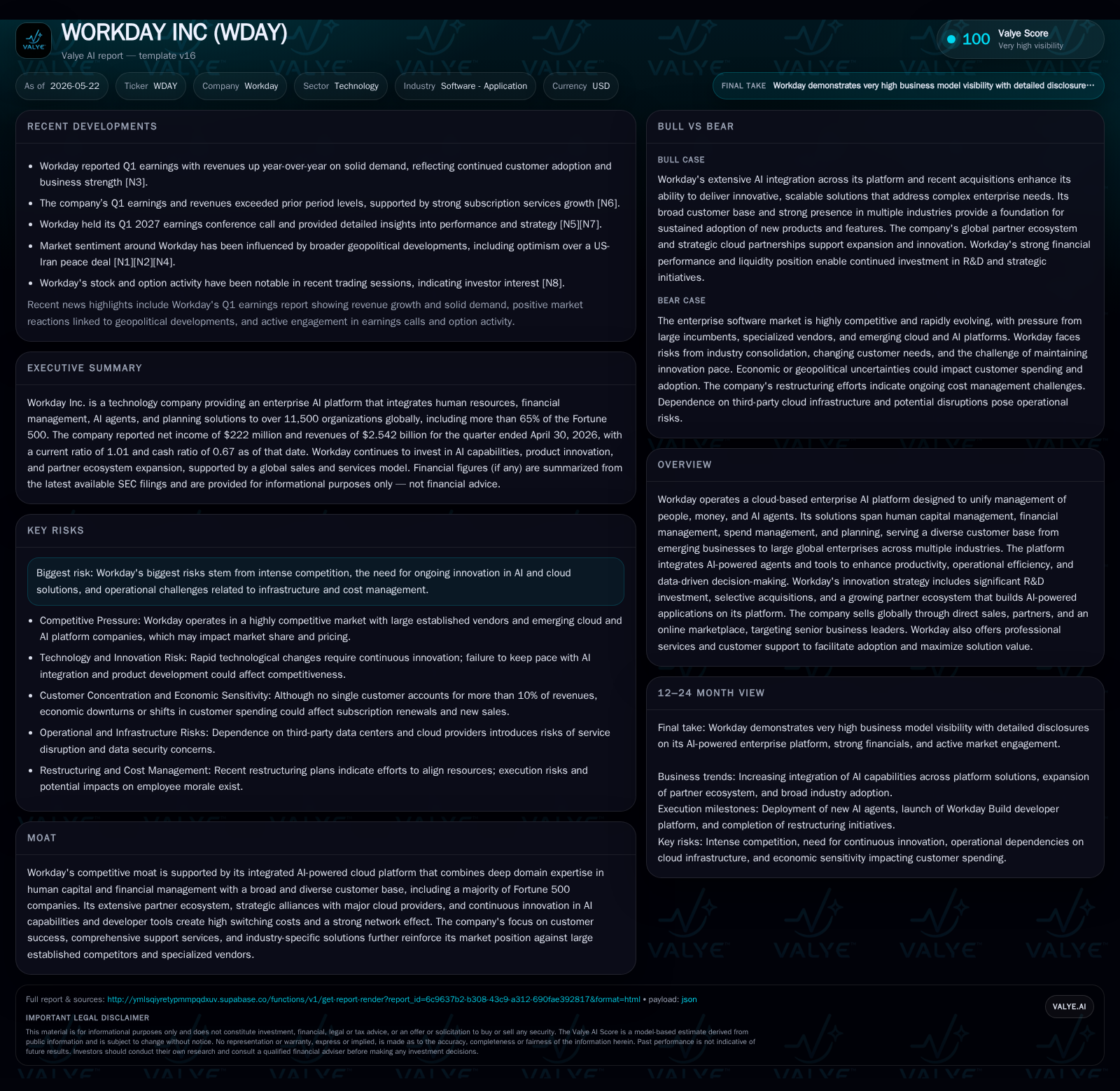
In its latest quarterly filing ending April 30, 2026, Workday reported robust revenue recognition from a sizable remaining performance obligation backlog of $27.3 billion on subscription contracts. The company is executing on its strategy to unify HR, financial, and AI agent management through cloud-delivered solutions that target Fortune 500 clients as well as midmarket enterprises globally. Workday's focus on AI integration, continuous product enhancements, and ecosystem expansion supports steady subscription growth and customer retention, positioning it well in the competitive enterprise software industry. Recent workforce restructuring aims to optimize operating efficiency amid ongoing technology investments. Financially, Workday maintains significant debt with healthy liquidity and strong cash flow generation to fund innovation and share repurchases.
Recent Operating Update
Workday's most recent quarterly report for the period ended April 30, 2026 (Q1 fiscal 2027) highlights sustained strength in subscription revenue recognition, with $2.0 billion recognized during the quarter from previously unearned revenue balances [S2]. This indicates solid underlying demand and expansion within its recurring SaaS business model. More notably, the company's remaining performance obligations (RPO) for subscription contracts approached $27.3 billion as of quarter-end, pointing to strong backlog visibility. The expected revenue recognition schedule shows that approximately $8.8 billion will be realized over the next twelve months and an additional $15.6 billion over the following twelve months [S2]. This multi-year contract visibility anchors Workday's growth trajectory.
Operationally, the company implemented a workforce reduction affecting around 2% of headcount primarily in non-revenue generating roles during fiscal 2026 Q4, aimed at realigning resources toward strategic growth areas such as AI and product development [S13]. Despite these cuts, hiring continues in critical functions focused on revenue expansion. Infrastructure investments remain ongoing with cloud hosting partnerships involving AWS and Google Cloud to ensure scalability and service resilience across global data centers [S6].
Financially, Workday exited the quarter with a substantial debt load comprising $3.0 billion in senior notes spread across maturities in 2027, 2029, and 2032 but no borrowings against its $1.0 billion revolving credit facility [S4][S5][F1]. Liquidity remains adequate supported by cash balances near $559 million [F1]. Notably, the firm ramped share repurchases considerably in Q1 deploying $1.6 billion to retire approximately 12 million shares at an average price of $133 [S12], reflective of management’s confidence in cash flow generation.
Business Model
Workday operates a cloud-based subscription SaaS model delivering integrated enterprise applications for managing people (human capital management), money (financial management), spend management, and strategic planning—augmented heavily by embedded artificial intelligence agents [S1][S10]. Its offerings leverage an AI-driven platform architecture enabling automated workflows such as talent acquisition automation (e.g., HiredScore AI), financial close acceleration, frontline worker engagement enhancements, and spend analytics.
Revenue is predominantly recurring from subscription contracts which bundle software licenses with cloud hosting and support services—resulting in high gross margins typical for SaaS but requiring continuous innovation investment. Professional services accompany deployments for configuration assistance but represent a smaller portion of total revenue [S2]. Pricing dynamics involve volume-based seat or usage licenses plus flexible models such as recently introduced Flex Credits allowing customers scalable access to premium AI functionalities [S25].
Sales efforts deploy an industry- and geography-aligned direct sales force supplemented by partners who resell or co-sell Workday solutions globally through multiple channels including the Workday Marketplace platform [S10][S25]. Customer retention revolves around net retention strategies driven by customer satisfaction from seamless integration across HR-finance functions enabled by Workday’s unified data model.
Industry Structure and Competitive Position
Workday competes within the enterprise applications software sector dominated by a mixture of large incumbents (Oracle ERP/HCM Cloud, SAP SuccessFactors) and emerging cloud-first pure plays focusing on niche or adjacent segments (e.g., Paycom for HCM). The firm’s moat derives from its integrated AI platform combining deep domain expertise in human capital management (HCM) with financial applications underpinned by sophisticated data models capturing operational context.
Strategic partnerships with leading cloud infrastructure providers like AWS and Google Cloud grant operational advantages through scale economies while providing customers modern cloud infrastructure choice options that can reduce their total cost of ownership [S25]. Furthermore, its partner ecosystem actively contributes bespoke AI-powered extensions via the newly launched Workday Build developer environment—a move enhancing stickiness through customizable solutions tuned to industry verticals.
Customer concentration is diversified; although more than 65% of Fortune 500 companies use Workday solutions extensively alongside thousands of mid-market organizations globally [S1]. The lengthy enterprise sales cycles typical for SaaS enterprise deals are balanced against high customer lifetime value driven by broad functionality adoption across departments once initial penetration succeeds.
Growth Drivers
- Expansion of Subscription Base: With over 11,500 customers worldwide already on platform contracts combined with significant RPO backlog ($27+ billion), growth will be driven largely by net new customer additions plus upsell within existing customers expanding into additional functional areas such as finance modules or advanced AI agents [S2][S25].
- AI Innovation: Continued development of AI capabilities embedded into products such as recruiting automation tools (HiredScore AI), frontline worker assistants, and finance close agents are key differentiators enabling Workday to capture value beyond basic ERP/HCM functionality [S1][S10]. The introduction of flexible usage models like Flex Credits may lower barriers for incremental feature adoption.
- Partner Ecosystem Scaling: The launch of developer tools such as Workday Build allows third-party innovators to build specialized industry accelerators or integrations enhancing the solution portfolio without proportional internal development costs [S25].
- Global Geographic Penetration: Extending go-to-market reach into underpenetrated regions continues given global economic digital transformation trends warranting comprehensive HR/Finance cloud solutions beyond North America [S25].
- Professional Services & Customer Success: Effective deployment-related services paired with continuous product updates promote customer retention while shortening time-to-value realization supporting recurring revenue growth sustainability.
Risks / Watchpoints / Growth Constraints
- Intensifying Competition: Competing against incumbent ERP vendors who have entrenched footprints plus emerging best-in-class SaaS startups applying advanced AI poses threats to market share unless Workday continuously innovates effectively.
- Operational Costs: Significant investments into R&D (~high absolute dollar amounts), marketing/sales expansion, along with costs associated with data center operations can pressure operating margins especially if revenue growth moderates or pricing power weakens [S2].
- Technology Reliance & Disruptions: Dependence on third-party cloud providers introduces risk related to service availability disruptions or geopolitical regulatory changes that could impact delivery consistency or cost structures [S6].
- Customer Adoption Cycles: Enterprise adoption cycles are long; delays in closing deals or renewals could temporally impact revenue recognition patterns despite large backlog figures.
- Debt Load & Leverage: Approximately $3 billion principal debt requires ongoing interest servicing ($29 million quarterly expense) though manageable given current cash flow generation; however leverage constrains flexibility [F1][S4][S5].
What to Watch Next
Key milestones include quarterly bookings trends evidencing new contract wins beyond backlog replenishment levels; incremental revenue realized from newly launched AI agents especially those debuting in fiscal year 2027; progress metrics on partner ecosystem contributions via Workday Build; execution on workforce alignment activities impacting productivity ratios; any material shift in leverage ratio relative to covenants associated with the revolving credit facility; and guidance updates concerning capital expenditures linked to data center expansions or acquisitions fitting core platform strategy [N2][S2][S13]. Monitoring competitive moves by Oracle/SAP around AI integration into their suites will also be insightful.
Financial Profile Context
As of April 30, 2026, Workday held approximately $559 million in cash equivalents alongside available marketable securities amounting to nearly $3.8 billion mainly invested in short-to-medium term government securities and corporate bonds classified within current assets due to their liquidity characteristics [F1][S3]. Total debt outstanding remained at about $3 billion principal composed mainly of senior notes maturing between 2027 to 2032 bearing effective interest rates near ~3.7%-3.9%, placing recognized quarterly interest expense around $29 million illustrating steady financing costs [F1][S4][S5]. Working capital metrics reflect a current ratio near parity at approximately 1.01 corroborating balanced near-term liquidity positions [F1]. Operational cash flow improved to roughly $696 million for the trailing quarter driven by higher net income compared to prior year periods reflecting improving profitability dynamics amid scale economies although share-based compensation remains a notable non-cash expense component [S19][F1]. Capital expenditure levels increased modestly consistent with ongoing investment into infrastructure enhancement initiatives [S19]. Share repurchases accelerated substantially returning $1.6 billion during the quarter at a materially discounted price relative to prior periods which reflects market price normalization supporting shareholder equity reduction programs [S12].
This analysis is based solely on publicly available filings from March through May 2026 and does not constitute investment advice.
Disclaimer: This is research-only, informational analysis and not investment advice. It may include AI-generated interpretation and general industry context. Always verify important details using primary sources.

Comments